Saturday, August 12, 2006

MORE Pics – INTERNAL AUDIT Chief FELL to his DEATH from the 15th Floor; Transferred from LABUAN to PUTRA JAYA; Death – Is SUICIDE an OPTION?

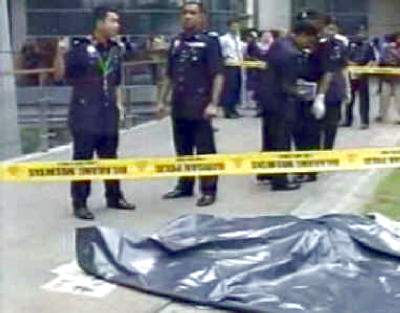
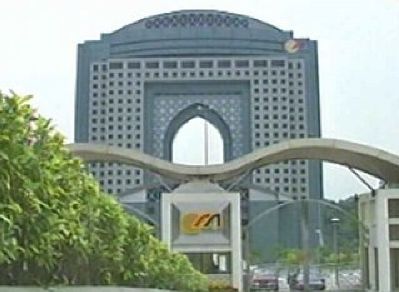
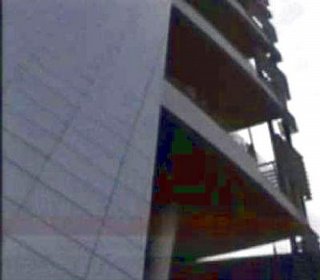
The Ministry building above from which Tan took his life from the 15th Floor
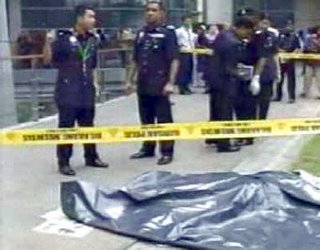
Internal Audit Chief of the Mineral Department fell to his death from the 15th Floor of the Natural Resources and Environmental Ministry building. Police have classified the case as sudden death.
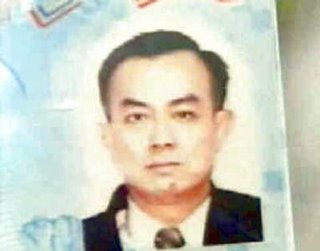
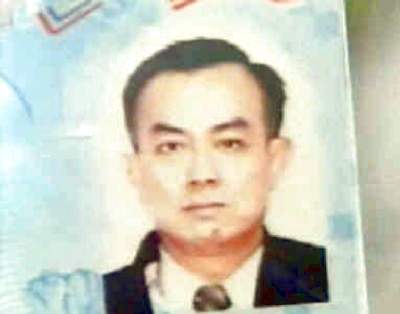
The victim, Tan Sing Kiong; The choice of life and death is always yours

Putrajaya Police OCPD Supt Mohd Khalil Kader Mohd said that the victim Tan Sing Kiong 48 was believed to have fallen from the 15th floor at 11.45am on Friday morning.

He was just transferred from the Labuan office to Putrajaya last month. Police would try to get more information regarding the victim’s health prior to the incident. According to colleagues in the department, Tan was seen restless after clocking in in the morning and was seen going to the toilet several times.
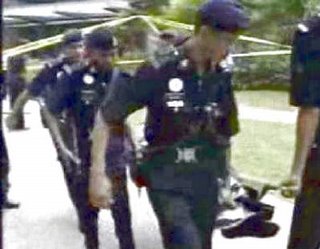
and here is a more detailed account from NST

Civil servant falls to death in Putrajaya's first suicide case

11 Aug 2006; Deborah Loh and Hamidah Atan ;PUTRAJAYA, FRI.:
An auditor with a Government department had looked pale and disoriented when a colleague bumped into him in a washroom this morning.

One-and-a-half hours later, Tan Sing Kiong, 48, was found sprawled faced down on a pavement in front of the 17-storey Natural Resources and Environment Ministry building.

He is believed to have fallen to his death about 11.45am from either the 14th or 15th floor of the building where his office is located. He was clad in a pair of black trousers, light blue long-sleeved shirt and a red tie.

Tan, who was with the National Audit Department, had been on secondment with the ministry since March.

He is said to have been battling depression and was on anti-depressants.

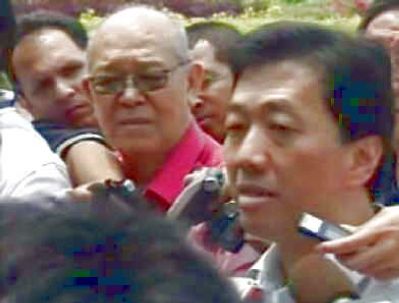
His wife, Yap Joo Teng, a schoolteacher in Cyberjaya, rushed to the scene and appeared shocked over the incident. As reporters approached her, she asked to be left alone as she spoke on her mobile phone.

Her three sons joined her shortly. The eldest is believed to be a university student while the other two were in secondary school. They, too, were in shock and stared in silence at the spot where their father’s body had been earlier.

Tan had enjoyed a game of badminton the evening before his death and was in good spirits, a friend who requested anonymity said. However, according to Nur Ikram Aziz, a ministry employee, Tan had looked disoriented and pale when met in the washroom this morning.

Putrajaya police chief Supt Mohd Khalil Kader Mohd told reporters that police would get Tan’s medical records from doctors who had been treating him at Putrajaya Hospital.

“At this stage, there does not seem to be any foul play but we will continue to investigate,” Mohd Khalil said.

He said if Tan’s death was a suicide, then it would the first such case in Putrajaya.

Tan’s superior, Deputy Auditor-General Datuk Azizah Arshad said Tan had served with the department for 20 years. He had been asking to be transferred back to Kuching, his hometown, but there were no vacancies.

“We know that he had been receiving treatment for some time but his condition had never affected his work. Whenever I asked him how he was, he would always tell me that he was okay.”

Azizah said the department would offer to pay for the funeral expenses and provide other assistance to the family.

the STAR has a more concise report:


Audit chief dies in fall from office building

PUTRAJAYA: The head of internal audit of the Natural Resources and Environment Ministry fell to his death from the 14th floor of the building.

Tan Sing Kiong, 48, was found on the ground floor at 11.45am.

Putrajaya OCPD Supt Mohd Khalil Kader Mohd said Tan’s death has been classified as sudden death.

Tan leaves behind wife Yap Joo Teng, a teacher at a school in Cyberjaya, and three sons aged between 13 and 18.

Tan’s 15-year-old son Alvin, who was at the scene with his brothers and mother, said his father’s constant advice to him was to take care of the family if anything happened to him.

My father was always stressed out at work and was under medication,” he said.

Also at the scene was Deputy Auditor-General Datuk Azizah Arshad who said Tan had wanted a transfer to Kuching after his secondment to Putrajaya but his request could not be granted as there was no vacancy.

+++++++++++++++++++++++++++++++++++++++++++

Our deepest condolences must be to the victim’s family in their hour of grief and loss.

Remember life implies death, and death implies life.

Death is greatly misunderstood as being the end of it all, of coming too soon, sporadically at the right time, not being justified, and all of it never, never having been created by the soul, let alone being respected as such. Death always seems to be something just out of your understanding, responsibility, control and power. This is completely inaccurate.

Death is transformation - from one way of being into another. Each individual soul creates its own life and transformation. Death is a part of the life process during which a being decides to withdraw life force from the life-sustaining systems and organs of the body in order to transform and move into another focus. Death is created by the individual for many reasons; each case is unique. Some of the reasons include: fear and departure of life fully lived in the body, completion of life and it's purpose in the current physical vehicle - which include the desire to experience another mode of operation.

There's no predetermination, only free will along a vast spectrum of nested aspects of God. So we experience suffering only to learn how to avoid it. Our experience learning through various challenges like debilitating diseases set up in advance (this is a kind of evolutionary or pre-birth choice). Some people enjoy exploring all sorts of pain. It's a choice of experience.

In each life you choose and create your own settings or environments; and in this one you chose your parents and whatever childhood incidents that came within your experience. You wrote the script. Like a true absent minded professor, the conscious self forgets all this, however, so when tragedy appears in the script, difficulty or challenges, the conscious self looks for someone or something to blame.

You form your experience; you form your past, your present, and your future. You are responsible for each daily moment, individually and en masse.

En masse, your beliefs bring about the world conditions that you know. Individually, they form your intimate daily life. You are given the gifts of the gods. Your beliefs become reality. What you believe in, it becomes real in your experience. There are no other rules. There is no area in your life to which this does not apply.

You make your own reality: your dreaming reality, your waking reality, and all realities in which you have existence. There are no accidents. Your joys come from you, and your successes, and your failure, or what you think of as failure.

You are in physical existence to learn and understand that your energy, translated into feelings, thoughts and emotions, causes all experience. THERE ARE NO EXCEPTIONS.

You create your own reality. You form your experience according to your thoughts, emotions, and beliefs. Whatever you focus on in your mind will be materialized in your life. If you want to change your reality, you must first change the thoughts and emotions that you focus upon.

Death - Is Suicide is an option?

Death is therefore as creative as birth, as necessary for action and consciousness, in your terms.

Rest assures that death is another beginning. A death is just a night to his soul. He had lived before and will live again.

In the entire fabric of your existence, this life is a brilliant, eternally unique and precious portion, but only a portion, from which you emerge with joy and understanding whether you die tomorrow or in years to come. The choice of life and death is always yours.

There is always a reason to realize that each soul is making these decisions is a beautiful, healing and freeing experience.

Death, however, does not exist in those terms. In the dawn of physical existence, men knew that death was merely a change of form.

No man dies unless he wants to die, and for a much better reason than that you want him to. There is always some conscious recognition, however, though the individual may play tricks with himself and pretend it is not there. Even animals sense their dying ahead of time and on that level man or woman is no different.

Many more human beings are aware of their impending deaths than is generally known. It seems, perhaps, easier to have no conscious idea of the year or time that death might occur. Unconsciously of course each man and woman knows, and yet hides the knowledge.

The knowledge is usually hidden for many reasons, but the fact of death, personal death, is never forgotten.

Sometimes you may think that suicide as ignominious and passive, but of war as aggressive and powerful. Both are equally the result of passivity and distorted aggression and of natural pathways of communications not used or understood.

In the case of suicide, for example, the self is to some extent acting out of context with the body, which still has its own will to live.

There is no implying guilt on the part of a person who takes his or her own life. In many cases, a more natural death would have ensued in any event as the result of diseases.

The desire for suicide is often the last recourse left to frightened people whose natural impulses toward action have been damned up - intensified on the one hand, and yet denied any practical expression.

Spiritu­ally the death sentence given you is another chance at life, if you are freely able to accept life with all of its conditions and to feel its full dimensions, for that alone will rejuvenate your spiritual and physical self.

Some people might say, I have a right to die, when they are arguing the case for suicide. And while this is true, it is also true that the people on our planet need every bit of help and encouragement they can get from each person alive. In a certain sense, the energy of each individual does keep the world going, and to commit suicide is to refuse a basic, cooperative venture.

Left alone, the self and the body are so entwined that the separation would be smooth. The body would automatically follow the wishes of the inner self. In the case of suicide, for example, the self is to some extent acting out of context with the body, which still has its own will to live.

Now
what about THE FATE OF SUICIDE BOMBERS/TERRORISTS?

The following Q & A account is illuminating for all who can comprehend and care to know

Question: The Muslim Fundamentalists believe that if they commit suicide in the process of murdering those who are not Muslim, they will go to heaven and receive all kinds of awards and praises. Is this true?

Answer: Everyone goes to the same "place" after physical death. All those who come to this realm are met and comforted. Those with strong belief systems may continue to carry over these beliefs into this realm, and they are confronted with truth - the truth being the highest vibration and truth that exists - LOVE.

When they are able to perceive and experience this unconditional love, compassion and acceptance, they are humbled. This is especially true in the case of suicide terrorists as they will face a very hard lesson on the other side. They realize that what they have done in committing suicide while murdering others involved huge illusions of separation demonstrated as fear, ignorance, anger, arrogance, denial, and rejection of the divine.

This isn't within the ability to create for growth and understanding; it provides GREAT opportunities for these things and all life created by God is valued. But, it is what you can consider to be of the lower vibrations, a less preferred path one could choose, and the recovery from such actions can be quite difficult. You see, when the path of least resistance and faster growth is chosen there is less baggage to eliminate and clear understanding is easier to grasp.

Those who were killed by that individual's actions receive great healing and counseling and also have the opportunity to understand themselves, their own fears, and the terrorist's feelings. Those who commit these acts of terror will receive healing and counseling, and then face their own terror with the opportunity to feel what they have done to others, until it dawns on them that all life is divine, all from the same Source - there are no favorites (and this may also apply to some of the so-called "victims"). When these terrorists genuinely apologize for their actions to those who were their targets, they are on their path of real healing. The terrorists will understand how they chose to be in separation from themselves, and others.

If their apologies are acknowledged and accepted, the healing is even more rapid and complete. However it is not mandatory or always possible for the apologies and acceptance of such apologies to occur at the same time. Eventually, a more complete healing all the way around will occur when all involved souls reach a certain point in their growth.

What is important is that each soul understands its choices and actions, and the consequences of their actions. However when the moment of enlightenment occurs, it will be a time of great celebration - a celebration of real truth with love.

Read on for the latest postings on:

RAZALEIGH : EXCL INTERVIEW-(Final PART); INVESTMENTS in DOLDRUMS; UNEMPLOYMENT; CONTINUE SPENDING WISELY; Combat CORRUPTION without OSA

Datuk Samy Vellu REWARDS CLASS F Contractors. ARE there ANY NON-BUMIPUTRA Class F CONTRACTORS around? MCA Class “Contractors” getting 9MP CRUMBS?

or GoTO TOP (Main Page)


RAZALEIGH : EXCL INTERVIEW-(Final PART); INVESTMENTS in DOLDRUMS; UNEMPLOYMENT; CONTINUE SPENDING WISELY; Combat CORRUPTION without OSA


Please support Malaysiakini by subscribing for as low as

RM10 for 20 days / RM15 per month to RM150 per year.
Details at http://www.malaysiakini.com/register/manage4me/

http://www.malaysiakini.com/news/55240

Q&A: Corruption has increased, laments Ku Li ;Beh Lih Yi Aug 11, 06 3:14pm

In this final of a three-part interview, Umno veteran Tengku Razaleigh Hamzah, who is former finance minister, talks at length about the problems confronting our economy.


Malaysiakini: What's your take on the economy?

Razaleigh
: Politically, the country is very stable. Nothing untoward is happening - the (general) election was nearly three years ago, the next one will only come about in two years' time. Umno has not much to talk about (nor is there) any tussle within Umno. Everybody is more concern about the economic situation in the country although the Ninth Malaysia Plan has been announced. But people in the marketplace are restless because there is really nothing happening.

People hope after the announcement of the Ninth Malaysia Plan, something big would happen but it has, more or less, petered out. Although the prime minister (Abdullah Ahmad Badawi) announced a number of projects that will be implemented soon costing about RM15 billion - all these will be tendered and not going to take place for another three months or so. With the high expectations, people are a bit disappointed.

I was told the stock market is not performing. The money capital - they said (the investors) try to find safe heaven elsewhere. That is very disturbing because we need the money. Not much of the money come into this part of the world. (There are) competitive giants like China, Vietnam, Singapore – this doesn't help. Singapore is doing remarkably well despite the problem they faced two years ago. With the announcement of two big casinos in Singapore, it will create confidence in the economic future in Singapore.

* YTL Corporation has proposed to build a bullet train to Singapore.

The proposal of a bullet train to Singapore will not help us. It will drive more people into Singapore with just a 45-minute ride, so it's helping Singapore, not helping us. That bullet train is not good for Malaysia, maybe good for the proposer. In fact, it is going to affect Genting (Highlands) as well because Genting doesn't depend so much on foreign gamblers. About 60 to 70 percent of frequent Genting visitors are locals.

All this is not helping us although economically we are okay. We are getting good returns simply because of high crude oil prices. Palm oil prices have value because of high crude oil prices. Our rubber seems to be doing better because of the high cost of the raw material for synthetic rubber. And I don’t see the crude oil prices come down too much. It will hold in the region of US$73 per barrel. If that holds, rubber prices will also hold for sometime.

Our electronic industry is just performing at the same level. With no new investments, it is not creating new jobs. Especially with the rising living cost in view of increased petrol prices, electricity tariffs, it has helped fueled domestic inflation but real income has not increased. Still a large number of people are unemployed, particularly graduates. It is the region of 20,000 or so, and I am told it is more than 20,000.

Some say these people are unemployed because of mismatch (of skills), they can't respond to the demands of the employers because they don't possess the kind of skill or educational qualifications that their employers demand. But whatever it is, we are not creating enough jobs. In the agriculture sector, it is slow in picking, that's why it's not helping. Like I said, economically we are okay, but for other new activities I suppose we have to wait till the end of the year.

* The prime minister has just announced the Southern Johor Economic Region project.

I don't know whether this is the right thing to do because Khazanah Nasional Bhd was set up to look after the investments of the government, but now they are taking a pro-active stance going into urban renewal, housing and whatever. Is that what they're suppose to do? I thought we have gone through the privatisation phase and therefore it should be left to the private sector to undertake this. Probably, we don't see the plan clearly - I don't see (the government) is going to invite private sector involvement in the development in southern Johor.

We think Khazanah should confine itself to the management of existing investments of the government rather than going to venture into new things like undertaking this very big project. But then again, I don't know whether this (project) is going to help the development of the country in line with the New Economic Policy. Who is going to participate in this - not just building but also owning those properties? If Malays are going to be left out, it will create political dissatisfaction in Johor again.

* How's that?

The development from Johor Baru right to Kluang - a lot of things undertaken were snapped up by foreigners, namely Singaporeans, Taiwanese, to the extent that the locals not having the opportunity to own any of these properties. The Malays can't match the ability of the foreigners who come in with their expensive dollars (against) our devalued ringgit. Naturally, we can't match what they can spend. The Malays are going to be marginalised, that is our concern. We have to re-examine all this and see where this is going to lead us.

But Johor is an important part of the region because it's very close to Singapore. Whatever happens in Singapore, Johor should complement. But we must also make sure it will not cause political disruption within Malaysia itself. When you undertake this development, you want a stable society and we want a fair proper distribution of wealth among the people of various races, no one should be deprived or marginalised in the process.

* What about the new policies of Abdullah's administration - the focus on agriculture and the Free Trade Agreements (FTAs) with Japan and United States?

To begin with, I have not read the provisions in the FTA - even Asean (free trade agreement) - although the salient features were published but I am not privy to (the full text). So far as Asean agreement is concerned, I think it is just points for actions, is not to be implemented yet, they are going to have more discussion between Asean and the United States. In our case, I think we have move ahead and talk about having a free-trade arrangement with the US, but the point is are we in a ready position to embrace US? They are very advanced.

We have been fighting them on the WTO (World Trade Organisation) front, on invisible trade, services, banking, which we think if we allow this to come through, not just us (but) many other countries, will be swamped by the big giants. We are going to lose jobs because they are going to bring their people here, the services provided by the industry here cannot compete with them, we are going to be deprived. That's just one aspect, what about other aspects? Can we compete with them? If we open the door, they are going to swamp us.


Like the arrangement with Japan, we are going to export vegetables, what kind of vegetables? We are even importing vegetables from Sumatra, Thailand, so what vegetables are we exporting? What kind of cars are we importing? (The cars) have got bigger values, what amount of vegetables we are exporting? It doesn't make sense.

But then again, I have not seen the full text of the agreement. We are afraid of (losing) jobs. Even in America, they are also concern of job loss when they outsource because it's cheaper to get things done in developing country. Can we fight these advanced countries? I am not saying we shouldn' t. We should be prepared for it ultimately but are we ready now? We can ape them but up to a point, we must make sure our people are protected.

* Judging from the scale of the 9MP projects, some people suggested the government is running out of money.

We have cut down our income tax rate to 28 percent that means a loss of revenue. It was 45 percent, so that's substantial loss. We have done away with a lot of duties, that's also a loss of revenues.

* Mahathir has been saying we have Petronas money. Is it proper to use that money for national development?

You can't spend all of that. Remember in the 70s, 80s, our currencies were very strong, RM2.30 to US$1. We can buy one Singapore dollar with RM0.98. I used to get RM0.68 for one Deutsche mark which is equivalent to about one euro today, but now is over RM4. Imagine the devaluation of our ringgit. I think it is because of our excessive spending which caused the weakening of our balanced of payment, especially in our current accounts - too much outflows, don't have strength.

If we go on spending, the value of our assets will go. That's why Singaporeans, Taiwanese come here to buy things because they are half price, cheaper. Must we allow this to happen? I mean we like foreigners to come here to participate in our economic activities but not to an extent it is going to be a sell-out.

We build all the beautiful houses, condominiums and we should let our people enjoy and own these things at the right value. We can't allow people to just come and take. It's very hard for us to resist also because they offer dollars, there is temptation for us to let go. If the currency value is right and strong, people won't come, they will think twice before buying properties here, for instance, we won't go to Singapore to buy properties.

We must be managing the economy carefully. Even as ordinary citizens, we have a limit to spending, we can't keep on spending till we are in debt. Same thing with Petronas, even though they may have a lot of money, but they must think of the priority - education and healthcare, the two important things. When I was the finance minister, I made sure these two things are looked after - at least 40 percent of the budget - and then security.

There is a limit in spending but we shouldn't hold on to the money, or just because we are in deficit, we should cut here, cut there. No, I don't think so. We must continue spending, so people can go about in their daily businesses but it has to be reasonable. We can't just spend Petronas money or EPF (Employees Provident Fund) money. EPF is trust money, same with Tabung Haji, can't just take and spend.

* People in the business community complain there are not too much economic activities going on.

Our economic is strong, fundamentals are right, otherwise we won't be getting trade surpluses running into billions of ringgit. We are doing very well but if we rely purely on forced savings like EPF, very soon we will be in trouble. If we are strong fundamentally, why can't we borrow? We have good credit standing. We can borrow provided we use that money to finance productive projects. They can bring returns, not in dollar and ringgit sense, but more graduates.

We are talking about Vision 2020, we are not developed yet, still far, far away. We may get the concrete blocks up, but here (pointing at his head)? Have we developed here? We afraid of this and that, OSA (Official Secrets Act) here, OSA there. That is not developed status.

* So the government should do away OSA?

I am all for it.

* Internal Security Act?

You want to keep it in view of terrorism and all that but you must have qualification. Things have changed, situation changed, you don't have communism anymore, you want to use it against your political enemies? I don't think so. The UUCA (Universities and University Colleges Act) should go also. You are talking about fighting corruption; you must get rid of OSA.

* How do you rate the government's efforts in combating corruption.

OSA should go first.

* What about Abdullah's successes in fighting corruption in the last three years.

Only two (prominent individuals) arrested, plus three minor politicians, so there is no more corruption in the country? Corruption has not gone down but has increase instead.

* Is that because Abdullah lacks political will?

I don't know, I am not accusing him but I am saying generally.

For a better context on the state of our country’s economy and prospect check the FEER posting at

FEER Prognosis on 9MP-AN IMPERFECT PLAN; MALAYSIA WHICH WAY? Mind the MINDSET GAP; IMPLEMENTATION; NO More HEADY GROWTH

or Goto the TOP (Main page)

Datuk Samy Vellu REWARDS CLASS F Contractors. ARE there ANY NON-BUMIPUTRA Class F CONTRACTORS around? MCA Class “Contractors” getting 9MP CRUMBS?

It would be silly for a non-malay to register in the class F category and pay the prescribed fee when they would not be helped by the Works Ministry. The Bernama’s account stated clearly “30,000 Class F bumiputera contractors” will get the share while the Star report is just for Class F contractors.


So where is the truth? Has the Star conveniently edited out the preference or the Bernama account is a fake. Therein lays the media truth. But the MCA under its boss Datuk Seri Ong Ka Ting is under a Bigger class and was invited (with other MCA top guns and the Chinese Businesses leaders) to meet PM Abdullah to pick up the better “9MP crumbs” than the Class F types. (see pictures below)


“We didn’t come to complain or raise issues. We just come here to give our views, the feedback. PM also asked a lot of feedback. In fact the PM wanted to meet them for sometime already; so today we are happy to put a few reps together and instead of the PM meeting them individually which is rather time consuming”

The Class E Mercs and BMWs entering PM Putrajaya Office for the gathering

The Chinese business community pledged full support to the government in ensuring the smooth implementation of the 9MP after a closed door 3 hours meeting which touched on various issue pertaining to the economy. This is in view of the numerous development projects being made available now and 2010

He added that the Chinese business community welcomed the government continuous efforts to boost investment and competitiveness for all races.


Datuk Seri Sammy Velu explaining the rewards to Class F Contractors

“Many contractors have sent me SMS, day and night asking for help and work from the works ministry. I believe, rather than giving the project to large contractors and then they give it to smaller contractors becoming bankrupt. I don’t want that to happen. This programme really takes care of the interest of the class F contractors.

We will call the Class F Contractors, after that verify their experience and divide them into several groups of 20 to 30, and then divide on projects via balloting.

Some RM18.7 Bln Up For Grabs, Contractors Get Their Share; August 10, 2006 12:42 PM

KUALA LUMPUR, Aug 10 (Bernama) -- More than 30,000 Class F bumiputera contractors will get their share of the 400 infrastructure projects worth RM18.7 billion, to be implemented by the Works Ministry under the Ninth Malaysia Plan (9MP), its minister Datuk Seri S. Samy Vellu said Thursday.


The real Class F will no longer depends on the Big Contractors
Towards this end, he said the Public Works Department (PWD) had been directed to set up a special group to identify certain works in the infrastructure projects which could be included as provisional sum and which could be carried out by Class F contractors.

Of the 400, he said, 241 were extension projects while another 159 were new. To date, tenders for 42 road and bridge construction projects had been issued, he added.

"This means out of the large scale projects, small jobs worth less than RM20,000 will be distributed to Class F contractors based on areas, and payments will be made direct to the Class F contractors through key contractors," he told reporters after launching the Integrity Action Plan book for the ministry here.

Samy Vellu said the matter had received the approval of the Cabinet last week.

He said under this system, all projects to be implemented by Class F contractors, will be divided into several groups and selection will be via the balloting system.

Samy Vellu said priority would be given to contractors from states where the projects would be carried out.

For example, if a project is to be held in Johor, then priority will be given to the Class F contractor from the state, he said.

He said the Construction Industry Development Board (CIDB) had also been directed to screen and verify the expertise of each of the 39,000 registered Class F contractors, and to ensure they were capable of handling the jobs.

Earlier, Samy Vellu said a Management Resilience Committee was set up at the ministry level to monitor the progress of all programmes and activities which were planned in the Integrity Action Plan book.

He said the plan which was based on the framework outlined under the National Integrity plan among others, was aimed at eradicating corruption and abuse of power, improving the public sector delivery system and minimising the bureaucratic red tape as well as raising the standards of corporate governance and business ethics.

Following STAR's account available here

Work for Class F contractors;

KUALA LUMPUR: The Works Ministry has decided to allow part of the work in the 400 infrastructure projects, worth RM18.7bil under the 9th Malaysia Plan to be given directly to Class F contractors.

Its minister Datuk Seri S. Samy Vellu said this was necessary to help Class F contractors who were having difficulty getting projects.

“Some of the contractors, who had completed their work, had not received payments from the sub-contactors or the main contractors. I have received numerous SMS messages from them,” he told reporters after launching the Integrity Action Plan book for the ministry here yesterday.

Samy Vellu said the problems faced by Class F contractors were discussed in the Cabinet last week and it was decided that some of the projects would be handed to them directly.

“The payment for the work done would be paid directly to the contractors by the Public Works Department,” he added.

He said the PWD had also been directed to set up a special group to identify work in the infrastructure projects that could be channelled to these contractors.

Samy Vellu also said there were about 39,000 Class F contractors who could bid for projects of up to RM200,000.

Of the 400 projects, he said, 241 were extension projects and 159 were new.

Tenders for 42 road and bridge construction projects would be issued this year.

He said that all projects, which would be allocated to Class F contractors, would be divided, and eligible contractors selected through a process of balloting.

Friday, August 11, 2006

PAC SHAHRIR: ECM Libra-Avenue MERGER: NOTHING ABNORMAL except POLICY, STRATEGY & CONTROL; MATRADE DELAYS: Direct Negotiation instead of OPEN TENDER

Check the RAZALEIGH INTERVIEW (2nd Part) at
RAZALEIGH : EXCL INTERVIEW-(2nd PART); ANWAR: 2 OPTIONS to be PM; ABDULLAH: LACK of DIRECTION in ECONOMICS Front & EMPLOYMENT; REVAMP Abused NEP

PAC chairman Datuk Shahrir Abdul Samad

"In the ECM Libra-Avenue MERGER , the final evaluation shows there is an enhancement in value, in the shares owned by the government following the merger. But what remains to the PAC committee warrants further briefing from the Finance Ministry is the loss of Control over the merged entity and its policy and strategy"

For the MATRADE building delays: "although direct negotiation was allowed, in this case the ministry should have opted for open tender."

##################################

PAC Finds ECM Libra-Avenue Merger In Accordance With Procedures
August 10, 2006 16:49 PM

KUALA LUMPUR, Aug 10 (Bernama) -- The Public Accounts Committee (PAC), which
sat Thursday on the issue regarding the merger between Avenue Capital Resources Bhd and ECM Libra Bhd, is satisfied that the exercise was done legally and in accordance with the relevant procedures.

PAC chairman Datuk Shahrir Samad said the Securities Commission (SC) had provided a thorough explanation on the issue, but the committee was, however, concerned with the "policy and strategy" adopted.

"The committee is worried of the government losing its control on this new merged entity as Avenue Capital is a government-linked company," Shahrir said.

"We are concerned who will sit on the board and who will regulate the company," he said at a press conference after chairing the four-hour meeting.

Shahrir said that he had requested for the PAC meeting after receiving a lot of information on the merger, which was widely discussed in Internet forums and had raised questions as it involved two well-known personalities.

When asked who the personalities were, he named Datuk Kalimullah Masheerul Hassan and Khairy Jamaluddin.

Shahrir said that the PAC would meet again on Aug 25 for further clarification from the Finance Ministry, which also addressed the forum today, on the policy aspect. -


Problems Of Matrade Building Began With Direct Negotiation Decision ; August 10, 2006 23:00 PM

KUALA LUMPUR, Aug 10 (Bernama) -- Problems that plagued the Malaysia External Trade Corporation (Matrade) building began after the Finance Ministry decided to award the construction contract through direct negotiation, the Public Accounts Committee (PAC) said Thursday.

PAC chairman Datuk Shahrir Abdul Samad said that although direct negotiation was allowed, in this case the ministry should have opted for open tender.

This was because construction of the building did not require specific expertise available only from certain suppliers, he told reporters after chairing a PAC meeting with officials of the Finance Ministry and the Ministry of International Trade and Industry at Parliament House.

He said PAC was told the decision to use direct negotiation was made because Matrade wanted the building completed on a fast-track basis.

"This could still have been done via open tender which would have taken only three months," he said.

Shahrir said PAC proposed that the conditions for direct negotiation be tightened because it was clear that in the Matrade building, the Finance Ministry had failed to adhere to the procedures set by the government.

"We hope what happened in Matrade will be a lesson to the government not to be too hasty in opting for direct negotiation," he said.

PAC said the problems were aggravated by the failure of the Public Works Department (PWD) as the monitoring agency to recommend a halt to the project even though it had discovered weaknesses in the building construction.

The project, originally estimated to cost RM167 million, was awarded to Perangsang International Sdn Bhd (PISB) in 1994 and was supposed to be completed in 1997. It was finally completed in 2005.

The delays and repairs increased the cost to RM287.5 million.

The government is seeking to claim RM95 million in fines from PISB.

see previous post on May 23 06

MALAYSIA GUINNESS WORLD RECORD – Longest Delay in Completion of a MATRADE Building – 9 years


RAZALEIGH : EXCL INTERVIEW-(2nd PART); ANWAR: 2 OPTIONS to be PM; ABDULLAH: LACK of DIRECTION in ECONOMICS Front & EMPLOYMENT; REVAMP Abused NEP

Please support Malaysiakini by subscribing for as low as RM10 for 20 days / RM15 per month to RM150 per year. Details at http://www.malaysiakini.com/register/manage4me/

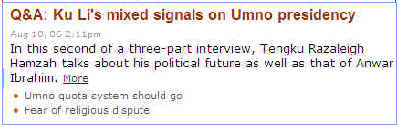
In this second of a three-part interview, Umno veteran Tengku Razaleigh Hamzah talks about his political future as well as that of Anwar Ibrahim.


Razaleigh: I don’t write off any politician. The only politicians that have retired from politics are dead ones [laughs]. Since he (Anwar) was removed from the party, (you may think he has) no more future. I don’t think so. It depends on what happened in the society, if the situation demands his participation, he will rise again. You can’t say a politician has no more future.

Of course, Anwar has no place in the political arena today. I am told that PAS is a bit disenchanted with him and he has no place in mainstream politics. He came to see me, and I advised him if you want to get back to mainstream politics, or want to be prime minister, you should go back to Umno. How? He has to work it out. I am not to advise him. If he wants to plays opposition politics, then he should become PAS president and change PAS.

PAS shouldn’t be what it is today. PAS cannot excite the new generation. Unless PAS changes its face and ways, it won’t capture the imagination of young people. And the non-Muslims won’t respond to it if it goes on this kind of conservative attitude. So I said: ‘You go into PAS and become president and change PAS.’ Like this man (Prime Minister Tayyip Edrogan) in Turkey, (his party) was an old Islamic party led by people in jubah (robes) and he changed it into a progressive Islamic party. Everybody voted for it.

* What about PKR?

PKR has no future. But then again, I am not writing off PKR. But compare it with the party I once led, Semangat 46 - it was a national party and we were fighting against people in power. Here, PKR is only a Kuala Lumpur party, and it's not a Malay party, it's a mismatch, along with the socialist crowd - the Parti Rakyat Malaysia that has been rejected by the people. (The party has) no base. Their bases were pockets from Johor, Terengganu, Penang. I don't see how (it can be a major force). I told Anwar this.

* What was his response?

He kept quiet. He agreed with me. I said, "Your wife (Dr Wan Azizah Wan Ismail) only won because it was your (previous) seat in Permatang Pauh". But now I doubt whether he will win if he was to stand again in Permatang Pauh - unless he stands on either PAS or Umno ticket.

* Should he go back to Umno?


Yes, because elections is coming. There is no point being a politician without participating in the election. I am not writing him off, he is quite a maverick.

* In his recent interview with malaysiakini, he said he might stand in a multi-racial seat.

Because he doesn't think he can get support from the Malays. And I don't think he is going to get support from the non-Malays also. It's very hard to get a seat. Predominantly Chinese seats in the urban areas are either (contested by) MCA, Gerakan or DAP. DAP is not going to give up the seat for him, why should they?

* What about yourself?

Me? I am here [laughs]. It's up to the party leadership, if they think I should stand, and then I stand (in the next general election).


* And the party presidency?

That depends on Umno members, isn't it?

* Do you still have intention to be party president
?

No, I have no plans whatsoever. Even the last time, I didn't want to oppose (Umno president) Abdullah (Ahmad Badawi) except for the fact that I disagreed with the supreme council's decision that the No 1 and 2 posts should not be contested. I don't think that is right because it was not written anywhere in the (party's) constitution.

So I just wanted to make a point to make Umno members realise democracy is not dead as even the No 1 can be challenged. I didn't really campaign. (I contested) just to show my protest.

* What about the quota system in Umno?

I think it should go. You must be confident in yourself if you want to be a leader. You don't need all these things. You talk about removing the tongkat, but you yourself are protected by that quota. You don't need that.


* During your last interview with malaysiakini (January 2004), you said it was too early to judge Abdullah's performance as prime minister as he had been in power for only 50 days then. What is your assessment now?

I won't say what I have in mind yet. But people say there is lack of direction (of Abdullah's premiership) especially on the economic front. That 's why things are not moving. There are a lot of things happening. For instance, the Article 11 and the counter reaction from the Islamic groups. I went to one meeting recently, they were not violent nor extreme in their views except for saying we must protect the constitution pertaining to Islam and we were not going to allow anybody to jeopardise our position.

If this is not handled properly it will cause some problems, big problems to our country. The prime minister has came out with a statement (to stop discussing the issue). Whether the people will take heed of his advice, I don't know, but the undercurrent is quite strong. Maybe it's good in some sense to have an open debate in matters like this, but for those who lack understanding of the real problem, it can be very murky.

* If this is to go on, will it affect Barisan Nasional in the coming elections?

All these things matter, it does affect the thinking of the people. What I am trying to say here is these things didn't happen before, it is not because it has been kept underwrap, but people understand certain matters shouldn't be brought up for open discussion because a lot of people don't understand, don't comprehend the problem at hand and it can get out of hands. Who is to stop this or provide the solution? Very difficult.

The crime rate is also on the rise. It is all because of (the lack of) economic activities, unemployment, even among graduates. We have full employment until 2002, now we have what? More than 20,000 unemployed graduates, but I am told the figure is more than 60,000, not including those who came back from Saudi Arabia, Egypt, Jordan, Indonesia and Taiwan. We are not creating enough employment opportunities.

* Anwar has called for the New Economic Policy to be abolished. Is it time to do away with it?

I think NEP is a good thing, but probably it must be reshaped into a new policy, a new strategy in ways never done before. The problem with the NEP - it was abused by the people who are not supposed to get all those things. That tainted the NEP. In spite of all the weaknesses, (the NEP) has worked.

After all, in spite of what we have done with the NEP, the Malays only own about three percent (of equity) , that's all, a lot of them have lost. Where are (tycoons) Tajudin Ramli), Halim Saad? They may be driving a big car but they have big fat borrowings. Compared with (Lim) Goh Tong, Robert (Kuok), or Ananda (Krishnan), you can't pick any Malay (from among the tycoons).

Unless, you give a fair opportunity for everybody, open up education like during (former prime minister) Mahathir (Mohamad)'s time. If the Chinese complain, they can (still) go to private colleges. Malays are not complaining as they can't go to some of these places because they can't afford them, they are (also) going to some colleges which give them slightly inferior training, they come out not as well qualified as the Chinese. In workplaces, you can see a kind of discrimination (against the Malays) again.

We are lucky we don't have problems today. But the ugly thing that is happening in the religious front - that I am afraid of, because when you come to religious quarrels or fights, nobody can pacify them because it is (based on) faith.

Tomorrow (Last part): Expect economic woes soon

for a better context: Check his RECENT INTERVIEW with ASIA TIMES On Line
and also his Interview with Malaysiakini
1st Part
2nd Part
Final Part

Thursday, August 10, 2006

TENGKU RAZALEIGH HAMZAH: EXCLUSIVE INTERVIEW-(1st PART); ABDULLAH SHOULD Meet MAHATHIR; NOT Exercising POWER; START-GO-NO BRIDGE WHY? -Ans: Y Y Koon

Read on below the detailed explanation by Chartered Civil Engineer Y Y KOON on
the Technical hitches that "sink" the crooked scenic bridge


Please support Malaysiakini by subscribing for as low as RM10 for 20 days / RM15 per month to RM150 per year.
Details at http://www.malaysiakini.com/register/manage4me/
_________________________________________

http://www.malaysiakini.com/news/55117


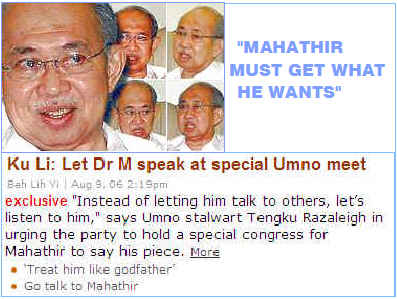
Q&A: Mahathir 'must get what he wants' ; Beh Lih Yi Aug 9, 06 2:40pm

In this first of a three-part interview, Tengku Razaleigh Hamzah shares his views on the current spat between Dr Mahathir Mohamad and Abdullah Ahmad Badawi.

Malaysiakini: You have said that Abdullah should meet with Mahathir, but in fact they did meet in Tokyo recently.

Razaleigh: That's just a call on him. I don't think he (Abdullah) wanted to explain what Mahathir had raised all this while. I am just guessing but my view is - why not on a Sunday or a weekend, Abdullah drives over to see Mahathir.

* You mean Abdullah cannot continue to keep quiet.

Obviously, Mahathir is not happy or satisfied with the explanations given so far and Abdullah has not responded, he allows other people to say (on his behalf). I think Mahathir probably expect this to come from Abdullah himself - the man he appointed to take over from him.

* Do you think a mediator will help? Like (Umno veteran) Khalil Yaakob.

It may help and may not, but knowing Mahathir, he must get what he wants.

The government has begun distributing booklets to explain its decision to cancel the 'crooked' bridge. (The explanation) which is what Mahathir doesn't accept.

* Mahathir had reportedly told Khalil that the spat can be resolved.

Yes, probably that's why there is no need for mediation because it's not a quarrel. It is Mahathir wanting to get satisfactory answers to all the points he raised. He wants explanation not from the junior chaps - he was everybody's boss before - so he expects his successor to come and explain to him.

* But his anger is beyond just these issues...

I suspect, because he has been mentioning all this in his speeches. Of course, I follow this in the papers and your internet newspaper, I don't go to all these (events).

Mahathir said he made the wrong choice in picking his successor.

He said that publicly. He repeated it in Kelantan. I was told he also said he would not support Abdullah again.

* Do you think he has an agenda beyond all this?

I don't think he wants to be prime minister or Umno president again. My reading is that (Mahathir thinks) Abdullah is not the right choice. Secondly, Mahathir feels Abdullah is not using the office of the prime minister - with all the powers (it has) - and instead allow other people to manipulate it. That's the impression that I get.

That's why the bridge project is 'start, go, no'. At first, Abdullah said 'okay', we proceed with this, we would continue with what Mahathir has started. That's what he said after he took over and he even went to lay the foundation stone of the bridge and in that function he announced no matter what happened, we would build the bridge. Why the about-turn? We MPs were told to support this bridge project in Parliament and suddenly we were told, 'no, we are going to cancel it' - the reason being the people is against
this. (SEE BELOW ARTICLE from ALIRAN which explains the REAL Problems for aborting the bridge)

When did the people say this, we don't know. Probably they have got a proper sounding, we don't know, they are the government. Secondly, it's about legal implications, (again) we don't know. Mahathir is a little bit taken aback. But I suspect it is not just that, it's maybe more.

* Do you think Mahathir's anger directed at Khairy Jamaluddin (Abdullah's son-in-law and Umno Youth deputy head) was justified?

I have nothing against Khairy. His late father, Jamaluddin, was a very good friend of mine, we are all (second premier) Tun Abdul Razak's boys. We worked together, Jamaluddin and a few others like Zain Azrai, worked for Tun Razak when he was the NOC (National Operations Council) chairperson and the prime minister. They did (work) on other fronts - I was on economic front - we worked closely (together). Jamaluddin has been a very good chap. Of course, I don't know Khairy, he was a little boy.

* Several Umno divisions have invited Mahathir to officiate their meetings. But the supreme council has to come out with an announcement that only party supreme council member can officiate the divisional meeting. Don't you think this will create a split at the grassroots level?

I think this is going to cause unhappiness. Even during Mahathir's time, the supreme council had made rulings on various matters including officiating annual meetings at divisions, but of course nothing (controversial) happened at that time and we said okay. Now, of course, there is a controversy, people who have invited Mahathir want to hear from Mahathir at this kind of functions, or probably just to show their opposition to the ruling (politicians).

I am told Mahathir had accepted some of these invitations. To me, why not? He is the ex-president of Umno for 22 years. This Umno was created by him - the old Umno was declared unlawful and de-registered. Who is a better person than Mahathir himself to address the Umno chaps? He has not gone against Umno struggle, he has his right to voice his criticisms or opposition to what is happening in the country.

* Is this spat going to affect Umno?

There is rumbling on the ground like Padang Besar (Umno division) that officially invited Mahathir and they had been told they couldn't (do so) because Mahathir is not a supreme council member nor a minister. However, they are members of the cabinet who are not supreme council members, not even division heads - (and) are outsiders - but they can go under the (supreme council) ruling; Mahathir who founded the party, an
ex-party president and ex-prime minister can't go, it's a little odd. He is not going to talk about communism [laughs], only talk about the bridge.

* Mahathir is also apparently not happy with the way (ministers and supreme council members) Mohd Nazri Abdul Aziz and Syed Hamid Albar had responded.

He feels slighted because these are little boys to him. I am sure he feels that way, that's why he calls Nazri a hatchet man.

* There are concerns that this will eventually affect the party.

Will they? I don't think so. I was at the state Umno liaison meeting last month. I spoke about Mahathir, I wanted them to recognise a fact – that Mahathir is an Umno member, he has done a lot to this country and party, good and bad, (but) I am sure he has done more good. Therefore, we can't rule him out.

Secondly, Mahathir is not saying anything against Umno. I don't think he would because he is so devoted to Umno, and actually we all are devoted. You can't therefore say we can't receive him or we are not going to listen to him. What is there to be afraid of?

Let's listen to him rather than letting him talk to others, or letting others listen to him. I suggested at the meeting for the party's publicity chief to convene a special general assembly to listen to Mahathir, let Mahathir has his say. I said, 'You (the party leaders) can't object to that because he is a special member of Umno, he was not forced out of office, he voluntarily gave up the office. Now he wants to say (something), (we should)
invite him, treat him like a godfather, come and speak to Umno members. Don't be afraid, we are all in the same family'.

Surely we can think - if he says the right things, we can support him; if he says the wrong things, we can condemn him. Why say, 'No, Mahathir can't join because we have a ruling'? Why discriminate against him? It makes it look like as if we are trying to bar him from meeting Umno members. Even in Kelantan recently, Umno members were not allowed to go, only a few went. I couldn't go because I was here. If I was in Kelantan, I would go. Why not? What can they do to me?

* What was the reaction to your 'special general meeting' proposal?

They kept quiet.

* It will not be sent to the supreme council?

Judging by the mood today, I don't think they are going to allow that. Why so afraid? There's nothing to hide. Let's come clean, give him the forum, he is not going to be prime minister again.

* This spat has been going on for months, how do you judge Abdullah's ability in resolving the issue
?

To me - I am only basing my answer on my experience with Mahathir - it will not go away unless he gets his answer. He will not keep quiet. He has audience around the world and he is recognised, whether you like it or not. (We) must acknowledge the fact that he is somebody in the world.

* Mahathir said he did not get the answers but Abdullah said the relevant government agencies have replied.

As long as the prime minister doesn't talk to him, I don't think he will stop. If he wants answers from Proton - he is advisor of Proton - he can call the board (of directors), but that's not the answer he wants. I think he wants more than that. My view is that Pak Lah, as somebody who took over from him, should jump into a car and drive to him, (and) talk to him.

* PAS leaders were seen associating themselves with (ex-premier) Dr Mahathir Mohamad lately.

I think PAS is trying to take advantage of what has happened between Mahathir and the government. It tries to be associated with Mahathir but I don't think Mahathir is associating with PAS. I think PAS is trying to jump on the bandwagon. I don't think Mahathir will give PAS that advantage, he is not blind to all this.

If there are PAS members present at the places where he speak, it's just a coincidence they came as part of the audience. Mahathir's audience is meant for the country because he is speaking on behalf of what he had done.

* In 1969, there was the May 13 racial riot; in 1987 and 1988, Umno was declared illegal; in 1998, Anwar Ibrahim was sacked. Do you think the 10-year circle is here again?

You have been looking at the crystal ball... But Mahathir started in 1981 [laughs].


Tomorrow: Ku Li on Anwar Ibrahim's future ____


following article is available from:
http://www.aliran.com/content/view/110/10/

Technical hitches sink crooked bridge ;Saturday, 29 July 2006

Koon Yew Yin takes a look at why Abdullah Badawi may have changed his mind over the proposed cross-channel link to Singapore.

I am well aware that many people including our previous premier Tun Dr Mahathir and our current Prime Minister, Abdullah Badawi, have expressed their opinion for and against the construction of the scenic or crooked bridge. Everybody is entitled to his or her own opinion. Bearing that in mind, I do not wish to bore you with any more similar arguments. However, as an old Chartered Civil Engineer, I think I know that there are some insurmountable technical difficulties, which the promoters may not have considered and should be interesting to you and all those concerned.

If we had Singapore’s cooperation to build a full-length bridge, the technical problem may be easier to overcome. But to just build half the bridge - I think the problem is quite insurmountable. Before I proceed, you may like to know what actually transpired in the Singapore Parliament that convinced our Prime Minister to change his mind. Singapore’s Second Foreign Affairs Minister Raymond Lim said that Malaysia did not have the right to unilaterally replace its half of the causeway with a bridge without the concurrence of Singapore. He reminded Malaysia that in 2003 it had applied for an injunction to the International Tribunal of Law of the Seas (ITLOS) to stop Singapore’s reclamation works when these works were carried out in Singapore’s sovereign territory.

While rejecting Malaysia’s application, ITLOS had ruled that all future engineering works in the Johor Straits would henceforth be subjected to the scrutiny of two countries. This rule is premised on the principle that works in one sovereign territory in the Straits could affect the other.

What about the railway?

Our Government must have woken up to the fact that it could not avoid the legal battle with Singapore if we went ahead to build half a bridge to replace half the causeway. Without Singapore’s agreement, how could we remove the existing pipeline and the railway on the causeway? Apparently, according to the separation agreement, when Singapore broke away, we were obliged to provide uninterrupted water supply and the maintenance of the railway to Singapore. If we stop running trains into Singapore for a certain period, Malaysia would lose all the railway land in Singapore. This is a very serious consideration, which I think our promoters did not take into consideration. However, I doubt if there was any cost-benefit study for the project.

From the picture as published in the newspaper I did not see any provision for the railway. Bearing in mind that trains, unlike motor vehicles, cannot take sharp corners or climb steep gradients, I think it is technically very difficult or impossible to design a bridge spanning half the causeway and to comply with these conditions. Moreover, the crooked half bridge would look queer and would likely attract ridicule than admiration if it could be built. One thing is sure. If we had gone ahead with the construction without Singapore’s agreement, there would have been a legal battle.

and ASIA TIME online INTERVIEW with ANWAR IBRAHIM

and FAR EAST ECONOMIC REVIEW on 9MP PROGNOSIS

Read also the Datuk Charged with Spraying Dr Mahathit at

Datuk NIK SAPEIA NIK YUSSUF charged - VOLUNTARILY INJURING 4 - Dr MAHATHIR, Datuk IBRAHIM ALI, MOHD NASIR MUDA & SUBERI SAHIDAN by SPRAYING Substance


Datuk NIK SAPEIA NIK YUSSUF charged - VOLUNTARILY INJURING 4 - Dr MAHATHIR, Datuk IBRAHIM ALI, MOHD NASIR MUDA & SUBERI SAHIDAN by SPRAYING Substance

Witness identifies Nik Sapeia; 13 Mar 2007; By Sulaiman Jaafar; NST

KOTA BARU: The magistrate’s court here was told that businessman Datuk Nik Sapeia Nik Yusof was seen spraying a small canister of gas at the occupants of a Mitshibishi Pajero. The witness, restaurant operator Wan Muhammad Hafiz Wan Awang, 26, said former prime minister Tun Dr Mahathir Mohamad was in the vehicle. Wan Muhammad Hafiz from Pasir Pekan, Tumpat, told the court he recognised the man who sprayed the cannister (containing pepper spray) as Nik Sapeia. When asked by deputy public prosecutor Raja Rozela Raja Toran whether the man was in court, the witness pointed towards Nik Sapeia, who was in the dock.

ABOVE: Datuk Nik Sapeia arriving with his wife Datin Dr Suriani Yahya

Nik Sapeia was charged with causing hurt to Dr Mahathir, Datuk Ibrahim Ali, Md Nasir Muda and Shukri Shahidan with a dangerous weapon by using a spraying instrument at Sultan Ismail Petra Airport in Pengkalan Chepa on July 28 last year. Nik Sapeia also faced four separate alternative charges of causing hurt to Dr Mahathir, Ibrahim, Md Nasir and Shukri at the same time and place. The witness said he saw Nik Sapeia spraying the cannister with his right hand but did not know where he took it out from. "I hit his hand and asked him why he did it. He uttered some gibberish," Wan Muhammad Hafiz said. Cross-examined by defence lawyer Zainal Abidin Mustaffa, Wan Muhammad Hafiz said he was Ibrahim’s nephew and was not a member of any political party. He was a committee member of the Kelantan People’s Action Council, one of the organisers of Dr Mahathir’s visit to Kelantan.

Earlier, Ibrahim, who was the first witness, said the council of which he was president, had organised a dinner for Dr Mahathir in Kota Baru on that day. Ibrahim said Dr Mahathir had arrived about 11am and was taken to the Pajero so that he could address the crowd, when the incident occurred. "I had difficulty breathing and my eyes were burning. I thought I had suffered a heart attack as I had recently undergone an angioplasty. "Dr Mahathir dropped the loud hailer he was holding and sat down and said his eyes were hurting. I then shouted for Dr Mahathir to be taken to another vehicle," he said. The trial before magistrate Mohd Azman Mustapha continues today.

Pepper spray charge stays, says court

12 Mar 2007; Sheridan Mahavera; NST

KOTA BARU: Lawyers for the businessman accused of attacking Tun Dr Mahathir Mohamad with pepper spray failed to get the case dismissed. The lawyers for Datuk Nik Sapeia Nik Yusof filed a preliminary objection on the grounds that the prosecution did not follow proper procedures. But magistrate Mohd Azman Mustapha rejected it. At the magistrate’s court, counsel Zainal Abidin Mustaffa had argued that the prosecution erred when it submitted a summons for Nik Sapeia to appear before court to face a charge under Section 324 of the Penal Code.

The charge stated that Nik Sapeia had allegedly caused hurt to four people, including the former prime minister, with a dangerous substance through the use of a spraying instrument. The charge carries a maximum three-year jail term, a fine or whipping. "This charge requires an arrest, but instead of issuing an arrest warrant, my client was given a summons. "If the court continues to hear this case, we would be a laughing stock because this charge requires an arrest and not a summons.

"So I appeal to the magistrate to dismiss this case as it is prejudicial to my client and release him," Zainal Abidin told the court. In her reply, deputy public prosecutor Raja Rozela Raja Toran argued that the charge against the accused was still valid since legal principles stated that the court had jurisdiction to try him irrespective of the manner in which he came before the court. Raja Rozela said this was made clear in the case of Public Prosecutor v Liew Choo Kwong and others (1962) and Saminathan v Public Prosecutor 1937.

In dismissing the objection, Mohd Azman said while he agreed with the defence that an arrest warrant was required and not a summons, and that the police had not followed proper procedures, the court was of the opinion that this did not prejudice the accused. Zainal Abidin said he would seek a review of the magistrate’s decision from the Kota Baru High Court. Azman agreed to postpone the hearing until today so that Zainal Abidin can seek a revision. In the incident on July 28 last year, Dr Mahathir was hit with a gust of pepper spray as he was giving a speech from the sunroof of a vehicle at the Sultan Ismail Petra Airport.

= = == = == =

The Datuk arriving with his lawyers, wife & 2 Children (behind)

Businessman Datuk Nik Sapeia Nik Yusoff claimed trial to a charge of spraying a substance towards former Prime Minister Dr Mahathir last month. He was charged under Section 324 of the Penal Code is liable to a maximum three years' jail or a fine or both.

He was charged in the Kotar Bahru Magistrate court for the offence also allegedly committed on three others. He was alleged committed the offence at the Sultan Ismail Petra Airport on 28th July 2006.

here is the Bernama'saccount.
Nik Sapeia Charged With Voluntarily Injuring Dr Mahathir; Aug 09, 06 19:54 PM

KOTA BAHARU, Aug 9 (Bernama) --Businessman Datuk Nik Sapeia Nik Yusoff, 53, was charged in the Magistrate's Court here Wednesday with voluntarily injuring four people including former Prime Minister Tun Dr Mahathir Mohamad on July 28.

He is charged under Section 324 of the Penal Code for injuring them by spraying a substance which posed a danger to the body when inhaled.

The three other victims are former Pasir Mas member of Parliament Datuk Ibrahim Ali, Mohd Nasir Muda and Suberi Sahidan.

Nik Sapeia who was represented by counsel Zainal Abidin Mustaffa and Ilias Md Nor, claimed trial.


Magistrate Tengku Amalin A'ishah Putri who is the Sultan of Kelantan's only daughter, fixed Nov 22 for a re-mention. She allowed Nik Sapeia bail of RM8,500.

The prosecution was conducted by Deputy Public Prosecutor Shahidani Abd Aziz.

If convicted, Nik Sapeia is liable to a maximum three years' jail or a fine or both.

The incident happened at about 11am when Dr Mahathir was about to give a speech to a crowd upon his arrival at the Sultan Ismail Petra Airport.

It drew public attention nationwide including Prime Minister Datuk Seri Abdullah Ahmad Badawi who immediately ordered the police to investigate.

Nik Sapeia was arrested the next day and placed under remand for four days.


The Datuk left the Court house at about 5 pm after posting RM8500 bail

He arrived at the courthouse at 3.50pm wearing a black suit without a tie accompanied by his counsel, wife and two children, and left at about 5pm in a black four-wheel drive after posting the bail. and following is the media NST account and other details:

Pepper Spray Incident: Nik Sapeia charged with causing hurt ;10 Aug 2006

KOTA BARU: Businessman Datuk Nik Sapeia Nik Yusof was charged yesterday over an incident in which former Prime Minister Tun Dr Mahathir Mohamad was hit by pepper spray. He was charged with voluntarily causing hurt with a dangerous substance through the use of a spraying instrument. Apart from Dr Mahathir, Nik Sapeia was alleged to have caused hurt to three others at the Sultan Ismail Petra airport about 11am on July 28. Nik Sapeia, 53, arrived an hour before the magistrate’s court closed for the day.

He was accompanied by his wife, Dr Suriani Yahya, son Nik Fatani and daughter Marina. As journalists, supporters and Special Branch policemen packed the court’s small public gallery, the accused took a seat in the dock and was seen calmly reciting prayers while waiting for proceedings to begin. Nik Sapeia, represented by Zainal Abidin Mustaffa and Illias Md Nor, was charged before magistrate Tengku Amalin A’ishah Putri Sultan Ismail Petra. Besides hurting Dr Mahathir, 81, he was also charged separately with hurting former Pasir Mas Umno leader Datuk Ibrahim Ali, 55, Mohd Nasir Muda, 45, and Suberi Sahidan, 48, at the same time and place. He pleaded not guilty to all charges.

If convicted, the former Kuala Krai Umno division faces a maximum jail term of three years, whipping, a fine or any of the above.
It is understood that the four hurt were in the same vehicle when they were hit by the pepper spray. Deputy public prosecutor Shahidani Abdul Aziz applied for RM10,000 bail. However, Zainal Abidin objected to this, suggesting RM7,000 bail as his client was facing a summons charge. Tengku Amalin A’ishah Putri set bail at RM8,500, which was posted by Nik Fatani, pending mention on Nov 22. Nik Sapeia and his family were rushed out of the court complex about 5pm in a black MPV . Nik Sapeia was detained on the eve of July 28, some 10 hours after Dr Mahathir was hit by a gust of pepper spray when he arrived at the airport. Dr Mahathir was addressing a crowd of supporters from the sunroof of a four-wheel drive when the incident occurred. Nik Sapeia was released from police custody three days after he was detained.

= == = = For background read, Go H E RE ON

Dr MAHATHIR-SPRAYED with PEPPER IRRITANT Before SPEECH on ARRIVAL; “DESPERATE ATTACK, Our PEOPLE NON-VIOLENT”; 4 Confirmed ARRESTED


Wednesday, August 09, 2006

FEER Prognosis on 9MP-AN IMPERFECT PLAN; MALAYSIA WHICH WAY? Mind the MINDSET GAP; IMPLEMENTATION; NO More HEADY GROWTH


It looks bad as Malaysia faces real long-term challenges and in some quarters there is a feeling that “doom is on the horizon. and it is time for new ideas and fresh approaches.”

Read on the insightful analysis.

From The Far Eastern Economic Review; Issue July/August 2006

Abdullah’s Imperfect Plan
By Colum Murphy

The recent mudslinging by former Prime Minister Mahathir Mohamad at his successor Abdullah Ahmad Badawi has enthralled Malaysia almost as much as the 2006 World Cup. Not since he dumped his former protégé, Anwar Ibrahim, has Mr. Mahathir’s vitriol been so potent.

Mr. Mahathir has accused Mr. Abdullah of incompetence and “stabbing him in the back” by halting some of the large projects begun when he was leader, including the plan to replace the causeway linking Malaysia to Singapore.

At stake is more than hurt feelings. Mr. Mahathir and his cronies are not happy with Mr. Abdullah’s approach to overhauling the Malaysian economy. In March, Mr. Abdullah announced the first installment of his blueprint—the $60 billion Ninth Malaysia Plan, or 9MP, which covers the five-year period 2006-10—aimed at keeping Malaysia on track to
achieve its much touted goal of becoming a developed country by the year 2020. While the goal is consistent with the “Vision 2020” slogan coined by Mr. Mahathir, there are some notable differences in Mr. Abdullah’s approach.

Gone are the graft-prone giant infrastructure projects of the 1980s and 1990s, and in their place the government is investing in human capital. This shift to a “people focus” is an attempt to ensure that Malaysians have the skills and attitudes needed in a global economy.


In a further break with the past, the Abdullah administration is also showing a greater willingness to liberalize
Malaysia’s economy: An economic partnership agreement with Japan will go into effect later this month, and trade negotiations with the U.S. are already underway and are expected to result in a free trade agreement by early 2007. Consolidation of the banking sector is also ongoing, and new rules allow for higher foreign ownership in banks. Reform of government-linked companies such as the energy provider Tenaga and communications company Telekom is under way.

Not that all trademark elements of meddling in the Malaysian economy are being jettisoned. Khazanah, the government’s investment arm, is becoming more ambitious, investing in strategic assets both at home and overseas. Mr. Abdullah still clings to affirmative action for the mainly Malay bumiputra. The blueprint reiterates the goal of putting 30% of Malaysian equity in bumiputra hands by 2020.

Malaysia, Which Way?

Malaysia faces real long-term challenges. The economy grew by a respectable 5.3% in 2005, according to the country’s central bank, but that’s considerably lower than the average 8% growth rates of the mid-1990s. Mohamed Ariff, executive director of the Malaysian Economic Research Institute, an independent think tank that acts as consultant to the government on industrial policy, says the days of heady growth are over and it is time for new ideas and fresh approaches.

As elsewhere in the region, change is being driven by globalization, mainly in the form of a rising
China. For now, Malaysia is benefiting from China’s explosive growth by feeding mainland factories raw materials and components. China is now Malaysia’s fourth most important trade partner after the U.S., Singapore and Japan, and last
year bilateral trade between the two countries was 85.1 billion ringgit, or around $23 billion. This is expected to more than double by 2010.

In the long term,
Malaysia has little hope of competing with China, at least in lower wage manufacturing. And even if Malaysia moves up the value chain in manufacturing, Mr. Ariff says, that will only stave off the inevitable. “It will take 10 to 15 years, but eventually China is going to catch up,” he says. The challenge is for Malaysia to find new growth areas, and build an economy that is not on a “collision course with China. This includes reducing dependency on manufacturing to 20% to 25% of GDP within 15 years, from the current level of around 32%. Services should increase to around 65% from 58% in the same period, says Mr. Ariff.

The 9MP, and the related Third Industrial Master Plan (IMP3, expected to be released shortly), are supposed to help by pushing high-technology, knowledge-intensive activities with high value-added content in areas like electronics, petrochemicals, biotechnology,
aerospace and maritime, according to Senator Effendi Norwawi, the minister in the prime minister’s department responsible for the 9MP. On services, the goal is to spread the sector out from its traditional base in greater
Kuala Lumpur, with Johor being eyed as a regional services hub. In particular, tourism, health services, financial services and education will be targeted for growth, the senator says. For the first time in a long time, a strong focus will be placed on developing agriculture and related industries.

In
Penang, the China threat has been around for years. That’s hardly surprising, given that around a quarter of a million Penangites—out of a population of 1.3 million—are employed in the cutthroat electronics sector, in which China’s profile increases with each passing year. While defections to China are occurring, the sector still seems reasonably healthy. Even so, there is a feeling that doom is on the horizon and moving up the value chain has become a mantra.

Wong Siew Hai, the retired head of Intel in
Penang and current chair of the Malaysian American Electronics Industry association, explains: “In the past, 60% of these jobs were direct labor and 40% were indirect labor such as engineering, planning and human resources.” The aim is to reverse those figures, he says. Mr. Wong believes Penang’s
electronics industry must concentrate more on R&D, marketing, and product design for semiconductors, microelectronics and software development.

But first,
Malaysia needs highly skilled graduates. Currently, there are a reported 60,000 Malaysian university graduates who are seeking work, largely because of a mismatch between university curricula and employer needs. In the case of the electronics industry, for example, Mr. Wong says there are only one or two universities in the whole of Malaysia that have graduate-level programs in new technologies such as semiconductor design.

Mind the Mindset Gap

It is precisely these gaps that Mr. Abdullah hopes to fill under 9MP. He warns against having a first-class physical infrastructure with a third-class mentality. The goal is a labor force that has the ability and attitude to excel in a globalized world. It sounds a bit nebulous, but a first step is to pour money into revamping the education system—no less than 40 billion ringgit, or roughly 20% of the total 9MP expenditures, is earmarked for this.

It would be hard to find fault with greater investment in education as long the money is spent properly and the goals are achieved. But throwing money at universities is not going to be enough. In a globalized world, knowledge workers also need the right attitudes: flexibility, tolerance, and the ubiquitous ability to “think outside the box”—attitudes, some say, that are sorely lacking among Malaysians. It is for this reason that Mr. Abdullah’s plan hopes to instill “progressive attitudes and thinking, strong moral and ethical values” in its citizens—all under the auspices of Islam Hadhari, or Civilizational Islam, a development framework that “emphasize[s] faith and piety, a just and trustworthy government, and balanced, comprehensive economic development.”

The introduction of such abstract concepts in an economic plan has left many observers bewildered. In Mr. Mahathir’s time, it was easy to understand what was going on—
Malaysia was building a lot of really big things. Mr. Abdullah, however, is leaving himself wide open to criticism because attitudinal changes are not only hard to achieve but hard to measure.

There are several possible explanations put forward for Mr. Abdullah’s insistence on including such high-concept ideas in his plan. One school of thought says that this is just rhetoric meant to soothe those who lament the loss of
Malaysia’s Islamic soul. The second school says the concepts are clues to Mr. Abdullah’s underlying intentions. Said one economics professor at a public university in Penang: “What makes the 9MP plan especially challenging is how to get people to read between the lines.”

But divining Mr. Abdullah’s intentions is not easy. One big focus of the plan is “integrity,” a clear a nod to the government’s anticorruption drive. But grasping his true intentions on the thorny issue of affirmative action is trickier.

On the one hand, the plan clearly states that “during the Ninth Plan Period, the distributional agenda will be pursued more firmly so as to ensure the achievement of a more equitable distribution of the benefits of economic development by all Malaysians.” The plan also brings back the controversial issue of bumiputra equity ownership after it mercifully faded into the background over the past few years. The goals have now been restated unequivocally: Bumiputras should hold between 20% to 25% of Malaysian equity by 2010, and 30% by 2020. The figure was around 18% in 2004 but realistic figures on equity holdings are notoriously hard to find. Similarly, the government wants to increase bumiputra ownership of residential, commercial and intellectual property.

In addition, the government also wants to reduce income disparity between bumiputra and nonbumiputra ethnic groups. Chinese Malaysians, for instance, typically had incomes 64% higher than bumiputras in 2004; the 9MP wants that reduced to 50% by 2010. With huge chunks of the Malay community unable to join the middle class, income disparities between “have Malays” and the “have-not Malays” is also a concern, albeit one that, for obvious reasons, politicians would prefer to play down.

There is a fundamental contradiction here. Mr. Abdullah wants to create a more competitive
Malaysia yet he supports strategies that protect the bumiputras. Abdul Razak Baginda, executive director of the Malaysian Strategic Research Center, not only considers the goal of 30% equity ownership as “meaningless,” he is concerned that affirmative action does more harm than good. The initiatives first set down in 1970 have been good for middle-class Malays, he says, but they have also had “the unintended result of Malays losing competitive ethos.”

The government would argue that ensuring equitable income distribution is the only sure-fire way of keeping
Malaysia stable and avoiding a return to the times when racial tension erupted into violence. But without economic growth, there can be no redistribution of wealth. If Malaysia turns too readily to affirmative action it runs a risk of creating a workforce that falls down in the face of more competition-driven economies. In short, Malaysia, can’t expect to be competitive in external markets if it is protectionist in the domestic market.

Proponents of “reading between the lines” caution against taking Mr. Abdullah’s bumiputra stance too literally. Instead, they point to the emphasis on morals, ethics and integrity. This, some say, is a subtle hint to segments of the Malay population that might see themselves losing out—letting them know they must fend for themselves if they wish to partake of the benefits of growth. Some interpret the plan as a call to the bumiputras to take greater responsibility for themselves, and say that in a very quiet way the plan offers hope that the government is prepared to, if not abandon, at least tone down
affirmative action.

However, this sounds a lot like wishful thinking, and the main flaw of the plan remains the tension between aspirations to first-world thinking and an unwillingness to take the painful steps to create an open, vibrant and competitive
Malaysia. “We keep telling the
government that the space for affirmative action is getting more and more limited
,” says Mr. Ariff of MERI. “We can’t do things that we could do in the 1970s and 1980s in the 21st century.”

Mr. Abdullah’s success in office could be harmed by the schizophrenic nature of the plan. On the one hand, the prime minister wants to build a
Malaysia that is able to stand on its own feet and meet the challenges of a rising China. On the other hand, he is hanging on to some of the old—and politically popular—ways of protecting the bumiputras.

The Proof is in the Implementation

Even if the tension between change and political inertia could be resolved—and this is unlikely given that abandoning affirmative action would invite political turmoil at the grass-roots—there are a host of other challenges if the plan is to succeed. First, Mr. Abdullah needs to win people over to his vision. The
prime minister seems popular and
the tirades from Mr. Mahathir will probably serve him well. Malaysians seem to find the former prime minister’s antics tiresome. However, Mr. Abdullah will not be able to capitalize on the outbursts for long—sooner or later he will need to
provide meaningful answers. As it stands, his administration will have to sell his ideas—a task made all the more difficult by the vague, touchy-feely bits in the plan.

Second, Mr. Abdullah needs to cement support from his party, UMNO, by addressing the issues raised by Mr. Mahathir and dispelling rumors that it’s only a matter of time before Mr. Abdullah is replaced. Third, the civil service has the potential to make or break any plan to overhaul the economy. With a shift to investment in people, many wonder if the government and its civil service will even know where to start. Anticipating such claims, a substantial part of the 9MP is devoted to addressing “public-service delivery” issues.

For Mr. Razak of MSRC, timing is of utmost importance. “If after one year of the 9MP there’s no change, then it’s time to do something drastic,” he says. But he is unsure that Mr. Abdullah can pull it off. “[Mr.] Abdullah is a product of the system,” he says. “I am not sure to what extent he can break the mold and think outside of the box.”
But having a plan without the proper implementation processes in place would seem to be a classic case of putting the cart before the horse.

ATONLINE Interviews ANWAR IBRAHIM: Race Based POLITICS Obsolete; PERSONAL Dispute in PM & EX-PM Clash; Abdullah:NO Political WILL to INITIATE CHANGE

Malaysia's Anwar Ibrahim speaks his mind By Zari Bukhari and Shawn W Crispin

It is fashionable to conduct interviews with "busy people" on the move. In a recent e-mail interview with Asia Times Online , Anwar aired his views on Malaysian politics, his personal future and the escalating conflict in the Middle East.

KUALA LUMPUR - Former Malaysian deputy prime minister and finance minister Anwar Ibrahim is on the political offensive. Nearly two years after his early release from six years in prison on trumped-up corruption and sodomy charges, he now represents the biggest opposition threat to Malaysia's government led by the United Malays National Organization (UMNO).

Once groomed as former prime minister Mahathir Mohamad's successor, Anwar, now 58, has spread his wings widely since his 2004 release, serving as an academic fellow at the
Johns Hopkins School of Advanced International Studies in Washington and later teaching courses on Arab politics, inter-religious relations and Islam and modernity at Georgetown University. On the international lecture circuit, including high-profile stops in Europe and the Middle East, he frequently speaks about the growing schism between Islam and the West.

Throughout, Anwar has presented himself as the cool, rational voice of moderate Islam, and his name is now frequently mentioned as a possible successor to outgoing United Nations Secretary General Kofi Annan. Although his candidacy has not been launched formally, Anwar is believed to have support in Europe and close ties with several senior US political figures, including World Bank president Paul Wolfowitz and former US trade representative and deputy secretary of state Robert Zoellick.

ATol: How and why in your opinion would you represent a better political choice than the incumbent UMNO-led government? What would you handle differently and what specific political, economic and social policies would you enact toward that end?

Anwar: I believe that the opposition, particularly [Partai] Keadilan [Sejahtera], would be able to offer a new brand of politics in
Malaysia. There is a greater realization that the race-based politics of the ruling BN [Barisan Nasional] is obsolete, and is unable to face
the present challenges.

First, we are committed to democratic renewal - abolishing draconian laws such as the ISA [Internal Security Act], enhancing the role of parliament, restoring the independence of the judiciary and freeing up the media. Secondly, we are committed to a new economic agenda – one that takes a non-racial approach towards enhancing economic competitiveness and alleviating poverty for all Malaysians.

ATol: How do you reconcile your moderate Muslim image with your affiliation with the Islamic fundamentalist PAS [Parti Islam SeMalaysia, or Islamic Party of
Malaysia]? Is this a marriage of political convenience, or does your affiliation indicate that you have returned to the more conservative Islamic views you held during your early political career?

Anwar: Yes, PAS is a political party based on Islamic ideals. Yet what many people fail to appreciate is that it has been operating faithfully within the democratic framework for over 50 years, in spite of undue pressures exerted to its participation by the BN government.

There are things [on] which I do not agree with PAS, but in my engagement with them I am confident that we can work on a minimum set of programs that are in tandem with Keadilan's ideals.

When I was arrested under the ISA for the first time, it was because I protested against the poverty and economic deprivation of the rural folk in Baling, Kedah. My commitment to Islam has always been consistent - as a source of an ethical framework for
Malaysia, and one that promotes freedom, justice and human dignity.

ATol: What is your assessment of Abdullah Badawi's government? Has he lived up to his reform promise and, if not, what do you see as the more glaring discrepancies in his government's actions? What are your thoughts on the Mahathir versus Abdullah row? Do internal UMNO disputes provide you with a valuable political opening? Any plans to
politically exploit the widening row?

Anwar: Undoubtedly Abdullah's big victory in the 2004 elections was partly due to the fact that he campaigned on eradicating corruption and enhancing accountability. While there have been some changes - eg, in the freer democratic space, less interference in the judiciary – I think overall Abdullah has failed to fulfill his pledge. There seems
to be a lot of intent, but not so much political will in initiating change within UMNO. A lot of people have been disappointed, and Mahathir is exploiting on this. Personally, I view this clash as a personal dispute, as it seems ironic that Mahathir is talking about strong opposition, free press and accountability when it was he who destroyed all that during his rule. I believe that this has allowed the people to see our consistent commitment to reform more clearly, and hopefully they will give us the opportunity to implement it.

ATol: Looking back at your time in detention, what realizations did you come to while in prison about
Malaysia's governance? As a former senior UMNO member, what do you view as the party's biggest historical shortcomings and future political soft spots?

Anwar: Even when I was back in UMNO, I was committed towards combating corruption and promoting freedom. But when in prison, it made me realize that I underestimated the force of the vested interests that are committed to derail reform.

The problem with UMNO is that it has been in power for so long, and that it relies on racial politics as its strength. At times, this requires it to stir racial emotions for the sake of political expediency, but at the expense of the country.

ATol: Your name has recently been bandied about as a possible candidate to succeed Kofi Annan as United Nations secretary general. Any truth to those rumors, and if so, how will you campaign? Did you broach this idea with your contacts in
Washington during your recent stint at Georgetown University? Obviously there is a growing global
call for a moderate and modern Muslim leader to take the UN secretary-general post. Are you that candidate? Why or why not?

Anwar: I have [made] some comments to that effect ... The problem is that the discussion involves presidents, prime ministers and foreign ministers. The discussion has been going on for the past six months, more serious now with non-governmental organizations and the UN apparatuses - across the world. So I don't think it's polite to be so dismissive in rejecting the option. Most of them asked me to give it serious thought, or at least to consider the option.

To my colleagues here in the Keadilan and the opposition I have stated that my commitment is here. They asked, why don't I state a categoric rejection or denial? I told them I don't think that would be polite. I am not saying that it would be easy for me [to get the UN post] in the event I choose to run, but I think it is a serious proposition. But in the discussion with party leaders, I have made it clear that I am ready to work here.

ATol: What are your thoughts on the unfolding events in the Middle East, including the spiraling Israel-Lebanon conflict, the
United States' occupation of Iraq and the growing pressure emerging on Iran? As UN secretary general, how would you hypothetically respond to these challenges?

Anwar: It is disgraceful that the
US has given Israel yet another blank check in its offensive against Lebanon even when the whole world is condemning it. The US has to realize that it needs to be consistent to its own ideals of promoting freedom and democracy in the Middle East even if that requires distancing itself from Israel.

This will only serve to infuriate Muslim opinion even more. The few Arab countries that the
US can deal with are all unpopular with their own citizens. In reality, the UN can only do so much if the US continues to stand by Israel come what may. Israel must be reined in, and genuine democracy must be promoted in the region - which means the US must be prepared to deal with parties that are not willing to be dictated by its whims and fancies.

This is really unfortunate, because historically the
US has been seen as the beacon of freedom and democracy throughout the world. The neo-conservative policy unfortunately has only exacerbated anti-Americanism in the Muslim world.

Tuesday, August 08, 2006

EXCLUSIVE TV3 INTERVIEW-PM ABDULLAH; REPLIES ALLEGATIONS- LEADERSHIP Style, DECISIONS Made; INVOLVEMENT of FAMILY Members; Measures to SAVE PROTON

PM Abdullah being interviewed by Datuk Annuar Zaini, Chairman of Bernama

The Prime Minister Datuk Seri Abdullah Ahmad Badawi gave a special one hour interview (recorded) SEMMUKA Perdana Menteri aired on TV3, 8.30 pm Monday 7th August 2006.

He elaborated on various allegations pertaining him, his son and son-in-law and replied frankly to allegations and prejudices on him, particularly on his leadership style and decisions he made as the prime minister.

He also said he would do whatever is possible to help first national car Proton. This project is getting attention and I know Proton is national company and the pride of Malaysian and I will not allow proton to fail.


"I do whatever to help Proton. Proton has many vendors, if Proton is sick many vendors would be affected. Hence he gave his assurance that he would not allow proton to be taken over. The measures include improving the National Car Policy announced last March."


Son-in-Law Khairy Jamaluddin

Datuk Seri also denied that son Kamaluddin and son-in-law Khairy Jamaluddin has benefited from government projects as prime minister

The duo has never misused their positions with him. There is no poof to allegation that Khairy has benefited from (government) projects

My Style is different from Tun Dr Mahathir’s. He himself has acknowledged this. But I won’t run from implementing national objectives, for example vision 2020 which I do my way, what more in this current situation where oil prices are soaring, I have to find the right way and I am responsible for each and everything I do. People said that Khairy influenced all my decisions. After suffering umpteen years as minister, how difficult to be prime minister, and then hand power to him. How can?


"This is my principle which I will hold dearly,"

He said he wants to lead the country like his marriage to his late wife Datin Seri Endon Mahmood, filled with love, sincerity and fairness.


I choose to be silent because I don't not want to use the media as a platform to quarrel with Tun. Tun himself has said he wanted details about certain issues and if the prime minister does not want to reply , let the ministers reply, so I decided that the ministers should reply.

FULL INTERVIEW 30 Q & A Transcript

The Full text of PM's special interview

This is the full interview of Prime Minister Datuk Seri Abdullah Ahmad Badawi with Bernama chairman Datuk Annuar Zaini broadcast on TV3 Monday night.

1. Q: What are the main thrusts to fulfill the general election manifesto that were reflected in the Ninth Malaysia Plan (9MP)?
A: My core values are to build quality human capital. If we don't have that, we cannot achieve success as outlined in Vision 2020. We must also add value to our human capital. Lastly, we want to close the economic disparity between races and overcome unbalanced economic opportunities so that everyone, regardless of their race and economic standing, can have a better standard of living.

2. Q: Things that were your favourites or priorities did not take long to implement. Are people getting used to the physical development now?
A: The approaches being taken to achieve success in Vision 2020 must be continuous. Meaning that they will continue in 10MP, 11MP and beyond. Many projects had been announced for 9MP - to develop new areas, new corridors and other areas which needed development.

3. Q: A total of RM15bil for 880 development projects have been allocated under 9MP. Is this all?
A: This is fiscal and it is not over yet. This is just the first phase. More will be announced in time.

4. Q: Previously, the public noticed that the Prime Minister was worried about the national deficit. But suddenly, we have this big RM15bil announcement. How did this come about?
A: The country was facing a deficit economy when I took over the Prime Minister's post. The rate was quite high. It should not be allowed to go higher or it could bring negative effects. As Finance Minister, I immediately took measures to successfully reduce the deficit from year to year. The deficit and inflation rates managed to be controlled and reduced over a period of time, and the economy became a bit healthier. This in itself is a good achievement. We then decided that we are ready to set aside money to spend (for the 9MP). In fact I will announce more development plans from time to time. But when the oil prices surged at that time, what can we do. So we decided to spend money and use other approaches like PFI.

5. Q: What is the mechanism to ensure fair economic distribution and opportunity under the 9MP?
A: There are 880 development projects in this to be shared by everyone. We are not talking about big projects alone. Everyone - from Class A to Class F contractors will get a fair deal. This is not announcement that just concentrates on mega projects only. If that happens, the small-time contractors would be elft wondering what would be left for them although they had been waiting over a year to secure 9MP projects.

6. Q: That is the Prime Minister's vision to do it openly and have a fair participation.

A:This will spur the sluggish construction sector and at the same time hardware shops will also reap the benefits.

7. Q: You are working hard to implement the policies. But some say you don't have the time to micro-manage. This could create a dissatisfaction and doubt that the implementation will be successful.
A: That is why, as I mentioned in thrust earlier, the fifth thrust relates to the implementation. To implement things in a better manner, we formed the National Implementation Action Body, of which I am the chairman, Datuk Seri Najib Tun Razak my deputy and the ministers are the members. We want to oversee that projects are implemented quickly and efficiently without any hitches. Implementation and good coordination is also important. Obviously I cannot go down and micromanage. I don't really like micro-managing things...managing details. That's not the Prime Minister's job. If the people concerned cannot do it, then get someone else. However, to ensure that the projects are implemented properly, like it or not, I still need to go down to the ground often to visit the states to find out if the right things are implemented. Recently, I visited Terengganu, I was given briefings in the district office and I asked the officers there for all the details and I pushed for things to be carried more quickly than before. I don't want delays.

8. People can see your determination. But the issues raised are on economic opportunities, tenders and how to get benefits from it. The media reports on the RM15bil projects was that it was an open tender but it had already been awarded.
A: That's not right. These allegations are giving the impression as if I had lied to the people. They give an impression that I'm lying and that I have given the RM15bil allocation to other people. This is slander. If it is true, then, put in writing. I want to know where did they get the information from. Berani kenar benar (Be brave because if it is the truth) and then we will take action. I want proof, if there is none, then be prepared to face the consequences.

9. Are you ready to open your door to those with such proofs to come and see you and give information?
A: Write a letter to me, and make a copy to others such as the police, the Anti-Corruption Agency or the related agencies. Show me the proof. I want an explanation on how he knows this happened. If these are lies, they are trying to hina (insult) me and the Government. How can they do that?

10. Q: You are noted for your clean image here and internationally, but there are talks as if your name has been damaged. How can such situation occur?
A: I don't know how it had happened. Such people are trying to belittle me and make wild accusations. Maybe they are doing so because they have a hidden agenda. If I'm accused of being corrupt, please write and tell all. But these people seemed to only know things and nothing else. That is not sincere.

11. Q: Some believe that you still have the clean image. Others say that people around you are very influential on you. For example, your son-in-law Khairy Jamaluddin.
A: Khairy once worked with me. All officers have their roles. They give their reports and views but it is my decision whether to accept or reject their views and decision. When stories came up about an influential 28-year-old in the Government, he resigned and did not want to work with me anymore. But he has to make a living like the others. He bought a small amount of shares and became a partner in ECM Libra and he took his own loans. But there is no proof that he hijacked and took over a government project.

12. Q: Is it a dilemma to have a family member as a member and political influence in Umno?
A: I've spoken frankly when he wanted to become a youth member. I remember when Hishammuddin (Umno Youth Chief and Education Minister Datuk Seri Hishammuddin Tun Hussein) was angry with me, he would say that he (Hishammuddin) decided and suggested that Khairy should be the deputy youth chief. He told me jangan kacau (not to interfere). "Pak Lah jangan kacau. (don't interfere). This is a youth matter and the youth chose who they want. We want him…" he told me. As a youth deputy, he has to do work and how far of an influence he has on the government depends on what he can do and the work he has achieved. I don't think him (Khairy) being the son-in-law is the number one factor. We can't do something just by assuming that he is anak sipolan (so-and-so's child). But as someone's child, people want to know how far is his capabilities. First, he was booed at the Umno AGM (Annual General Meeting). But when he has the capability to raise a motion on youth and economy, he was cheered and praised. Before that it was another story all together.

13. Where is the line between a family relationship and the relationship between a party president and the deputy youth chief. For example, when he comes up with business-related proposals. Does this happen and what happens then?
A: When he attended youth meetings, I was told that he never took part in pushing for this or that. When he attends youth meetings, he stands and speaks as an Umno youth representative. He has never spoken, asked, pressurised or threatened the government to give him anything. He has not come to me and said "this is my project and I want you to approve. No, he has not done that as he knows I will not give it to him.

14. Q: Is there a possibility that he is being used by some people?
A: Maybe. Some people might be looking to use him. There are people out there when they want something from a person, they seek after the person's children, son-in-law, wife and best friends. I have had cases where people have sought after my old hometown friends. Some have gone to Kepala Batas looking for me. A person who wants something will find ways to achieve their goal. Some have accused me and said that I have become a Prime Minister for so long but until today, they have not received anything while there are others who just keep quiet and don't complain much. We have to be fair and can't just give just give things as we like.

15. Q: There were talks that the Prime Minister was being too careful and this resulted in delays in approval of development projects.
A: If its important we have to take the time to think over a matter, I only took over the Prime Minister’s job 2 and ½ years ago and yes I have immense powers but I have to be very careful and there was one thing I knew when I became the Prime Minister that whatever decisions I made, good or bad, would have a bearing on the people. If it is a bad decision the people would take the brunt of the consequences and if it is good, Alhamdullillah, but I worry when it is a wrong decision many would suffer in agony.

16. Q: You are known to be a man of a gentle character but the Machiavellian political concept says that a leader should be popular and feared. Do you agree with this?
A: As a Muslim we cannot adopt the Machiavellian concept as a practice. We cannot legalise our actions at any costs. That is not the way to go and I do not hold to such philosophy.

17. Q: Singapore had personality like Lee Kuan Yew and Malaysia Tun Dr Mahathir Mohammed and compare this with you, extremely gentle and sluggish.
A: This is not a question of being gentle or tough. The question is that are we able to be firm on our standpoint and what one’s think is true and appropriate. What is important is truth and justice and that is being firm in one’s decision. I normally make hard decisions but make it look easy and I have no reasons to show this to the general public.

18. Q: The media has a perception that there are Ministers that tackles issues in two different tones. What is your comment?
A: There are certain people who speak with an ordinary tone. Samy Vellu (Works Minister Datuk Seri S. Samy Vellu), for instance, speaks in a tough manner as if he wants to fight with someone. Others like Mustapa (Higher Education Minister Datuk Mustapa Mohamed) who speaks normally without a high tone. What is important is not to differentiate from the substance aspect. I reprimanded some of them (tegur). Just read the papers. I give them a call and tell them that things should be rectified and asked them what were they talking about and told them to fix it. Previously, when Datuk Seri Law Hieng Deng was the Science, Technology and Environment Minister, I called him and asked him to check on open burning activities. He then rushed out to get to the bottom of the matter.

Another instance was when I read a story that 200 vegetable farmers were evicted although they claimed that they were legal farmers. I then asked Khir Toyo (Selangor Mentri Besar Datuk Seri Dr Mohd Khir Toyo) to investigate the matter before things got out of hand and before there was a stand off between the Chinese group and the Malay-led government. I told him to handle the matter and get information and he came back and told me that the farmers had been there for quite some time and 80% of the vegetable supply in KL (Kuala Lumpur) came from this area. I solved this problem by approving the land, which is now being cultivated, by the Malays, Chinese and Indians and they have now set up a co-operative. Everything is well now.

19. Q: As we approach our 49th National Day, questions have cropped up about foreign ownerships of local companies especially by Singapore companies, which is a sensitive issue.
A: This means they have confidence in our economy. That is why they bought Malaysian business entities. The most important thing, however, is that our control over these companies are not taken over by foreigners. And none of our local companies have been taken over. Malaysian companies shares have been bought by US, Japan and Korea, people keep quiet about it but they start furore when it involves a Singapore company. I don’t know why.

20. Q: At the Umno AGM (Annual General Meeting) last year, the party’s sentiments was on Proton. Today, some say it no longer receives attention under the Pak Lah era. What is your comment?
A: This project is getting the attention it needs, as this is a national project and the pride of the nation. I will not allow Proton to tersungkur (fail). I will do everything in my power to help Proton and I know Proton is a national company. Proton has many vendors. If Proton is ‘ill’, it will directly affect many vendors. I will make sure that Proton does not fold.

21. Q: Does this mean that the National Automotive Policy will be reviewed?
A: If there are shortcomings to the policy, it will be addressed quickly.

22. Q: You are known as Mr Clean and Mr Nice Guy. Sometimes that intention is disrupted because of business interests. Besides KJ (Khairy), your son Kamaluddin is also in business and has he misused or taken advantage of his relationship with you to excel in his business?
A: Kamal has never used his relationship with me to advance in business. His business is in a field which only has two companies in the world. Of the two integrated oil companies, one is in the US (United States) and the other is his. He is not involved in many other companies and he operates overseas. Sometimes people ask why is he overseas. He tells them that since his father has become the Prime Minister, it is difficult for him to make a living here. That is why he opted to do it overseas. Eighty percent of his contracts are from overseas and that is where he gets his rezeki (livelihood). Petronas usually participates in international open tenders. Any tenders he gets is too small compared to what he gets overseas and he also has to compete for the tenders with other companies. He usually gets tenders from companies like Shell and Esso because it is related with oil and gas. He has never asked for help from the Government. There is also no bail out. None.

23.Q: In your capacity as the Finance Minister, has his company obtained government tenders?
A: No, not at all. To my knowledge, he has not received any. He does not manage the business and is only the major shareholder and had made a move to buy a
Singapore company with 188 ships to transport coal.

24. Q: Some say that the Penang monorail is reserved for Kamal. Is that true?
A: Siapa cakap? (Who said so?) I tell you, it is hard to be nice.

25. Q: Maybe it is time now not to be too gentle?
A: I am worried as well that things might turn out to be difficult if I push it too far.

26. Q: I cannot run away on why Datuk Seri is said to remain quiet on Dr Mahathir, to be evasive and not face reality
A: I chose to keep quiet because I do not want to quarrel with Tun (Dr Mahathir) in the newspaper. Tun said in a statement that he was slighted because he did not get the information he asked for and if the Prime Minister does not speak, let the ministers speak. I chose to let the ministers speak. There are a lot of things he raised come under the ministers' jurisdiction. They should be responsible to explain to the people. People want to know and many Cabinet ministers prefer that I don't speak. Many feel that it is better that I don't speak, many say that Paklah go on and speak. So it became chaotic. Let the ministers speak; this is not about being evasive. The questions raised were directed to the Government and the Government answers.

27. Q: Some questions were directed to you and your family members
A: I don't like to bring up matters relating to my family. That is my view. I know that my children are not involved in things as claimed by certain people. Since you asked, my answer is that my children are not involved in companies and concessions that are appointed by the Government or hope for the Government's assistance and bailout and ask for this and that. Khairy Jamaludin as a son-in-law does his own work. He looks for his own job. He cannot live without a job, how to take care of his wife and children?

28. Q: The misperception, from a rumour can turn big. What are the steps that should be taken? As a leader you need to think about a powerful formula
A: I felt that if I play football for less that 10 minutes, people should not punish me. My style is different from Dr Mahathir's style. I don't run away from the Vision 2020 in view of the current situation, the escalating oil prices. So I have to choose my style and I am responsible for what I have chosen. People say that I do things as Khairy says. There is no such thing. How can I suffer for so many years in politics until I become the Prime Minister and then surrender my power to him?

29. Q: You have a huge agenda for the people, but the Government seem to be giving more emphasis to the poor among the Malays rather than those among non-Malays.
A: We want to eradicate poverty regardless of race. We want to eliminate hardcore poverty at least by 2010. That policy has never changed, but many among the poor are the Malays. It seems as though we are focusing on the Malays and we neglect the Indians. Datuk Seri S Samy Vellu always asks for special allocation to help the Indians. I strongly uphold to the strategy that whatever developments must benefit the people. We can't run away from that. I am Barisan Nasional chairman, I am the Prime Minister to Barisan Government and all races. How can I not help other races? Justice must be upheld. I hold on to the fact that Allah wants me to be fair. Fair to the people, that is the responsibility entrusted by Allah. I hold on strongly to that. To me I should be a pious Prime Minister, fulfilling the fardhu kifayah, with the power as a Prime Minister certainly I want to increase charitable work, surely I want to be fair to all, that is my belief.

30. Q: When you took over with a huge mandate between three and six months after the elections, you reminded the Mentris Besar that their honeymoon is over. You honeymoon all your life with Endon.
A: Her love is fair and sincere. That is Endon. She does not doubt that and I proved it. My love is fair and sincere. That is my belief. That is why when people cannot see me, I feel sad. They say I have a lot of other work. I have to ask whether they come from far. If they come from far places, even how small their intentions are, they are big enough to them. How can they come from far and spend so much money unless they have high hopes that they could see


Meanwhile Tun Dr Mahathir find time to address the students of PETRONAS U
the following account is from the STAR:

ABOVE: The Speaker and the Petronas U crowd in attendance to the Negara Ku

Dr M: I did not criticise Umno, but its leader

TRONOH: Former prime minister Tun Dr Mahathir Mohamad has described his recent outburst as not criticising Umno but rather the leader of the party.

“I did not criticise Umno in my speeches. I only criticised the leader who swayed away from the wishes of Umno,” he told reporters after giving a lecture on Challenges in Running a Country at Universiti Petronas here yesterday.

To a question, Dr Mahathir said he was not only open during his reign as Umno president but was even challenged by Tengku Razaleigh Hamzah, Musa Hitam and Prime Minister Datuk Seri Abdullah Ahmad Badawi.

They tried to topple me and I did not stop them from going to the kampungs and divisions to make speeches to topple me. I was almost defeated,” he said.

“Now they are stopping me. I can’t even speak to former Umno members.”

Dr Mahathir said he would attend the Kubang Pasu division meeting if he was picked as a delegate but he would not want to be selected as a delegate to the annual general assembly because he would not be allowed to speak.

Earlier, in his speech, Dr Mahathir said that a leader with power was always exposed to many opportunities and could also make wrong decisions for the country.

If leaders were not able to contain their desires and temptations, their actions would result in an abuse of power, he said.

He said a leader who came to power through the people’s mandate, must also demonstrate that he was confident of steering the country to greater heights.

###################

A more detailed account from The Straits Times; REME AHMAD, CAROLYN HONG

Mahathir remains in attack mode ; Tuesday, August 08, 2006;

EVEN as Prime Minister Abdullah Badawi was making his reply to charges from Tun Dr Mahathir Mohamad yesterday, the former leader appeared prepared to keep up his attack.
Tun Dr Mahathir addressed students at a Perak university yesterday, where he said, in general terms, that a prime minister should be given enough time to implement his policies rather than be limited to a two-year term.
'But if he has no talent, do not waste time waiting for success,' he said in a statement that will certainly be given a deeper meaning than a mere hypothesis.
He said the people were wise enough to know that no success could be achieved in this situation.
Asked later by reporters to explain his statement, he said it was up to the people to decide how long a prime minister should serve.
'If we have a PM who sells the country, should we wait five years?' he asked, but added that he was not suggesting Datuk Seri Abdullah had sold the country.
He also said he was not threatening Umno, only leaders who did wrong, and there was no reason for Umno to be afraid of him speaking out.

Asked about the statements over the weekend by Datuk Seri Abdullah's son-in-law Khairy Jamaluddin in response to allegations of wrongdoing, Tun Dr Mahathir said Mr Khairy failed to answer his questions as to how he managed to raise RM9 million

Mr Khairy had said he obtained a loan from the people who sold him the shares.
'Which friend lent him RM9 million? I also want to borrow. Pemuda Umno also wants to borrow and buy ECM shares. Then all Umno members will go and borrow,' he said sarcastically.

Tun Dr Mahathir is clearly not giving up the battle.
He has a busy month ahead, where there will be many opportunities to keep it up.

He is addressing the German-Malaysian Chamber of Commerce today and is expected to address Umno members at a party meeting in Petaling Jaya this weekend.
Two weeks later, he is scheduled to visit his home state of Kedah, and then go on to northern Perlis state.

Government leaders have been struggling hard to stop the 81-year-old from his so-called roadshows to the various states, but he has all but ignored them.
They are naturally worried that his continued attacks on the Abdullah administration have already benefited the opposition.

Whether admirers or critics, they have all seen how 'focused' Tun Dr Mahathir can be once he is set on achieving something.
'He is very focused in addressing issues, and I expect to see him keep hammering at this,' said a senior leader of opposition Parti Islam SeMalaysia, which has been the focus of Tun Dr Mahathir's attention in years gone by.

It was understood that several top Umno leaders had gone to see the former prime minister recently to advise him to stop the roadshows, arguing that it confused the party faithful.

He told one leader that they should just arrest him if they wanted him to stop.
One pattern seen by observers is how Tun Dr Mahathir has shifted the grounds of his attacks.

In the first few months, he focused on four issues that he said should be answered.
These were the scrapping of the Johor bridge to replace the Causeway, the future of Proton, why the national carmaker sold its Italian motorcycle unit at a big loss and the issuance of Approved Permits for imported cars.

In Kelantan two weeks ago, he moved the goalpost by targeting Datuk Seri Abdullah's son-in-law Khairy and the Premier's circle of advisers.

He also declared that he no longer supports Datuk Seri Abdullah.
This has sparked many theories about just what his next move will be.
No one knows for sure whether he will raise some fresh issues or make more personal attacks. But few doubt that the former premier (S$4 million) to buy shares in an investment bank.
has lost the killer instinct which he is well-known for.

###################

Update: Aug09 06

The following is the S’pore ST report on the Interview with factual errors – the interview was exclusively aired on TV3 only and not on state run RTM stations and the age of Khairy was quoted at 28 and 30. Obviously it was reported with “extra juice” added in.

MALAYSIA: Abdullah goes on TV to defend himself and family

The prime minister uses television for mass communication for the first time

Straits Times; Tuesday, August 8, 2006; By Carolyn Hong

Kuala Lumpur --- Prime Minister Abdullah Badawi yesterday appeared on national TV to defend himself and his family and reassert his reputation as the Mr Clean of Malaysian politics.

This is the first time he has turned to TV to clear the air, after repeated attacks by predecessor Mahathir Mohamad brought rumours about his family out into the open.

The 40-minute interview, recorded on Friday at his official residence in Putrajaya, was conducted by the chairman of national news agency Bernama, Datuk Annuar Zaini, and shown on the private TV3 and state-run RTM TV stations.

It appeared to be the chance PM Abdullah had been waiting for -- he was clearly prepared and did not hesitate in his answers.

Explaining why he had remained silent on Tun Dr Mahathir's allegations for so long, he said: "I didn't want to quarrel with Tun."

But he stoutly defended his son, Kamaluddin Abdullah, who controls oil and gas company Scomi and was last year listed by Malaysian Business magazine as one of the country's richest men, with an estimated wealth of RM330 million (S$142 million).

Mr Kamaluddin, 38, as well as son-in-law Khairy Jamaluddin, 30, are accused of receiving preferential treatment in their business dealings with the government.

Datuk Seri Abdullah said Scomi hardly had business dealings in Malaysia, as 80 per cent of its business came from abroad, and any contracts it had received from national oil company Petronas were won in international bidding.

"He is not involved in government concessions and has never asked for government help," Datuk Seri Abdullah said.

But when pushed on whether the recently announced Penang monorail project was "reserved" for Scomi, which is bidding for it, he betrayed a flash of exasperation.

"Who said this? Sometimes it's hard to be nice," he said, but did not answer the question.

Accusations about his family benefiting from his position are a particularly sensitive point for PM Abdullah, who came into office on a platform of integrity.

He also fended off claims that his son-in-law influenced his decisions.

"He used to work for me, and like all officers he had a role to play in giving me reports, views, and opinions. It was up to me to accept them or not," PM Abdullah said, referring to the time when Mr Khairy was one of his advisers, two years ago.

"But after people called him the most powerful 28-year-old, he resigned. He no longer wanted to work for me."

He said there was no proof that Mr Khairy has tried to grab government projects.

"Never has he come asking me for projects, and I will never allow it," he said.

The interview also touched on the recent unveiling of massive development projects under the Ninth Malaysia Plan, dubbed a mega spending spree by his critics and contrary to his pledge to end state spending on giant projects.

One of his first acts after entering office was to shelve a major rail project.

But PM Abdullah said he had successfully tackled the budget deficit while keeping economic growth steady and inflation low.

"This is an achievement, and now we are ready to spend," he said.

He promised that these projects would be awarded through open tender, and denied rumours that many of them had been given out before they were announced.

He also refuted accusations that his administration was lethargic, saying that he was just cautious as he did not have much experience in leading a country, and that while he had a different style from Tun Dr Mahathir, "I know my goals."

"People say I have surrendered powers to Khairy. How can this be after I have struggled so long in politics to become Prime Minister?"

see also previous initial updates immediately after interview at:

SLANDEROUS ACCUSATIONS – 9 MP PROJECTS AWARDED to Close RELATIVES – PM Abdullah; CHALLENGE: Put them in WRITING, ACTION will be TAKEN

and the latest Posting (AUG 10 06)

TENGKU RAZALEIGH HAMZAH: EXCLUSIVE INTERVIEW-(1st PART); ABDULLAH SHOULD Meet MAHATHIR; NOT Exercising POWER; START-GO-NO BRIDGE WHY? and the detailed explanation by Chartered Civil Engineer Y Y KOON on ABORTING Bridge

Monday, August 07, 2006

HAZE Gets in your EYES & LUNGS: DOE Assures NOTHING to WORRY: ONLY UNHEALTY Place -TANJUNG MALIM; Go to EAST Coast or EAST MALAYSIA for BETTER AIR.

Look out from your windows and this is what you can expect in the "moderate" API areas
The haze is everywhere in the Klang Valley

Despite the deteriorating hazy condition, the Department of environment insists that the API level remains at a satisfactory level. Based on the API readings (taken at 5 pm, Sunday Aug 06), DOE said that 33 readings of the 51 locations show readings of 51 or more suggesting MODERATE AIR QUALITY. 18 readings show readings below 50.

The ONLY area with unhealthy reading is in TANJUNG MALIM with an API of 108 (UNHEALTHY) compared to 94 on Saturday. See table of readings below. DOE advised staying indoors and refrain from open burning identified as the major source of the smog.

And if you want good air, take a break and have a holiday in Kelantan or East Malaysia where the air quality is amongst the lowest (30s) from the table

What the DOE did not explain is the dry weather without much wind to blow the haze away. This hazy condition is actually formed by “temperature inversion” wherby the upper atmosphere has a slightly higher temperature thereby trapping the air below which cannot rise.

It looks like it is LOCALISED opening burning explaining WHY Tanjung Malim has a localized high reading. DOE should carry out more checks but their hands are tied. So the Public help is needed.

If you see any deliberate BIG burning, contact:

Hunting Line : 03-8871 2000 / 8871 2200
Complaints Line: 03-88891972
Fax: 03-8891973/75
; see also below

JASLINE :1-800-88-2727

Can you imagine: NO Email? No internet connection or unable to use email?

So folks get your masks ready when going out. For those with weak hearts and and chronic chest problems better stay indoors (you breathe the SAME polluted air though) but being indoors, you reduce your physical activities and thus reducing your air consumption.

An air conditioning atmosphere helps a bit but if you have an Ionizers, it would be much better as it brings down the dust level.

Meanwhile the visibility in Penang improved in the afternoon today following rain at midday.
A spokesman from the State Metrological Department said the reading at the ground level was more than 10 kilometers as at 4pm in Bayan Lepas while in Prai the reading was at eight.

Look further and the visibility drops further

AIR POLLUTANT INDEX (API)
Tarikh : 06 Ogos 2006 (Ahad/Sunday)


STATE AREA TIME 11.00 am TIME 5.00 pm
PERLIS Kangar 52* 56c

KEDAH Langkawi 60* 63*
Alor Setar 59* 59*
Bakar Arang, Sg. Petani 76* 77*

P.PINANG USM 36* 38c
ILP, Perai 62* 61*
Seberang Jaya 2, Perai 67* 68*

PERAK Jalan Tasek, Ipoh 70* 70*
S K Jalan Pegoh, Ipoh 67* 68*
Kg. Air Putih, Taiping 74* 71*
Seri Manjung 62* 64*
Tanjung Malim 55* 108c

SELANGOR Gombak 51* 58*
Pelabuhan Kelang 63* 67*
Petaling Jaya 54* 62*
Country Heights, Kajang 55* 62*
Shah Alam 54* 61c
Kuala Selangor 72* 78*

W.PERSEKUTUAN Kuala Lumpur 53* 61*
Putrajaya 51* 60c
Labuan 35* 35*

N.SEMBILAN Nilai 62* 69*
Seremban 50* 59c

MELAKA Bukit Rambai 64* 66*
Bandaraya MELAKA 54* 58*

JOHOR Pasir Gudang 59* 61*
Larkin 51* 51*
Muar 64* 66*
Johor Bahru 52* 52*

KELANTAN Pengkalan Chepa 29* 30*
M.Sult.Ismail, K.Bharu 34* 43c

TERENGGANU Kemaman 55* 56*
Paka 39* 42*
Kuala Terengganu 46* 46*

PAHANG Jerantut 54* 55*
Indera Mahkota, Kuantan 45* 49*
Balok Baru, Kuantan 55* 57*

SARAWAK Kuching 55* 56*
Sibu 49* 46*
Bintulu 61* 63*
Miri 31* 33*
Sarikei 47* 45*
Limbang 29* 29*
Samarahan 53* 54*
Sri Aman 51* 52*
Kapit 40* 43*
Petra Jaya 53* 52*

SABAH Kota Kinabalu 31* 31*
Tawau 52* 50*
Keningau 45* 45*
Sandakan 36* 36*

Explaination

API Indication No of Areas No of Areas
(11.00am) (5.00pm)

0-50 Good 16
51-100 Moderate 35
101-200 Unhealthy 0 1
201-300 Very Unhealthy 0 0
>301 Hazardous 0 0
# Technical Problem 0 0

Nota / Note
* = Habuk Halus (PM10) c = Ozon (O3)
a = Sulfur Dioksida (SO2) d = Karbon Monoksida (CO)
b = Nitrogen Dioksida (NO2) & = Lebih daripada satu pencemar

ENVIRONMENTAL POLLUTION

Complaints pertaining to the environmental pollutions can be made via mail, phone-call or can be submitted directly to the relevant Department of Environment State Office's. DOE's HQ Control Room in Putrajaya will be operational from
7.00 a.m. until 11.30 p.m. inclusive of Sunday and public holiday.

Complaints in writing can be forwarded to:

Department of Environment
Ministry of Natural Resources and Environment
Level 1 - 4, Podium 2 & 3,

Lot 4G3, Precint 4,
Federal Government Administrative Centre
62574 Putrajaya

SLANDEROUS ACCUSATIONS – 9 MP PROJECTS AWARDED to Close RELATIVES – PM Abdullah; CHALLENGE: Put them in WRITING, ACTION will be TAKEN


In an angry tone pointing his finger he stated that “They have given the impressions that I have deceived the ‘rakyat’, that I have announced RM15 billion 9MP projects which have already been awarded to others. This is slanderous. If they are daring enough they should put it in black and white and we will take action”
INSERT: Interviewer, Chairman of Bernama

The Prime Minister Datuk Seri Abdullah Ahmad Badawi will explain about various allegations pertaining him, his son-in-law and daughter in a special one hour interviewSEMMUKA Perdana Menteri – to be aired on TV3, 8.30 pm Monday 7th August 2006.

Here is an excerpt and a challenge to the accusers

Speaking to National News Agency Bernama’s Chairman, Datuk Anuar Zaini. Datuk Seri Abdullah also responded to allegations that several 9Malaysia Plan projects have been awarded to certain people including to those related to him.

In an angry tone he stated that “They have given the impressions that I have deceived the ‘rakyat’, that I have announced RM15 billion 9MP projects which have already been awarded to others. This is slanderous. If they are daring enough they should put it in black and white and we will take action”

Other topics covered will be Proton’s car Maker and its future .. no more bail out no more ..

So make a date tonight. It will be in Bahasa Malaysia.

And more update when details are out.

##########################

UPDATE1: Interview: Initial report from Bernama, time stamped 21.12pm


Abdullah Keeps Silence To Avoid Discord With Dr M; August 07, 2006 21:12 PM

KUALA LUMPUR, Aug 7 (Bernama) -- Datuk Seri Abdullah Ahmad Badawi said Monday night he kept silence from replying to allegations by Tun Dr Mahathir Mohamad on several government decisions because he wanted to avoid misunderstanding with the former prime minister.

Instead, he said, it was better for the issues raised by Dr Mahathir be answered by the relevant ministers as they were more knowledgeable in their respective portfolios.

"I chose to keep silence because I do not want to quarrel with Tun in the newspapers. Tun himself had said in a statement he made, he felt hurt because he did not get the information he wanted. He hopes to be informed. If the PM does not speak, let the ministers speak."

Abdullah said this when interviewed by Bernama Chairman Datuk Mohd Annuar Zaini in the "Bersemuka Bersama Perdana Menteri" programme aired by TV3 tonight.

The prime minister said as the issues raised by Dr Mahathir had something to do with the government, it was appropriate for the relevant ministers to reply to all the questions raised.

"It is the people who want to know what is happening. This is what is being done and it is true the Cabinet ministers prefer if I don't talk," he said.

Abdullah said many supported his decision to keep silence to avoid confusion that might affect relations between him and Dr Mahathir.

"Many people feel if I don't talk is better. Many people told me not to talk, (it will) cause confusion. Don't. Allowing the ministers to answer is enough," he added.

.. more to come and read on........... from Reuters

Malaysia PM denies nepotism, fends off Mahathir

Updated : 07-08-2006 Media : Reuters; Story By : Jalil Hamid

KUALA LUMPUR, Aug 7 (Reuters) - Malaysian Prime Minister Abdullah Ahmad Badawi used national television on Monday to deny accusations of nepotism and to defend his squeaky-clean image, which has come under heavy attack by his predecessor.

After months of turning the other cheek, refusing to respond directly to criticism by former leader Mahathir Mohamad, the premier finally answered some of the most sensitive allegations.

Abdullah denied that his businessman son, Kamaluddin Abdullah, 38, and son-in-law, Khairy Jamaluddin, 30, had profited from government favours or abused their connections.

"I don't want to quarrel with Tun Mahathir," Abdullah said in the 40-minute interview to be aired later on Monday. Tun is Mahathir's honorific title, the highest in Malaysian society.

"Kamal' has never abused his ties with me. Eighty percent of his business is from overseas," Abdullah said in the interview with TV3, excerpts of which were made available to Reuters.

"He is not involved with other local firms or government concessions. He has never asked help from the government or anything that required a bail-out for him."

Once the unchallenged "Mr Clean" of Malaysian politics, Abdullah and his cabinet have ended up facing the same kind of allegations that haunted Mahathir during his 22-year reign.

The irony is that Mahathir himself is leading the charge.

Mahathir, who at 81 years of age still has a sharp tongue and an acid wit, feels betrayed by Abdullah's decision to shelve some state projects that were proposed by the previous government. He says he wants answers, not Abdullah's downfall, but his attacks threaten to erode Abdullah's authority within the ruling party.

Mahathir has accused Abdullah's government of lacking "guts" and selling out Malaysian sovereignty. He has also lately attacked the business dealings of Abdullah's family members.

'MY STYLE IS DIFFERENT'
Kamaluddin was one of Malaysia's richest men last year with 330 million ringgit ($90 million) in wealth, according to a Malaysian Business magazine survey. He controls oil and gas services firm Scomi group (SCOI.KL: Quote, Profile, Research).

Son-in-law Khairy owns a minor stake in investment bank ECM Libra (ECML.KL: Quote, Profile, Research) and is deputy leader of the youth wing of the main ruling party, the United Malays National Organisation, which is headed by Abdullah.

Abdullah rejected any suggestions of nepotism, telling TV3 that his conscience was clear.

On Khairy, Abdullah said: "He bought shares to become a partner in ECM Libra...I knew he took a loan for that purpose. There is no proof that he seized government projects."

A devout Muslim, Abdullah recited some Koranic verses during the interview, part of his new tactic to respond personally to Mahathir's allegations. A nationwide roadshow is on the cards.

Abdullah's government has also embarked on a heavy spending spree, prompting speculation that he no longer has the political will to end the costly Mahathir era of mega state projects.

One of his first acts after gaining power from Mahathir in late 2003 was to shelve a major rail project.

But Abdullah recently unveiled some mega projects of his own, including a 15 billion ringgit development plan for southern Johor state. His government is also studying a proposal for a 8 billion ringgit bullet-train between Kuala Lumpur and Singapore.

Abdullah asked Malaysians, increasingly impatient with him after securing a big reform mandate in 2004 elections, not to compare his style with Mahathir.

"This is like playing football, hardly ten minutes and people have punished me. I'm just warming up and raising the tempo," he said. "My style is different from Tun Mahathir...But I've never deviated from my long-term goal. I know where I am going."
____
from
http://www.malaysiakini.com/news/55032

PM goes on air to defend son, son-in-law Aug 7, 06 9:24pm

Abdullah Ahmad Badawi has vehemently defended his son and son-in-law against allegations that the duo have derived political and business benefits from his position as prime minister.

Abdullah, who is also finance minister, said in an interview aired over private television station TV3 tonight that his son, Kamaluddin, had never abused his position as the premier's son to gain advantage in his business dealings.

He also said his son had never sought help from him and pointed out that Kamaluddin ran his gas and oil company, Scomi Group Bhd, on his own. Abdullah added that more than 80 percent of the company's businesses were conducted abroad because his son felt that it was difficult to do so in the country due to his father's position.

"Although his businesses are linked to petroleum but he has never asked any help from the government," said Abdullah in a 45-minute interview with national news agency Bernama chairperson Mohd Annuar Zaini.


The premier also stressed that although Kamaluddin successfully bid for a project from state-owned oil company Petronas, but compared with other foreign companies, what his son had obtained was "very little".

Abdullah revealed that Kamaluddin had recently took over a Singaporean company which owned 188 ships and the investment was to allow Kamaluddin's company to transport coal.

When asked whether Kamaluddin has any involvement in the recently-approved Penang monorail project, Abdullah rebutted: "Who said it?"

Over the past few years, Kamaluddin has become one of the top Malay business tycoons in the country.

Not power behind throne

Meanwhile, Abdullah once again brushed away claims that his famous son-in-law, Khairy Jamaluddin - who is married to his daughter, Nori – was the power behind the throne.

"It was not easy to become a prime minister, I will not hand over my power (so easily) to him," he said. Abdullah said Khairy, who had worked for him as one of his advisers, was at that time responsible in providing his opinions on matters involving the government.

"(However), whether to accept it or not it's my decision. Subsequently, Khairy decided not to work for me anymore and he purchased some shares in a company and become a shareholder.

"He applied loans to buy some small amount of shares in ECM-Libra," the premier said in reference to the 31-year-old Khairy's RM9.2 million stake in the boutique investment advisory group.

He said when Khairy joined Umno Youth, the movement chief Hishamuddin Hussein had asked him - as Umno president - not to 'intervene' in the matter relating to the

Khairy won the Umno Youth's No 2 post uncontested in the party's election in September 2004. Abdullah stressed Khairy had proven his capability in the Youth wing.

When asked how did he differentiate the relationship between him and Khairy as father-in-law and son-in-law, as party leader, finance minister and businessman, Abdullah said this depended on what capacity Khairy was meeting
him.

He said sometimes Khairy meet him as an Umno Youth leader but he never make demands from him in a "threatening way". When there are matters concerning business, Khairy had never asked him to approve certain projects.

"Because he knew I will never approve (the projects)," said the premier. However, the approved merger of ECM Libra with Avenue Capital Resources Berhad, a Finance Ministry-linked company, has raised many eyebrows.

Abdullah said he would not rule out the possibility of his son-in-law was being 'used' by certain individuals who thought Khairy could help them. ____

http://www.sun2surf.com/article.cfm?id=15025

Abdullah: I kept silence to avoid discord with DrM Updated: 08:40PM Mon, 07 Aug 2006 (Given advanced copy)

KUALA LUMPUR: Datuk Seri Abdullah Ahmad Badawi said tonight (Aug 7, 2006) he
kept silence from replying to allegations by Tun Dr Mahathir Mohamad on several government decisions because he wanted to avoid misunderstanding with the former prime minister.

Instead, he said, it was better for the issues raised by Mahathir be answered by the relevant ministers as they were more knowledgeable in the respective portfolios.

"I chose to keep silence because I do not want to quarrel with Tun in the newspapers. Tun himself had said in a statement he made, he felt hurt because he did not get the information he wanted. He hopes to be informed. If the PM does not speak, let the ministers speak."

Abdullah said this when interviewed by Bernama Chairman Datuk Mohd Annuar Zaini in the "Bersemuka Bersama Perdana Menteri" programme aired by TV3 tonight.

The prime minister said as the issues raised by Mahathir had something to do with the government, it was appropriate for the relevant ministers to reply to all the questions raised.

"It is the people who want to know what is happening. This is what is being done and it is true the Cabinet ministers prefer if I don't talk," he said.

Abdullah said many supported his decision to keep silence to avoid confusion that might affect relations between him and Mahathir.

"Many people feel if I don't talk is better. Many people told me not totalk, (it will) cause confusion. Don't. Allowing the ministers to answer is enough," he added.


End… Most of these news agencies are given advanced copy to avoid translation problems and their account are very similar but NO photos!

Update 2: 10.33pm

Govt Ready To Spend To Stimulate National Economy – Abdullah ; August 07, 2006 21:06 PM

KUALA LUMPUR, Aug 7 (Bernama) -- The Government is ready to spend to stimulate the economy through the Ninth Malaysia Plan after successfully reducing the national deficit, Datuk Seri Abdullah Ahmad Badawi said Monday night.

The Prime Minister said the RM15 billion allocation to finance 880 infrastructure projects announced under the ninth plan was the result of expenditure control measures all this while aided by higher contributions from Petronas.

"We have the money and we can take it out. Previously, when I took over the country's administration, the deficit was quite high and if it is left unchecked, it will continue to rise and bring about negative implications.

"So, time was given to address matters relating to the deficit, but we succeeded...I managed to reduce the deficit.

"From year to year, it was successfully reduced," he said in the "Bersemuka Bersama Perdana Menteri" programme aired by TV3. Abdullah was interviewed by Bernama Chairman Datuk Mohd Annuar Zaini.

Abdullah, who is also Finance Minister, said contractors from all classes would benefit from big and small infrastructure projects.

"There are tenders for the RM15 billion that we want to spend. Through tenders, all will have the opportunities to get contracts," he said.

Abdullah said implementation of projects would also stimulate the construction sector that had slowed down currently.

On the Ninth Malaysia Plan, he said it was the foundation to achieve Vision 2020.

He said: "My plan is towards Vision 2020. So, there must be approaches implemented from now till 2020. Meaning 9MP, 10MP, 11MP. What I've said is the core," he said.

To ensure all projects planned were implemented successfully, Abdullah gave an assurance he and Cabinet ministers would monitor every project.

"We have ministers, they have to implement the projects. If they cannot, we'll replace them with others. That is what I want. The policies and strategies have been determined," he said.

Abdullah said implementation of all development projects would take into consideration all groups of society irrespective of race.

"We want to eradicate hardcore poverty by 2010 at the latest, irrespective of race. That's definite. That policy has never change.

"But among the poor, many are Malays. So, when many are Malays, we give attention to them. It seems that's the only way," he said, explaining a perception as though the government only gave priority to developing the Malays.

He said as Prime Minister of the Barisan Nasional government comprising all all races in the country, he gave an assurance that no race would be sidelined from the country's mainstream development.
%%%%%%%%%%%%%%

UPDATE 3 ; 23.20pm Aug 7 06

Kamaluddin, Khairy Never Get Govt Projects, Says Abdullah; August 07, 2006 22:48 PM

KUALA LUMPUR, Aug 7 (Bernama) -- Datuk Seri Abdullah Ahmad Badawi Monday night denied his son, Kamaluddin, and son-in-law, Khairy Jamaluddin, have benefited including getting government projects from his position as Prime Minister.

Abdullah said since becoming Prime Minister and Finance Minister, Kamaluddin and Khairy never bused the family ties to get government projects.

"Kamal (Kamaluddin) never misused his relations with me. Kamal was never involved in local companies or concessions. No. He never asked any help from the government. Never in anything that needs bail-out," said Abdullah, who took over the country's leadership from Tun Dr Mahathir Mohamad at the end of 2003.

Abdullah said this in a 40-minute interview with Bernama Chairman Datuk Mohd Annuar Zaini in the "Bersemuka Bersama Perdana Menteri" programme aired by TV3 Monday night.

Kamaluddin is the biggest shareholder in the oil and gas services company Scomi Group while Khairy owns a small interests in the investment bank ECM Libra Bhd.

Abdullah said Kamaluddin had to find projects overseas because he did not want to linked with his father.

"If people ask why go overseas, he (Kamaluddin) will say father (Abdullah) is the prime minister, it's difficult to earn a living locally. His contracts, his business, 80 per cent are from overseas. That is his livelihood," he said.

Abdullah also quashed rumours that Scomi had been awarded the monorail project in Penang.

On Khairy, he said his son-in-law took a loan to buy shares in ECM Libra.

"But, to say he grabbed projects, I've no evidence with me that Khairy has taken government projects," he said, adding that Khairy never met him to ask for projects.

Abdullah said he never interfered in his son-in-law's political career and Khairy's position as Umno Youth deputy chief was an elected post by the movement.

"I am being frank. I don't know if (Umno Youth chief) Hishammuddin (Tun Hussein) is angry with me. Hishammuddin says "the Youth has decided, I have decided, I want to nominate Khairy for Youth deputy head, Pah Lah don't disturb, this is Youth affairs," he added.

UPDATE 4 – AUG 08 2.00am

Don't Accuse Without Proof Or Face Consequences, Says Abdullah ; August 07, 2006 23:03 PM

KUALA LUMPUR, Aug 7 (Bernama) -- Datuk Seri Abdullah Ahmad Badawi wants the people alleging that there are mismanagement in the government administration to come forward with evidence or face the consequences for the lie.

The Prime Minister said the allegations levelled at his administration had portrayed a picture as though he had cheated the people.

"This is slander, if they are sincere, write a letter, be brave because you are telling the truth. Tell us and we will take action. I want them to prove how, what information, where he got the information from. I want them. If they cannot produce (evidence), then they should face the consequences," he said.

Abdullah said this in an interview with Bernama Chairman Datuk Mohd Annuar Zaini in a 40-minute programme "Bersemuka Bersama Perdana Menteri" aired by TV3 Monday night.

Numerous accusations were made against the Government via the Internet, questioning Abdullah's credibility to lead the nation including by former Prime Minister Tun Dr Mahathir Mohamad.

The latest allegation was that the RM15 billion worth of projects announced under the Ninth Malaysia Plan was a drama as the contractors for projects have already been selected though tenders have not been given out.

Abdullah said besides him, those who made the allegations could also write it to the police, Anti-Corruption Agency or other agencies.

"I want them to explain how can they say such things because these are all lies. They want to insult the government, they want to insult me. How can this be," he said.

The Prime Minister said those who spread slanders actually have malicious intentions to belittle him and probably they have certain agenda.

On claims that he was slow in making decisions, Abdullah admitted that he needed time because every decision he makes would have an impact on the country and people.

"There are times I must be careful. One thing I realise since becoming prime minister is that whatever I do, be it good or bad, many people will feel the consequences.

"If it is bad, the consequences are serious. If it is good, thank God, but what worries me is that if it is wrong, becomes bad, many people will suffer and face hardship, this is what I fear," he said.

Asked on his attitude considered to be too soft, Abdullah said he preferred to be a respected leader than one who is feared by the people as opined by the famous political scientist Nicolo Machiavelli.

"I don't believe. As a Muslim, Machiavelli's approach should be practised. Cannot. We cannot legitimise anything to achieve what we want. I do not hold to this philosophy," he said.

According to him, adopting a soft or harsh attitude was not an important thing to be a leader but more importantly is to uphold the truth and justice.

"If what is done is the truth and fair, then there lies the firmness in the decision. There is no need to be "gung ho". I am used to make decisions and some among them are difficult for me. There is no need to show off. That's my style," he said.

Abdullah said he always monitored the running of the government including the actions by Cabinet ministers and reprimand them when necessary.

"I reprimand them during the Cabinet meeting, over the telephone. That's my way of reprimanding people, while in the car, I'll telephone them," he added.

Abdullah Replies Frankly To Allegations Against Him ; August 07, 2006 23:32 PM

KUALA LUMPUR, Aug 7 (Bernama) -- Datuk Seri Abdullah Ahmad Badawi Monday night replied frankly to allegations and prejudices on him, particularly on his leadership style and decisions he made as the prime minister.

In a 40-minute special interview aired by TV3 Monday night, Abdullah, among others, admitted it was difficult for him to be "Mr Nice Guy", as this had given rise to all sorts of allegations against him.

He said every decision he made, though it took time, was made very carefully, giving credence to the truth and fairness for the good of all Malaysians, regardless of race.

"There are times I have to be very careful... One thing I realise since I became Prime Minister, I know whatever decision I make, be it good or bad, many people will feel the impact.

"If I made a bad decision, the consequences will be bad. If there is a good impact on the people, I thank God for it.

"But what worries me is that if it turns out to be wrong... not good, a lot of people will suffer and face hardship... this is what I am afraid of," he said in an interview with Bernama chairman Datuk Mohd Annuar Zaini on "Bersemuka Bersama Perdana Menteri" programme aired by TV3 Monday night.

Abdullah also gave a lengthy reply to deny all allegations on his son Kamaluddin who allegedly benefited as the son of the prime minister and his son-in-law Khairy Jamaluddin, who allegedly influenced every decision made by Abdullah.


Khairy is above - Explaining to the UMNO youths

"People say all my decisions are influenced by Khairy. Where's Khairy? After suffering for umpteen years in politics, how difficult to become the prime minister, and then hand over power to him. How can?" he said.

On Kamaluddin, Abdullah said his son's businesses are mostly overseas and he was never involved in local companies or concessions offered by the government.

"(Kamaluddin) never asked help from the government, he never got involved in anything that requires bail-out... never," he said.

Asked on talk that the Penang monorail project has been awarded to Kamaluddin, Abdullah said: "Why talk like that... who said so? I want to tell you (Datuk) Annuar, it is not easy to be a good person, you know."

On why he was silent when former prime minister Tun Dr Mahathir Mohamad made stinging attacks on him and his administration, Abdullah said he did not want to use the media as the platform to quarrel with his predecessor.

Moreover, he said, the questions and issues raised by Dr Mahathir were directed to the Government and should be replied by the ministers concerned who know their field better.

"My cabinet preferred me not to talk. And many people feel it's better I don't talk. Many people told me Pak Lah you don't talk. Then it will become messy. Don't. Allowing the ministers to reply was good enough," he said.

Abdullah also said he did not like to discuss his family matters though they have also become victims to the accusations of irresponsible parties.

"I know my children are not involved in the things that certain people have accused. Now, since you (Annuar) have asked me, I have to answer," he said.

Asked on talk that his leadership was "soft and weak", he said it was not his style to be a "gung ho" or to show-off.

"Please be patient... I am like what people say in a football match, not even 10 minutes of play, people want to punish me... How can? Wait for me to warm-up, pick up tempo and move," he said.

Abdullah said though his leadership style was different from that of Dr Mahathir's, he never deviated from the real goal -- to achieve Vision 2020 -- which would definitely be achieved in its own way after taking into account the circumstances.

He said he also held to his principle to be a respected leader rather than follow the philosophy of the famous political scientist Nicolo Machiavelli who held to the concept of a feared leader by the people.

He said he wants to lead the country like his marriage to his late wife Datin Seri Endon Mahmood, filled with love, sincerity and fairness.

"This is my principle which I will hold dearly
," he added.

for the FULL TEXT of 30 Q & A of INTERVIEW & message to SAVE PROTON Goto:

EXCLUSIVE TV3 INTERVIEW-PM ABDULLAH; REPLIES ALLEGATIONS- LEADERSHIP Style, DECISIONS Made; INVOLVEMENT of FAMILY Members; Measures to SAVE PROTON

Sunday, August 06, 2006

INDIA Centre for Science and Environment ALLEGATION: PEPSI & COCA COLA has “HIGH Levels of PESTICIDE Residues; 12 STATES SAMPLES: PEPSI 30 times More

Drink Pepsi or Coca Cola with pesticides?

Coke and Pepsi told to spill secrets or face ban
From Ashling O'Connor in Bombay

INDIA’S highest court yesterday demanded that Coca-Cola should reveal its secret formula for the first time in 120 years.

The Supreme Court ordered the US soft drinks maker, along with its rival PepsiCo, to supply details of the chemical composition and ingredients of their products after a study released this week claimed that they contained unacceptable levels of insecticides.

Justice S. B. Sinha and Justice Dalveer Bhandari directed the companies to file their replies within four weeks, the Press Trust of India reported. “If they don’t comply, then the court has the authority to suspend sales,” Shreyas Patel, a lawyer at Fox Mandal
Little, India’s oldest law firm, said. “But no one is going to give away a 120-year-old secret, especially in a country like India. Someone would go and make it themselves.”

Coca-Cola’s original recipe, according to company policy, is kept in a bank vault in Atlanta where only two executives — banned from travelling on the same aircraft — know it.

The court order followed the release of a report by the Centre for Science and Environment, a non-government body, which contended that 11 brands sold by the two soft drinks makers contained high levels of pesticide residues. The organisation said that samples from 12 states showed that Pepsi products contained 30 times more pesticides than in 2003, when a similar study was conducted. Coke samples had 25 times the amount of pesticides as three years ago.

The report, published on Wednesday, caused a row in India’s lower house, where MPs from across the political spectrum brandished its findings as reason enough to ban the sale of Coca-Cola and Pepsi. “These companies are playing with the lives of millions and we can’t ignore such warnings any more,” said Vijay Kumar Malhotra, from the main opposition Bharatiya Janata Party, which staged a walkout over the issue.

It is not the first time Coca-Cola and Pepsi have found themselves mired in controversy in India. They are regular whipping boys for politicians who regard Western food products as a threat to Indian heritage, although sceptics suggest that their opposition has more to do with the companies’ virtual monopoly of the market than genuinely
held feelings of cultural protectionism.

The US companies joined forces through the Indian Soft Drink Manufacturers’ Association to reject the findings of the study. “Consumer safety is paramount to us,” they said. “The soft drinks manufactured in India comply with stringent international norms and all applicable national regulations.”

The Bureau of Indian Standards, the highest government body to maintain product quality certification, has set a pesticide standard for bottled water but not for soft drinks.

In 2003, at the time of the last report, pesticide claims provoked a backlash. Schools banned colas, and fruit juice sales boomed as yoga gurus reminded people of the value of healthy drinking. Coca-Cola’s sales dropped by as much as 11 per cent in the subsequent financial quarter.
source

http://www.timesonline.co.uk

Get complete protection against viruses, worms and Trojan horse programs – CA Anti-Virus 2008! Click here for cheap hotels
www.flickr.com
This is a Flickr badge showing public photos from Multidimid. Make your own badge here.
Blogroll Me!

Your email address:


Powered by FeedBlitz

Add to Google Add to Google
Google
 
Web powerpresent.blogspot.com