Saturday, December 16, 2006

TOLL HIKE PROTEST 10am SUNDAY (17-Dec 06) BANDAR MAHKOTA Cheras; DAP: Don’t BLAME SAMY; “UMNO “Mother of ALL Evils” in Malaysia.
MORE Toll PROTESTS COMING - Dec 31st & Jan 07 2006
UPDATE 19 th Dec 2006, 15:37 pm;

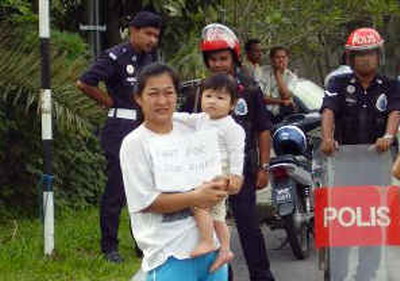
ABOVE: Ronnie Liu addressing the protesters present and BELOW: The silent protesters with the mini placard reading- "Fight for your Rights" under the watchful eyes of the FRU (Federal Riot Unit) personnel

MORE PICTURES TOLL HIKE Protest: SAMY is So KIND: NO Toll for LIFE So Toll increased By NOT Extending the Concession Period – Another Samy Spin From Venezula.

The new spin from Samy is NO TOLL FOR LIFE and he seems to be doing every motorist a BIG favor by approving the new rates. We cannot escape this spin of NO TOLL FOR LIFE, as one end and there will be another one to continue & follow.
There is another one coming - the DUKE (Duta Ulu Kelang Expressway) Highway (part elevated, now under construction) from Jalan Duta to Ampang – for another 35 years concessions
for HARIS ONN HUSSEIN – see previous post H E R E
The BIG Question here is: AFTER all the BAD deals in the current Toll agreements, WHAT is signed and agreed in this new DUKE Highway? The same skewed safety old clauses, so the NEXT generation will be tolled and and have to toil along these highways!
The government & the concessionaires are one and the same Gang working in cahoots (
questionable collaboration & in secret partnership) to rob the rakyat!
= = == = ==
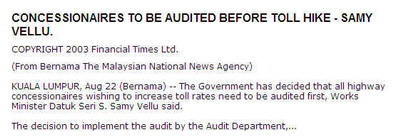
WAS THERE AN AUDIT Before the Hike?

Below is a 2003 report by Bernama that an AUDIT is necessary

= = = == = = = ==

from MALAYSIAKINI headline


ABOVE & BELOW: Another speaker voicing his anger at this enormous toll hike especially for LDP


Concession Period Will Not Be Extended, Says Samy Vellu; From Jamaluddin Muhammad; December 18, 2006 14:31 PM

ABOVE: SAMY ( & his Boss) in Caracas, Venezula after a fat dinner reception oblivious to the fuming anger of motorists back home, is doing us a favor - NO TOLL FOR LIFE - Believe it or NOT! by increasing the Toll Rates

CARACAS, Dec 18 (Bernama) -- The government could not spread the burden of imposing higher toll rates over a much longer toll concession period as it did not want toll collection to be a permanent feature in Malaysia, said Works Minister Datuk Seri S. Samy Vellu. He said the government had to put a limit on the extension of the toll concession period at between 30 and 35 years in order to avoid motorists from paying toll for life. If we allow the concession period to be extended to 60 years just to enable motorists to pay much lower toll rates now, it would result in motorists paying toll for life," he told reporters, here. Samy is here as part of a delegation of Prime Minister Datuk Seri Abdullah Ahmad Badawi's three-day official visit to Venezuela beginning Sunday. He was asked to comment on the possibility of imposing lesser toll charges with the extension of a much longer concession period following the recent announcement of toll hike of between 30 sen and RM1 for five highways starting Jan 1 next year.

The highways are the Lebuhraya Damansara-Puchong (LDP),
Shah Alam Highway, Cheras-Kajang Highway, KL-Karak Highway and the Guthrie Corridor Expressway. Samy said the government had to pay the toll concessionaires compensation in the form of cash and concession extensions as an option not to allow them to charge motorists higher toll rates according to the concession agreements. However, extending the concession period without any limit would not serve the interest of motorists as they would be paying toll for the rest of their life, he said.
He said motorists were no longer paying toll for the Jalan Kuching, Jalan Pahang, Jalan Cheras and Johor Baharu-Senai highway when their concession period ended.(…… This is NOT Correct SAMY, still spin by Bernama, see below ) He also said the government could not interfere with the concessionaire agreements with banks over the repayment period of 15 years for the loans to build the highways. "We simply cannot ask banks to extend the repayment period in order to avoid an increase in toll charges as it involves syndicated loans and it will affect the country's banking industry if loans are not paid within the stipulated time in the agreement," he said

= = = = = == = = == = = == = = == = = == = =

Samy’s ‘cheapest’ toll rates claim misleading ; Richard Teo; Dec 18, 06 4:08pm (from Malaysiakini letter)

Works Minister S Samy Vellu defends the coming steep rise in toll rates on grounds that Malaysia has the 'cheapest tolls in the world'. What the minister fails to add is that other countries’ citizens don’t pay road tax and their import duties and excise duties don’t reach to 100% to 200% levels depending on the models.

An average popular car like Toyota Vios cost US$10,000 (RM36,000) in America. In Malaysia, it costs almost RM90,000 - more than twice the value as in America. Naturally motorists in America don’t mind paying a higher toll rate since cars are cheaper. But in Malaysia, we are hit with a triple whammy - we pay road tax, road tolls and pay hefty import and excise duties on cars. When the American government builds their highways, the contracts are openly tendered and the whole process is transparent. All contracts, the terms and conditions of the highway contract agreements are opened for public scrutiny. When a contract of US$1 billion is given out, we can safely assume that it is a justifiable cost. On completion of the highway, the operator assumes the risk of a normal business venture. There is no such thing as a government guarantee that the highway toll collected will be profitable. Any loss would have to be borne by the operator and there is no such thing as compensation if the expected profit does not materialise. Can we say the same practice for our Malaysian highway construction? Here in Malaysia, highway contracts are given out without tender. Cost of a RM1 billion highway project is given at RM3 billion to companies dubiously connected to the ruling political party. Terms and agreement of the highway contract are so secretive that they come under the purview of the OSA (Official Secrets Act). Naturally, when inflated values are given to the actual cost of highways, the tendency is that toll rates are calculated based on the inflated rates. What should have been a RM1 collection becomes RM2 because of the inflated cost of the highway. The most ridiculous part of the whole highway contract agreement is that the government provides the operator with an iron-clad guarantee allowing them to increase the toll rates every few years. If toll rate increases are not given, the government gives an undertaking to compensate the operator to the extent of the amount loss in revenue. According to the works minister, an amount of RM2.5 billion was given as compensation to a concessionaire. This alone should create further suspicions as to whether the whole structure of the highway concession agreements was done in a fair and equitable manner. The minister should desist from comparing our toll rates with other countries especially when all other factors are not similar and equal. First and foremost, let us have a look at the highway concessionaire agreements to see if everything is above board. Then let the public judge whether the toll increase is justifiable.

= = = == = =

MORE QUESTIONS For SAMY,VV from Malaysiakinii

On Samy: If you want it, pay for it

Joey Chan: Samy Vellu, all I need you to do is to answer the following questions:

1. What is the annual collection from road taxes by the government? What is our annual collection from the duties on imported vehicles? What is our annual collection from excise duties on all vehicles? Then compare these with the annual road subsidies and maintenance of public roads.
2. In order to compare apples with apples, tell us what percentage of public roads in emerging markets (like
Thailand, Indonesia, Philippines, India and China) are toll roads. Then give us a comparison of the toll rates in such countries on a per km basis.
3. You say that the government cannot afford to continue to subsidise the tolls. Then why did your boss announce an extra RM600 million for Umno constituencies (to be used up in three months!), the RM400 million Istana project, the RM220 million Agricultural Expo project, the RM3 billion
Penang bridge project? These projects can either be delayed or downsized and the surplus funds be used to lessen the burden on the public. What is the reason for not doing it?

When you answer these questions, please look at us in the eye because we are not as dumb as the journalists you faced earlier this week.

Sharon: I'm deeply affected by the toll hike. I'm staying at Lagoon Perdana and I use the toll everyday to send my son to his babysitter. I pay RM3.20 for the toll everyday. Fuel prices have increase, and so are food prices but our salary remains the same.

The kindergarden itself is so expensive. Because of this, I'm scared to have another child (currently I have only one child). I hope all the society groups can fight this toll rise. I can’t take it anymore. My stomach is burning with fire when I think about how to survive and pay for this and that.
Dhammika: The government should immediately and completely remove the toll subsidy. It hurts more to stagger the increases. ‘Semi Value’ should stop comparing rates from other countries. This comparison cannot hold water. The country’s GDP must be taken into comparison as well as the respective strength of the various currencies.
Why must the ministers call a meeting with the editors to gag them from expressing the people’s views? Be more transparent and accountable in the administration of the rakyat’s money. Confiscate the assets and money of the corrupt few to pay for the toll. I hope the ACA will investigate the US$100 million commission paid for the purchase of submarines. Well, the list can go on...
Meng: Don’t complaint, just remember all this gross injustices and remember all the excesses, and the rich MPs and town councilors who squander and rob the people. When the BN government comes with all their sweeteners prior to elections and promises of projects, remember the racial remarks, remember the petrol hike, remember the toll hikes and most of all, remember the arrogant MP who says “if you want it, pay for it.
Who robbed the poor in Malaysia? Look at the auditor-general’s report where money supposed to be used for state development and the poor were channeled to office repairs, camera equipment etc. All this revelation has gone unchecked, and the ACA says it is hard to prosecute without evidence. The ACA should interview the auditor-general to find out about their claims.
The rakyat has one tool of evaluation and that is the ballot boxes
= = = = == = = == = = ==


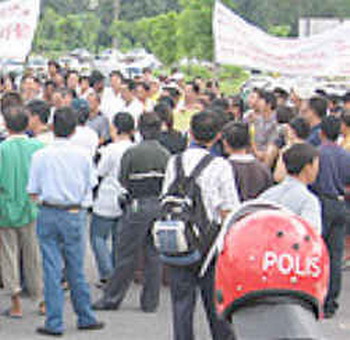
ABOVE & BELOW; The crowds were orderly and the FRU (Riot police) were there to make sure things do not get out of hand.
= = = = = = = == = == = == == = == = == = == =
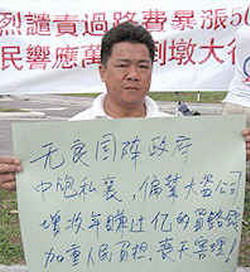
ABOVE: Protest Placard in chinese. Any translator can help? Give your version in the comments below

UPDATE: Dec 17 06: 22:45pm
MORE PICTURES & REPORT Of TOLL Hike PROTEST at Bandar Mahkota Cheras; 800 ANGRY Resident Backed by 4 MPS, 2 Assemblymen With Reps from PAS & Keadilan; BN Component parties MEMBERS “Too SHAMEFUL” to Attend

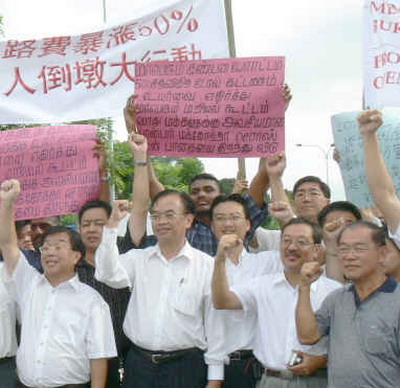
ABOVE & BELOW: The Dap supporters and leaders were predominant in the 1-1/2 hour protest with some nearby residients staying back until noon to watch

REPORT By Ronnie Lieu

More than 800 residents gathered at the peaceful protest organised by the Bandar Mahkota Cheras Open Access Road Action Committee(BMC-OARAC) today to say no the barricade and also to the toll hikes.
DAP sent its high-level delegation to lend support to the residents.They were 4 MPs from Kuala Lumpur (Dr Tan Seng Giaw, Fong Kui Lun, Tan Kok Wai, Teresa Kok) and 2 State assemblymen from Selangor (Teng Chang Khim and Ng Suee Lim), the Selangor Chiarman Ong Chee Keng and his committee members and leaders from DAP FT. DAP Veteran Club President Lau Dak Kee, former Kajang State Assemblyman Dr Abu Bakar of PAS and former Kajang candidate Lee Cheng Jin of Keadilan and some of their members were also there to give their support and solidarity to the residents. There is no sign of any leaders or members from Umno, MCA, Gerakan and MIC at the demonstration(any surprise?). They are too shameful to show their soiled faces supporting this toll hike and keeping quiet about it

ABOVE & BELOW: The symbolic push against the concrete barrier blocked by Grand Saga “illegally.... Satu, dua , tiga…tolak! From left: Kuan Perk Siong, Steven Chan, Tan Boon Wah, Fong Kui Lun, Tan Kok Wai, Thomas Goh, Teresa Kok;

= = = = == = = == = == = == = = == = =

BELOW: Dr Abu Bakar, Teng Chang Khim, Peter Tan, Ng Suee Lim
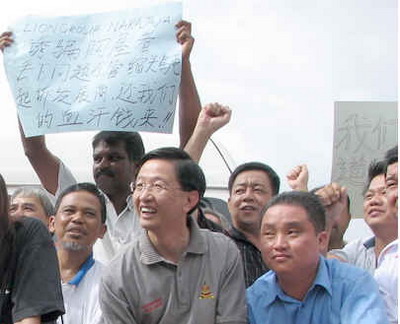

Tan Boon Wah, the Chairman of BMC-OARAC reiterated his strong objections to the barricade and the toll hikes before passing the microphone to DAP leaders. They each gave a short speech to express their undivided support to the residents.

In my speech, I expressed my great disappointment with the Umno-led BN Government for dragging their feet on the matter. We urge the Government to open the access road first and then holding all-party meetings ( between Malaysian Highway Authority(Government), The Lion Group(Developer) ,Grand Saga (Toll Company) and BMC-OARAC (Residents) to resolve the problem. They must not victimise the residents any longer.
I also highlighted the fact that the action commitee has brought the matter to the Parliament, the Minister of Works S. Samy Vellu, MPKj, LLM, The Lion Group and Grand Saga. Even the Prime Minister Department has received our memorandum. There are no more reasons for the Government to drag their feet on the matter.

The RM12 million access road was built by the developer with the approval from the LLM. It was blocked by Grand Saga “illegally”. There is dispute betwen Grand saga and The Lion Group on the question of compensation. Grand Saga is certainly an Umno-related company. But that does not mean that they can do what they want (like blocking the access illegally) without considering the interest of the rakyat. I said Grand Saga has done so illegally because they could not produce any document proof to show that they have the right to block the access during my last meeting with its director Zainal Abidin.

ABOVE: As usual the Police try to cut short the protest by cutting the speeches but eventually a compromise was reach to "make a hole" in the barricade by a bulldozer

Before the gathering was wrapped up, the committee and the police reached a compromise by allowing the bulldozer to knock a big hole right in front of the barricade (instead of pulling down the barricade) as a symbolic protest. The police was led by the new OCPD of Kajang DSP Rosli.

The crowd has agree to come back on 31 Dec 2006 to stage a protest at the 11th mile Grand Saga toll plaza at 10am. The protest will be joined by concerned citizens and representatatives from all opposition parties and NGOs.

Umno is the mother of all evils”.

= = == = == = =

The toll hike is tantamount to Robin Hood's reversed nobility - robbing the marginalised affordable (for cars) and helping the super rich cronies with the toll rights - protected by the skewed legalised agreements.
When things are legalised - it becomes unavoidable - "
something that cannot be avoided" - Abdullah or no choice - "have no choice but to go ahead" - Najib. See below their statements in response to queries from newsmen.

There will be a Toll Hike protest on Sunday (17th Dec 2006)- details below

Short is our memory, but long is the pain. Samy Vellu (above) boasted (STAR, Dec 15, see Below) “The Government has kept to its promise of stopping toll collections at sites where the concession agreements have ended He suffered severe memory lapse or his Ministry officials are “sleeping” on their records and cannot provide him with accurate information after 7 years.

Way back in 1999, when DAP formed the CAT (Coalation Againt Toll) in its media statement (see here); it stated (see below)

“one of the greatest injustices of the highway privatisation programme, the continued collection of the 50-sen toll at the Jalan Kuching toll plaza by Kamunting Corporation Bhd for more than three years although its nine-year concession had expired on January 8, 1996.

So don't believe him for sure.
= = == = =

December 15th, 2006 by ronnieliutiankhiew
Double jeopardy for BMC residents! First, their access road was blocked for months. And now, toll hikes for the Kajang-KL highway.
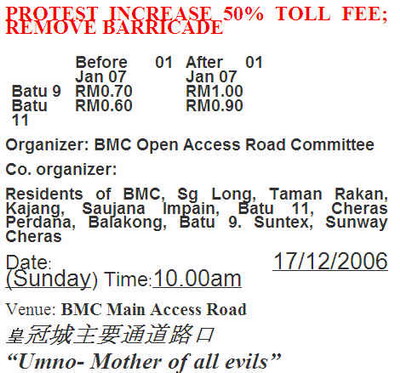
The Bandar Mahkota Cheras Open Access Road Action Committee has decided to hold a peaceful protest this Sunday morning to say no to the recent toll hikes and to free the access road. The Committee has started distributing a flyer as a notice to the public, inviting all to join the protest. See u there on Sunday!

= = = == = = = Background Bandar Mahkota Cheras Blockade

ABOVE: Ronnie Liu, 2 Dec 2006; Speech in Taman Indah Cheras Branch Dinner

On the case of Bandar Mahkota Cheras blockade, we have met the Director General of Malaysia Highway Authority (LLM) on last Thursday. We were disappointed with him as he has failed to organize the four-party meeting (between LLM, Developer Narajaya and Toll Concessionaire Grand Saga and the BMC action committee). Nevertheless, we have taken the opportunity to voice our disappointment and grievances to him for a better understanding of the episode. We even give him a VCD detailing the struggle of the action committee so far.

The action committee has met on Friday night and resolved that another two weeks will be given to LLM to fix a meeting of all relevant parties. Failing which, the residents will remove the blockade as we believed the barrier set up by the Grand Saga company was illegal. The residents will also demand the developer to pay compensation to the effected residents as the promise of a toll-free access road was stated clearly in their sales brochures and advertisements.

= = = = = = == = =

UMNO-Mother of all evils; December 15th, 2006 by ronnieliutiankhiew

Many Malaysians were furious when they learned that the BN Government has decided to allow the toll hikes up to 60% from 1 Dec 2007 for 5 different highways in the country inspite of the fact that these highways are making tonnes of money and most have recovered their building costs soon after several years of operations (like Gamuda of LDP and Grand Saga of Kajang-KL Highway).
And many Malaysians will blame S. Samy Vellu, thinking that he’s the only bad guy that stood for all the toll concessionaires.

But the mother of all evils is Umno.

Most (if not all) of these toll concessionires were owned by Umno or Umno-related companies. They obtained their concessions directly through the EPU of the Prime Minister Department ( not from the Works Ministry where Samy is the minister).
That explains why all agreements signed with these toll concessionaires were lopsided and totally against the interest of the people. Whether they make money or not, all of them were allowed to increase toll fees every three year, and each increase shall be no less than 20%. The Government even allows them to claim compensation if the traffic flow falls lower than the projected figures.

When they go bust (like the PD-Seremban Highway), the Government must rescue them by bailing out with taxpayers’ money. In the PD-Seremban case, the Government bought it back with a loss of more than RM142 million. The owner, Projek Lebuhraya Utara Selatan Bhd, is certainly an Umno company. When these companies are making money, they are allowed to keep all for Umno and its cronies. Ask PM Abdullah if you have doubts.

es. The mother of all evils is Umno. They are the beneficairies for most (if not all) of the 490 privitised projects throughout the country. None of these companies were owned by DAP, PAS or Keadilan. No use blaming Samy alone. He is serving Umno’s interest so that he can keep his job and the fat allowances and perks that come along with the position. The opposition parties and NGOs will hold at least one protest rally in the Klang Valley to express our disapproval. I will annouce the details in this blog. Hope to see you there in solidarity. But this is not a solution.
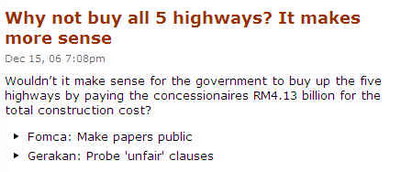
The Secretary General of DAP Lim Guan Eng (ABOVE)has suggested that the Government should buy back all the toll concessionaires at a cost of more than RM4 billion in order not to burden the people. It’s a brilliant idea but Umno would not listen.
The real solution is to kick out the mother of all evils in the coming general elections. There is no two ways about. And always remember that a vote for MCA/MIC/Gerakan is a vote for Umno. Period.
Kick out Umno. Do not bring in other issues like “Pas cannot be trusted”, “possibility of Anwar rejoining Umno” and “DAP is a Chinese party” to confuse ourselves.
Dear Malaysians, please wake up to the fact that Umno is the mother of all evils. Umno is the root of all the problems. If Umno lives, Malaysians will die. No?
= = = = = =

Government kept promise to stop tolls after deals ended

Friday December 15, 2006

KUALA LUMPUR: The Government has kept to its promise of stopping toll collections at sites where the concession agreements have ended. Samy Vellu: Says the next toll increase is in 2008. Works Minister Datuk Seri S. Samy Vellu said the Government had ceased collection in three places here and another in Johor. The toll plaza in Cheras was dismantled in September 2003 followed by the ones in Jalan Pahang and Jalan Kuching, while compensation of RM331.7mil was paid before the toll in Senai was closed in 2004, he said.

Samy Vellu (above) having Alzheimer? Where is your bargain??????? Remember Jalan Kuching under Kamunting!

"We've kept our bargain and closed the toll plazas after the expiry of the concession period," he told reporters yesterday. He said toll collection at the 17.5km point of the North Klang Straits Bypass linking Bukit Raja and Port Klang would cease in 2009. Samy Vellu said the next toll increase is scheduled for Jan 1, 2008. Among the highways scheduled to raise tolls are the Ampang-Kuala Lumpur Elevated
Highway, North-South Expressway, Elite, Kulim-Butterworth highway, Second Link in Johor, Seremban-Port Dickson Highway, North Klang Straits Expressway and the Penang Bridge.
____
from Background H I S T O R Y, 1999 - 7 years ago DAP Lim K S archive

Coalition Against Toll (CAT) calls on Malaysians to protest peacefully at the 100 toll plazas nation-wide on Sunday morning to show their seriousness in wanting the government to review unfair highway privatisation concessions and unfair toll rates
Media Statement by Lim Kit Siang (3/2/99)
(Petaling Jaya, Wednesday): The Coalition Against Toll (CAT) at its second meeting in Petaling Jaya last evening calls on Malaysians to protest peacefully at the 100 toll plazas nation-wide on Sunday morning to show their seriousness in wanting the government to review unfair highway privatisation concessions and unfair toll rates. This will be the second nation-wide peaceful protests by the people at the nation's toll plazas against unfair highway privatisation concessions and unfair tolls, the first being held at over 20 toll plazas last Sunday. The Coalition Against Toll meeting yesterday was attended by representatives from political parties and NGOs, including PAS, Parti Rakyat Malaysia, DAP, DAPSY, Wanita DAP, ADIL, ABIM, Perak Consumers' Association, Selangor
Consumers' Association, Selangor Chinese Assembly Hall Youth. The Coalition Against Toll reviewed last Sunday's first nation-wide toll plazas protest and urges all protestors to be at all times peaceful and civil, avoiding personal or character attacks against anyone in their placards, posters or utterances, and to remain united in their support for the CAT's demand for "Five Nos and Two Yes", namely:
No to Unfair Toll Rate Increase
No to Unfair New Toll
No to Government Compensation
No to Secret Concessions
No to Sell-Out of the People


Yes to Justice for Motorists
Yes to Justice For ALL


The CAT at its meeting yesterday also decided that the second nation-wide toll plazas protest on Sunday would focus on one of the greatest injustices of the highway privatisation programme, the continued collection of the 50-sen toll at the Jalan Kuching toll plaza by Kamunting Corporation Bhd for more than three years although its nine-year concession had expired on January 8, 1996. The protest against the unfair Jalan Kuching toll collection after its expiry in January 1996 will be held on Sunday at 9 a.m.. This is the time for all motorists who feel strongly about the injustice of having to pay 50 sen toll for over three years after the expiry of the concession in January 1996 to demand that Jalan Kuching should become toll free, especially as there had been no upgrading of roadworks whatsoever in the past three years. On 29th April 1996, Malaysians were shocked to read in the local press that Kamunting Corporation Bhd had been given permission by the Cabinet to continue to collect toll at Jalan Kuching for another six months although the concession ended on January 8 of the same year. The Works Minister, Datuk Seri S. Samy Vellu said that Kamunting Corporation Bhd might be granted a further extension to collect toll when the six-month extension ended on July 7, 1996 pending the consideration of the Economic Planning Unit (EPU) in the Prime Minister's Department on the future of Jalan Kuching. In July 1996, Samy Vellu announced that the Cabinet had on July 3, 1996 approved a 33-year concession to Syarikat Prestige that will entitle it to collect RM1 toll at Jalan Kuching when it completes a RM650 million underpass and road upgrading project. Samy Vellu said the RM650 million project also involved the setting up of another toll collection centre at Jalan Semantan, where motorists would have to pay either RM1.30 or RM1.60 to enter the city.

The road upgrading works for Jalan Kuching included adding two lanes to the existing four, constructing a tiered flyover over the Jalan Kuching and Jalan Segambut roundabout, and widening the two lanes on Jalan Ipoh. The underpass would connect the Jalan Semantan/Jalan Damansara interchange to the Jalan Ismail junction (Wisma Sime Darby area) via Wisma Tani, while another underpass would be built from Jalan Raja Muda to Jalan Tuanku Abdul Rahman to connect with the underpass at the Jalan Sultan Ismail junction. Gerakan, MCA and UMNO Ministers should speak up in Cabinet to demand a stop to the 50-sen toll collection at Jalan Kuching toll plaza as no work has been done in the past three years in the extension of the concession in exchange of the RM650 million underpass and road upgrading project. In fact, motorists are incensed that they are forced to continue to pay toll at Jalan Kuching for more than three years when the nine-year concession of Kamunting Corporation had ended on January 8, 1996 and they have been not been convinced that this is fair, just, proper and completely above-board.

= = = == = = =

December 15, 2006 22:11 PM

Toll Increase Unavoidable, Says Abdullah
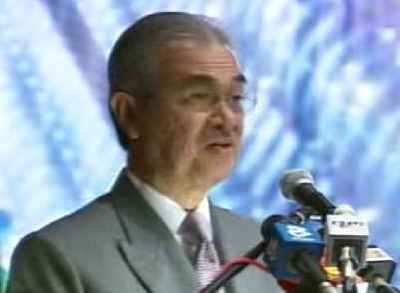
KUALA LUMPUR, Dec 15 (Bernama) -- Datuk Seri Abdullah Ahmad Badawi said the hike in toll rates for five expressways beginning Jan 1 is something that cannot be avoided and he hoped that the people understand and accept the increase. The Prime Minister said the government realised the additional burden borne by consumers, but emphasised that the government was still bearing the subsidy burden of RM2.6 billion after the increase. He said the increase was based on the concession agreement signed with the companies concerned. "It's certainly a heavy burden to raise the toll... that's why it was decided to share the burden. I hope the rakyat can understand," he said after opening the People's Progressive Party's (PPP) 53rd general assembly, here Friday.

As such, the Prime Minister hoped the rakyat would adopt several approaches to reduce their expenses following the latest increase in the toll. Asked on the concession mechanism which stipulated that the government must pay compensation if the concession company concerned suffered losses due to the shortfall in the toll collection, Abdullah said the problem could be in terms of the projected toll collection. He said the construction of tolled highways under the privatisation programme also benefited the consumers where they could avoid traffic jams which occurred in some neighbouring countries. The Prime Minister said that the construction of highways had resulted in land values in the vicinity of the highways going up and benefiting the people concerned besides promoting new growth centres in the area.

Toll Rates Increase Is Not A Matter Of Choice; December 15, 2006 18:24 PM

By Mohd Nasir Yusoff


JAKARTA, Dec 15 (Bernama) -- Datuk Seri Najib Tun Razak said that the increase in toll rates starting Jan 1 was not something that the government wanted to do as a matter of choice. The Deputy Prime Minister stressed that the government have no choice but to go ahead with the increase. "We (the government) have no choice but to go ahead (with the increase) but it has to be on the basis of sharing the burden," he told the Malaysian media. Najib who is on the second day of his four-day working visit here was asked to comment on the increase that was announced by Works Minister Datuk Seri S. Samy Vellu yesterday, which was received with resentment by the highway users. "This is not something that we wanted to do as a matter of choice. Important thing to understand is that to have world class infrastructure facilities, somebody has to pay for that. You cannot have quality highways but you're not willing to pay for it," Najib said. Najib said sharing the burden meant that the government would fork out a considerable amount of money which otherwise would have gone for development but have to be used to keep toll rates at the announced level.

He said if not for that, the toll rates increase could have been higher, citing as example, the Damansara-Puchong Highway toll rate would have been RM2.10 but instead it was fixed at RM1.60. He added that there was an earlier exercise which kept the toll rate at RM1 for much longer in 1999. "It is not that something which we (the government) pass on merrily to the people. We are mindful of the burden but the people too have to realise that world class infrastructure that we talk about so often doesn't come without a cost," he said.

[…]

= = = = = = =

Govt To Pay RM2.5 Bln Compensation To Highway Concessionaires; December 14, 2006 21:23 PM

KUALA LUMPUR, Dec 14 (Bernama) -- Despite the Government agreeing to increase toll charges at five highways from Jan 1 next year, it still has to fork out a hefty RM2.58 billion in compensation. Works Minister Datuk Seri S. Samy Vellu said the Government had to pay the compensation to the five highway concessionaires because the rates were not in accordance with the concession agreement signed by both parties. Samy Vellu today announced toll hikes in five highways -- Lebuhraya Damansara-Puchong, Lebuhraya Shah Alam, Lebuh Raya Cheras-Kajang, Lebuhraya KL-Karak and Lebuhraya Koridor Guthrie. "Even with the increase, we have to pay so much in compensation. We have to compensate the reduction in the toll rates we are collecting from the public... the Government has to pay the balance. "For LDP, for instance, the Government pays 50 sen for every car using the highway because according to the concession the new toll rate is supposed to be RM2.10 and not RM1.60 as we have announced," he said. Samy Vellu said going by the concession agreements the new toll rates for the five highways would be considerably higher than the rate fixed by the Government. He said the percentage toll increase for the LDP was 60 per cent, Lebuhraya Shah Alam (47 per cent), Lebuhraya Cheras-Kajang (43 per cent) (Batu 9) and 50 per cent (Batu 11), Leburaya KL-Karak (25 per cent) (Gombak) and 20 per cent (Bentong) and Lebuhraya Guthrie (40 per cent). Samy Vellu said the next toll hike would be in 2008 involving seven highways. They are Ampang-KL Elevated Highway, the North South Highway, Kulim-Butterworth Highway, Second Link, Seremban-Port Dickson Highway, North Klang Straits Highway and Penang Bridge. "Although we allow for toll hikes, we make sure the increase is not too high. We also pressure concessionaires to improve and upgrade facilities as localities developed and these costs are borne by toll operators. "At the LDP, we ask the concessionaire to build four new interchanges and an overhead bridge. They have built the facilities, so we can't complain much. They are doing their job," he said. Samy Vellu said toll rates in Malaysia were one of the lowest in the region, with 13.60 sen per km. The toll rate in the Philippines was 35.5 sen per km, Thailand 22.76 sen, China 27.62 sen and Indonesia 14.08 sen.

Works Ministry's Answers To FAQs On Toll Rates; December 14, 2006 19:24 PM

KUALA LUMPUR, Dec 14 (Bernama) -- Following are the Works Ministry's answers to frequently asked questions (FAQs) on toll rates and their increase.

1. Why is there a need to raise the toll rates for the five highways?

The toll rate increases for the five highways are provided for in the respective concession agreements. Nevertheless, the government has studied as to whether it can keep the toll rates at current levels or prevent awarding 100 per cent increases in the rates' review.

The study was done since Jan 2005, and it was found that the toll rate increases for the five highways must be given. The study covered the aspects of traffic volume, concessionaires' financial information and the loan repayments they needed to make for their borrowings to build the highways.

2. Why isn't compensation in the form of extending the concession period used? This method can help consumers as the toll rates will not be raised.

A 100 per cent compensation in the form of concession period extension cannot be given as it will create a cashflow deficit in the highway concessionaires' accounts. Furthermore, why should consumers be burdened with extended toll periods. Consumers should be aware that highway privatisations are done under the build, operate and transfer (BOT) method, whereby they (highways) will become government property when the concession periods end. Thereafter, there will be no toll charges for using them.

Therefore, the government needs to ensure that the concession periods are not be arbitrarily extended as this will be more burdensome for consumers despite the toll rates being kept reasonable levels.

3. Who determines the toll rate of a highway and its increases?

The Privatisation Committee of the Economic Planning Unit (EPU) in the Prime Minister's Department, comprising representatives from the Finance Ministry, Works Ministry, Attorney-General Chambers, Malaysian Highway Authority and relevant agencies will evaluate and assess all the information and data given to ensure the toll rates increases are not excessive.

4. There are perceptions that the concessionaires are already getting very high traffic volumes to ensure sufficient profits. Why does the toll rate still need to be raised?

From a general view, it looks like every highway has achieved its traffic volume targets, but in reality, it is the opposite. In the case of Damansara-Puchong Highway, the mean average is 20 per cent lower that the targetted numbers.

5. The targetted traffic volume used is very high and will never be achieved. The highway concessionaires may be using this to obtain toll rate increases or compensation if the rates are not revised?

The traffic volume targets given by the companies will be carefully evaluated and compared with that arrived at by the Road Planning Division of the Works Ministry. The most realistic one will be used by the EPU's Privatisation Committee for the next stage of negotiations.

6. Why not the government simply take over these highways and extend them as a free facility for the people?

Consumers must realise that highways are alternatives to existing roads. Why should the government take over an alternative to an existing road? In addition, the government will have to bear a very high cost to take over these highways.

Furthermore, the toll charges are only imposed on users of the highways. If users do not want to pay the toll, they can use the alternative roads. The government is also responsible to provide free infrastructure to the people.

Development of highways also involve many investors and they take huge risks whether the highways will be profitable or otherwise. If the government takes over the highways, it will give the administration a bad image. This will make investors lose their interest to invest in Malaysia, and subsequently, employment opportunities and economic growth in the country will not be generated.

7. The Highway Concession Agreement is said to be unfair and only benefits the concessionaire?

The government will ensure that the concession agreement will yield a win-win situation to both parties. All the terms in the agreement are studied and carefully reviewed by the Attorney-General's Chambers. Among the clauses attached is the Toll Review Mechanism. Under the mechanism, if the actual traffic volume is higher that the targetted volume, then the concession company may not receive any increase or only a partial increase in toll rates and the Government does not need to pay compensation.

8. Is the toll rate increase due to the hike in oil prices early this year?

No. The toll rate increase has nothing to do with the oil prices hike. It is provided for in the concession agreement, and it has been evaluated with care before being approved.

9. Why does the government refuse to continue to subsidise the toll? It can help reduce the burden on consumers.

Consumers must understand that it is better to use the money saved for developing other infrastructure that can benefit the people. Apart from that, it is also not fair for the government to be burdened with having to pay high compensations for alternative routes.

Every user of the highways must pay for the facilities in line with the users-pay concept.

10. Despite the high toll rates, traffic congestions still occur on highways.

Various measures have been taken by each concession company to ensure smooth driving on the highways. Sometimes traffic congestion cannot be avoided due to several factors peak-hour traffic, accidents or vehicles breaking down.

Nevertheless, if the congestion is due to the highway itself, the concession company will be directed to upgrade the infrastructure to improve traffic flow.

11. Are the toll rates imposed compatible with the service and comfort provided by these highways?

The Malaysian Highway Authority constantly monitors every highway to ensure that the concessionaire provides quality services and are appropriate to the toll rates they charge. Among the facilities provided are suraus, rest & service areas, emergency telephones and highway patrol teams. In addition, high-technology facilities like intelligent transportation systems are also provided for users' convenience.Therefore, it is only proper for users to consider these facilities and the comfort they obtain for every sen they pay for using tolled highways compared with the congestion and time wasted when using traditional roads.

12. Are the toll rates in Malaysia high compared to other countries?

The toll rates imposed in Malaysia are way lower than the rates charged by neighbouring countries. Furthermore, there are several routes in these countries where there are no alternative roads to tolled highways, which can be quite costly to use. The toll rates per kilometre in some of these countries are as follows:

The Philippines - 35.57 sen/km

Thailand - 22.76 sen/km

China - 27.62 sen/km

Indonesia - 14.80 sen/km

The factors that are considered in determining toll rates increases are:

i. The initial toll rates are not too high;

ii. The increases make sense and based on specific periods and not made too often; and

iii. The increases will not burden consumers but high enough for the concession companies to pay their monthly loans, operating and management costs.

Other aspects that the government has to consider before approving a toll rate increase:

i. The total amount of traffic using the highway, whether it meets the target or not;

ii. The increase will not burden consumers;

iii. The services and facilities provided justify the toll rate increase;

iv. The amount of compensation need to be paid by the government if it does not approve the increase in toll rate;

v. The government has sufficient funds to pay the compensation for not allowing toll rates to be raised; and

vi. If the allocation needed to pay compensation for not having the toll rates raised can be better used for other development projects that will yield more benefits to the people
= = = =

Check back, MORE pics will be loaded when available
Background to Bandar Makhota

Thursday, December 14, 2006

WHY THE TOLL HIKES? To Bail out the Privatised Companies - 11 Billion Wasted on 7 Companies; Revised the Concessions Agreement – Formca urged

For Latest TOLL HIKE Protest (21st Jan 07, Sun; at CHERAS) Go H E R E

On..MORE PICTURES & BRUTALITYANTI TOLL HIKE PROTEST on SUN:, Jan 21 07 Cheras Turned SOUR; 21 ARRESTED; 4 Injured Seeking Hospital Treatment; Detained includes-Tian Chua, Dr Hatta Rami & Ronnie Liu

= = == = ==

For the last Protest on 14 JAN 07; Go To H E R E on

MORE PICS – TOLL HIKE PROTEST - Gombak Toll Plaza -14 JAN 07; HUNDREDS PROTESTED Despite RAIN; Also Call on Government to LOWER Fuel Prices & Other Tariffs

= == = = == =

Check aslo the MOTHER OF ALL PROTEST: Bandar Sunway on 7th Jan 2007

Go H E R E

= = = == = == == = =


UPDATE: Dec 14 06; 18:50pm

Govt Announces Toll Rates Hike At Five Highways From Jan 1

KUALA LUMPUR, Dec 14 (Bernama) -- Toll rates at five highways in and around the Klang Valley will be raised between 30 sen and RM1, starting Jan 1 next year, Works Minister Datuk Seri S. Samy Vellu announced Thursday.

The five highways involved are Lebuhraya Damansara-Puchong (LDP), Lebuhraya Shah Alam, Lebuhraya Cheras-Kajang, Lebuhraya KL-Karak and Lebuhraya Koridor Guthrie. The new toll rates for LDP will be RM1.60, an increase of 60 sen, Lebuhraya Shah Alam -- RM2.20 (up 70 sen), Lebuhraya Cheras-Kajang -- RM1 (Batu 9) and 90 sen (Batu 11) (both 30 sen more), Lebuhraya KL-Karak -- RM5 (Gombak) (RM1 higher) and RM3 (Bentong) (50 sen more) and Lebuhraya Koridor Guthrie -- RM1.40 (up 40 sen). These rates are for cars classified as Class 1. The minister said if the government had allowed the five concessionaires to raise toll rates according to the concession agreement, then the burden on the consumers would have been much higher.
The LDP toll would have reached RM2.10, Lebuhraya Shah Alam (RM2.40), Lebuhraya Cheras-Kajang (RM1.20 -- Batu 9) (RM1.10 -- Batu 11) and Lebuhraya KL-Karak (RM8.80 -- Gombak) (RM3.70 -- Bentong). Starting Jan 1, the toll rates at the LDP, which was built at a cost of RM1.5 billion, will be RM3.60 for Class 2 vehicles, RM5.40 (Class 3), 90 sen (Class 4) and RM1.80 (Class 5).

Users of Lebuhraya Shah Alam, constructed at a cost of RM1.3 billion, would have to pay RM3.30 (Class 2), RM4.40 (Class 3), RM1.10 (Class 4) and RM1.70 (Class 5).

At the RM303 million Lebuhraya Cheras Kajang (Batu 9), consumers will have to fork out RM2 (Class 2 and 3), 50 sen (Class 4) and RM1 (Class 5). For the Batu 11 toll, users will be charged RM1.80 (Class 2 and 3), 50 sen (Class 4) and 90 sen (class 5).

At the Lebuhraya Koridor Guthrie, developed at a cost of RM862 million, users will pay RM2.80 (Class 2), RM4.20 (Class 3), 70 sen (Class 4) and RM1.40 (Class 5).

At the Gombak toll of the RM500 million Lebuhraya KL-Karak, motorists will pay RM10 (Class 2), RM15 (Class 3), RM2.50 (Class 4) and RM5 (Class 5). At the Bentong toll of the same highway, they will have to pay RM6 (Class 2), RM9 (Class 3), RM1.50 (Class 4) and RM3 (Class 5).

Class 1 is for cars, Class 2 for lorries below one tonne, Class 3 for big lorries and trailers, Class 4 for taxis, and Class 5 for buses.

ABOVE & BELOW: One of the "legalised EXTORTION SITE" that confronts you if you happen to pass this stretch daily

To increase toll or continue to subsidize that is the question. And the government opted to reduce the subsidy? WHY? It has no more money. All the extra for subsidy has been used (RM 11 Billion to be precise) and the details are given in a reply in the Dewan Raykat to bail out (or rescue a better term) the 7 companies (see below)

The alternative is to revise the skewed concession agreement as called by FORMCA (see below) but the companies would not budge. As argued they can forced the IPPs to do so with TNB, why not here. Is the government so impotent?

If the toll is to be allowed, then at least reduce the petrol prices as the drop in World Crude oil prices since middle of year has saved the government RM717 Million (see below). It should continue to subsidize the toll rates and reduce the rakyat’s burden.

= = = = = =

at the NPE - New Pantai Express way
The Road Builders built, maintain & collect Toll on this stretch, the boss (ABOVE) explained the TOLL EXTORTION clause: "Toll agreement has already been built into the concession agreetment. What the private sector asking is NOTHING new; the toll is already in the agreement. If the government does not agree to it, they HAVE to pay the compensation" BELOW: RM71 Million from toll in 2006 & MORE in 2007

= = = == = = = == = = == = = == = = == = = =
ABOVE & BELOW: The NPE- one of the most expensive tolled highway about 15km that links Subang Jaya (Bandar Sunway to Bangsar (RM1.60) and further to Sungei Besi or near Mega Mall (another RM1.60)
i.e. RM3.20 from KL to SJ

Malaysia road tolls to rise by up to 60 pct(Update 1)Updated : 13-12-2006 Media : Reuters; Story By : Jalil Hamid

KUALA LUMPUR, Dec 13 (Reuters) - Malaysia will announce on Thursday a sharp
rise in road toll rates to help trim state subsidies,
a source said on Wednesday, in a move that could spark a public outcry and raise inflation. Tolls will go up by as much as 60 percent and will affect users of five highways in and around the capital, Kuala Lumpur, said the source, who attended an official briefing on the matter. "The new rates take effect on Jan. 1," the source, who declined to be identified, told Reuters. "That's our New Year present." A spokesman for the Works Minister confirmed that an announcement would be made at a news conference at 3.15 p.m. (0715 GMT) on Thursday. He declined to give details.

Under toll concession agreements that critics say favour operators, the government has to reimburse operators if traffic volumes and revenues fall short of pre-agreed projections. Most of the highways were approved in the 1990s by the administration of then Prime Minister Mahathir Mohamad, which made privatisation and mega-projects one of its hallmarks. Works Minister S. Samy Vellu said recently the government would have to fork out 2 billion ringgit ($565 million) in compensation to five highway operators if toll rates were not revised. The operators include listed firms Gamuda Bhd (GAMU.KL: Quote, Profile , Research) and Lingkaran Trans Kota Holdings Bhd (LTKH.KL: Quote, Profile , Research).

Litrak operates the 40 km Damansara-Puchong highway, where the toll is to rise 60 percent, to 1.60 ringgit from 1 ringgit now, the source said. "The real toll is 2.10 ringgit, so the government is still subsidising 50 sen for each user," the source said. Residents along the densely populated stretch had protested strongly against an initial proposal to levy a toll of 1.50 ringgit, forcing the government to fix it at 1 ringgit. Some 418,000 vehicles used the highway daily on average, reflecting a 14.5 percent compounded annual growth rate for the past seven years, rating firm RAM said in a review of Litrak. Government officials told the briefing that one reason for the shortfall in toll collection was due to motorists switching to alternative non-toll roads, the source said.

The toll hikes, however, will not apply to Malaysia's biggest toll-road firm, Projek Lebuhraya Utara-Selatan (PLUS) (PLUE.KL: Quote, Profile , Research), a PLUS spokeswoman said. PLUS' rate increase is fixed at 10 percent every three years and the next increase is not due until January 2008. Malaysia's annual inflation was 3.1 percent in October year-on-year, down from a 7-year-high of 4.8 percent in March.____

Govt Spends RM11 Bln To Rescue Privatised Companies; December 13, 2006 18:17 PM

KUALA LUMPUR, Dec 13 (Bernama) -- The government has spent RM11 billion to take over seven companies saddled with management and financial problems after they were privatised. However, the number was small compared to about 490 companies which were successfully privatised since 1983, said Deputy Minister in the Prime Minister's Department Senator Datuk Abdul Rahman Suliman. The companies taken over by the government were Sistem Transit Aliran Ringan Sdn Bhd (Star LRT), Projek Usahasama Transit Automatik Sdn Bhd (Putra LRT), Malaysia Airlines (MAS), Sistem Pembentungan Negara Sdn Bhd, Muslim Goods and Food Analysis Unit (MGFA), the rehabilitation of abandoned Kuching Prison, and the Seremban-Port Dickson Highway Sdn Bhd, he said when responding to a question from Datuk Ismail Sabri Yaakob (BN-Bera) in the Dewan Rakyat, Wednesday. He said Star LRT and Putra LRT were taken over by Syarikat Prasarana Negara Berhad (SPNB) at a cost of RM3.3 billion and RM4.5 billion respectively, while the construction of Kuching Prison by the Public Works Department cost RM135 million. The Seremban-Port Dickson Highway was taken over by Projek Lebuhraya Utara-Selatan (PLUS) at a cost of RM142 million and MGFA was reinstated by the Malaysia Islamic Development Department at a cost of RM8.3 million, he said. He said Sistem Pembentungan Negara was taken over by the Finance Ministry Incorporated at a cost of RM192 million and the entire equity held by the concessionaire, Indah Water Konsortium Sdn Bhd. Abdul Rahman said the government's decision on privatisation hinged on two aspects, that they were viable and benefited the people.
= = = = = = = =

Govt Petroleum Subsidy Burden Declines Since August; December 13, 2006 19:02 PM

KUALA LUMPUR, Dec 13 (Bernama) -- The government's subsidy on petroleum products has declined since last August following the drop in world crude oil prices in the middle of this year, said Finance Ministry Parliamentary Secretary Datuk Seri Dr Hilmi Yahaya. He said the government managed to save RM65.35 million from the total subsidy of RM996.97 million last August, and RM493.47 million from the total subsidy of RM503.5 million last September. "For October, the total subsidy was RM346.12 million and the government managed to save RM158.38 million, and in November it saved RM38.28 million from the total subsidy of RM307.84 million," he said when replying to a question from Senator Dr K.N. Raja Ram at the Dewan Negara, here Wednesday. "However, the decision to increase or decrease the prices of petrol and diesel next year hinges on the world crude oil prices in the world market in 2007. "This is because despite the decline in world crude oil prices, the government has to pay subsidies on petroleum products to keep their prices at current levels, he said. Meanwhile, Home Ministry Parliamentary Secretary Datuk Paduka Abdul Rahman Ibrahim, when replying to a supplementary question from Senator Gooi Hoe Hin, said locals were given priority in the recruitment of workers. He said most of the foreign workers were engaged in sectors categorised as dangerous, difficult and dirty or the '3Ds' which the locals were not fond of. He said the ministry had taken various measures to ensure the bulk of the employment were filled by Malaysians in stages. "For example, locals are not interested in employment in plantations and interior areas where there are no electricity and running water, so we have to use foreign labour. "But in other fields, if possible, we impose conditions on employers to give priority to locals," he said.

= = = = = = = = = =Background; The warning was already given with much details TWO weeks ago when...

Five highways to charge new rates from Jan 1; Tuesday November 28, 2006; STAR

KUALA LUMPUR: Toll rates will be increased for five concessionaires come Jan 1, 2007, according to Works Minister Datuk Seri S. Samy Vellu. He said the Government could not afford to compensate the concessionaires for the Guthrie Corridor Expressway,

Works Minister Datuk Seri S. Samy Vellu.: "We cannot pay another 2 Billion as compensation. Everytime we pay compensation after compensation, nobody say "Thank you'"

Karak Highway, Grand Saga Cheras-Kajang Highway, Lebuhraya Damansara Puchong (LDP) and Kesas Shah Alam Highway the estimated RM2bil, if no increase was approved during this round of concession agreements. It is understood that this is how much the Government will have to fork out until the concession agreements lapse. Citing an example, Samy Vellu said the original toll rate when the LDP first opened was RM1.50.

“But because of complaints by the people, it was reduced to RM1. Just because the toll was reduced, it did not mean the balance of 50 sen did not have to be paid,” he said, adding that the Government had to compensate the LDP concessionaire RM68mil last year and RM76mil this year. Samy Vellu said the quantum of increase would only be finalised after a study by the ministry to make sure the increase was reasonable and would not burden the public.


The last toll increase was on Jan 1, 2005, when Plus Expressways increased toll rates by 10% on the North-South Expressway. In April 2002, Kesas highway also raised its rates by between 20 sen and 60 sen. Samy Vellu added that as a matter of policy, the Government would also ensure that if there were two different concessionaires operating on similar routes their toll rates would be identical. Meanwhile, in Petaling Jaya, Pan Malaysian Bus Operators Association president Datuk Ashfar Ali said he hoped that the increase would not apply to buses. “We cannot afford to absorb an increase. We hope that if the increase does apply to buses, then the Government will allow us to pass on the charges to passengers, as allowed for taxis. Pan Malaysia Lorry Operators Association president Er Sui See said if the lorry operators were burdened the increase would be passed on to customer. On another matter, Samy Vellu said the proposal for the 216km West Coast Highway was withdrawn by the Economic Planning Unit (EPU) at the last Cabinet meeting. He added that if the Government had carried out the project earlier, it would have been much cheaper, instead of the estimated cost of RM3bil now. Samy Vellu also said he would ask the Cabinet to stop issuing licences for Class F contractors because too many of them were dormant.

= = = = = = =UPDATE: 28 Nov 06; 21:55pm

Fomca Urges Govt To Review Toll Concession Agreement; Update: Nov 28 06, 21:50pm

By Mohsin Taib; KUALA LUMPUR, Nov 28 (Bernama) -- The Federation of Malaysian Consumers Associations (Fomca) has urged the government to review the agreements on toll concessions describing them as "one sided" and a burden to the people. Secretary General Mohd Shaani Abdullah said since the government through Tenaga Nasional Bhd could review the contract with the independent power producers (IPPs), the same thing should be done to the toll concession agreements. "If the contract with IPPs can be reviewed, why can't it be done to the companies awarded the toll concessions," he told Bernama here Tuesday. Mohd Shaani was commenting on a statement by Works Minister Datuk Seri S. Samy Vellu on Monday that the five concession companies in the Klang Valley have been allowed to increase toll charges starting Jan 1. The five concessionaires are those operating the Damansara-Puchong Highway (LDP), Guthrie Corridor Expressway (GCE), Shah Alam Highway (KESAS), Kuala Lumpur-Karak Highway and the Grand Saga Cheras Highway. Samy Vellu said the increase was aimed at removing some of the RM2 billion subsidy borne by the government. Mohd Shaani said the concession agreements should be reviewed as the companies had collected huge profits due to the high volume of traffic that way surpassed earlier projections. He added the huge profits and high traffic volume were good reasons for the government to call for a review or at least ask for discounts from the companies. "The Minister said the toll increase cannot be avoided. Fomca wants to know why wasn't this thought of before signing the agreements," he added.


Wednesday, December 13, 2006

MORE PICS – RAPIST & MURDERER HANAFI’s Final APPEAL DISMISSED – NO EMOTION, SMILING When Led Away & His “Flying-Kick” to Press Cameramen

“a case of sexual assault, the assailant would normally hold the victim’s neck” – pleaded the lawyer

Now, why not just hold the arms than choke her at the throat? The motive was to "silence" her after the rape, ie. to kill her off.

Murder of Noor Suzaily Mukhtar: Court confirms gallows for driver;
13 Dec 2006; A. Hafiz Yatim, NST

ABOVE: The smiling without remorse man being led away and BELOW : a violent man has to be restrained by TWO hancuffs. His last resort is to apply for a royal pardon and rightly should be denied

PUTRAJAYA: Murder convict Hanafi Mat Hassan showed no emotion when the Federal Court unanimously dismissed his appeal and upheld his death sentence. Yet, the former Kiara Express bus driver put up a different show when he was led outside the court after the judgment.

ABOVE: Showing his anger at the press photographers, he exercised his "flying kick" and was restrained for a 2nd one (BELOW)


He tried to kick Press photographers. Hanafi, 38, who had both his hands handcuffed to two Prisons Department officers, lunged forward at the photographers and kicked the hand of New Straits Times photographer Muhaizan Yahya who was about to take his picture. Muhaizan lost his balance momentarily but he was not injured. Earlier, when Hanafi arrived in court wearing a grey-checked shirt he tried to kick a Bernama photographer but missed him. The Federal Court, comprising a five-member Bench, rejected Hanafi’s appeal against conviction and sentence.

ABOVE: She took this empty bus on the morning to work and was taken for a ride by this lusty driver (whose wife was expecting at that time) to a loney spot where both crimes were comitted. BELOW, the spot where her naked body was dumped on. Luckily , the security guard saw the body & remembered the bus and the culprit was traced

He was found guilty of murdering Noor Suzaily Mukhtar, 24, (BELOW) a computer engineer, at the Taman Bukit Tinggi construction site near Lorong Pegaga, Taman Chi Liung, Klang, between 8.50am and 9.15am on Oct 7, 2000.


Hanafi, of Kampung Renik, Bachok, Kelantan, was also found guilty of raping the victim at the same place and time. He was sentenced to death for the murder and jailed 20 years and ordered to be given 12 strokes for the rape.

Appeal Judge, Datuk Abdul Hamid Mohamad, who headed the panel, said the court took some time to study the appeal records. "After deliberating on the matter, we reached a unanimous decision to dismiss the appeal and uphold both convictions and sentences," he said in an oral judgment. "There are also no questions of law in this case. The court will not be making any written judgment." Besides Abdul Hamid, the other Federal Court judges were Datuk Alauddin Mohd Sheriff, Datuk Ariffin Zakaria, Datuk Abdul Aziz Mohamad and Datuk Azmel Ma’amor.

With this judgment, Hanafi has exhausted his legal avenues. His last resort is to apply for a royal pardon. Despite the whipping sentence for rape being affirmed by the Federal Court, it is unlikely that the strokes will be implemented. Under Section 289 of the Criminal Procedure Code, a person who is facing the gallows shall not be whipped. Hanafi was immediately taken to the Sungai Buloh prison where he had been serving his jail sentence. Counsel Hamid Sultan Abu Backer was assigned by the Federal Court to represent Hanafi in the appeal. Deputy public prosecutors Mohamad Hanafiah Zakaria and Ishak Mohd Yusof represented the respondents. Hamid Sultan, in his submissions on Monday, appealed that Hanafi’s murder charge be reduced to culpable homicide as there was a possibility that Noor Suzaily’s death may have been accidental. He said in a case of sexual assault, the assailant would normally hold the victim’s neck."This is the normal thing to do, and there is a possibility that during the assault the victim’s struggle may have led or caused her own death," he said.

"In the absence of evidence as to what happened, it would be wrong for the court and the prosecution to assume Hanafi had a motive to murder her. Any murder charge requires a motive but this was not proven by the prosecution throughout the trial." Hamid Sultan submitted that an 18-year-old youth, A. Devan, saw Noor Suzaily topless in the bus crying for help and this showed that the victim had been raped and that she was still alive then. "Similarly, Devan also testified that he saw Hanafi pulling up his pants when he was at the bus driver’s seat, and there is only one inference that could be made, that Hanafi had committed rape," he said. Hamid Sultan said pathologist Dr Abdul Halim Mansar also testified there were two fresh hymen tears on the victim, and there was blood oozing from her vagina showing the victim was raped before she died. He also said that the DNA analysis confirmed the seminal stains belonged to Hanafi.

= = = = == = = =
Fire of anger still burns in them; 13 Dec 2006 NST

KANGAR: Her bedroom is almost as she left it six years ago, except that her parents have added a glass display cabinet. It contains Noor Suzaily Mukhtar’s prized possessions — her collection of soft toys, and the Queen Anne silver serving dishes she had bought to use at her wedding. Her parents now sleep there, because they feel closer to their murdered 24-year-old daughter there.

But the pictures of "Suzy" that once hung in the sitting room of the single-storey terraced house in Taman Suraini here are all packed away, except for the one of her and her fiance she kept in her room.

Her parents, Mukhtar Ibrahim, 61, and 57-year-old Harison Husain (ABOVE) said they put away her photographs during the funeral and just didn’t have the heart to put them up again. Yesterday, all the pain of their loss was re-awakened with the news that 38-year-old Kiara Express bus driver Hanafi Mat Hassan, the man who raped and murdered their daughter, had again lost his appeal against the death sentence. The Federal Court upheld the decision made by the Shah Alam High Court in 2002. The couple is satisfied with the decision. They wanted justice for their only daughter. "I could never find it in my heart to ever forgive that man. He is worse than an animal. He killed my daughter and threw away her body without a single thread of clothing on her. My heart still burns with anger. I will only feel at peace when the sentence is carried out. I hope it will be soon. We’ve waited long enough," said Mukhtar. Harison said her family feared for her sanity in the months after her daughter’s death. She and her husband also have three sons aged 22 to 32 and five grandchildren. "I still dream about her. If she was still alive, Suzy would’ve been 30 this year, and maybe the mother of several children," she said. The couple also expressed their gratitude to the judges, investigators, prosecutors and all those who had helped in the case. "We also want to thank everyone who prayed for us and ympathised with us," Harison said.

Mum wants to apologise to victim's family; 13 Dec 2006; NST

BACHOK: She cuts a forlorn figure sitting near the window of her decrepit wooden home in Kampung Renik. Her health is gone - she cannot walk, and her joints ache all the time. If there is one more thing she wants to do in her life, Hanafi Mat Hassan’s 80-year-old mother wants to meet Noor Suzaily’s family and apologise to them for her son’s terrible deed. "I want to beg for forgiveness. I am sorry, on behalf of him. I regret what happened. If possible, I would like to meet them (Noor Suzaily’s family), but my health wouldn’t allow it," said Mesah Said. Yesterday, the Federal Court upheld Hanafi’s death sentence for the rape and murder six years ago of the 24-year-old computer engineer. Hanafi is the seventh of her eight children. She hasn’t seen him since he was sentenced in 2002.

ABOVE: The condemned man in 2002, with a bit more weight than now

When told that her son’s sentence was upheld, all she could say was: "Well... I can’t do anything about it. I am sad but no one is above the law."

MORE PICS – MAFIA-STYLE KILLING OF DRUG PEDDLER in PENANG MALAYSIA. Shot 3 Times in Head in Car Which Accelerated And Rammed Into House

Three shots, then c-r-a-s-h ;BY BERNARD SEE; STAR, PENANG: Three gun shots and a crashing sound of a car that had rammed into a double-storey terraced house, shattered the afternoon calm of a suburban middle-class housing area here. Slumped across the steering wheel of the Nissan Sentra in front of the house in Changkat Tembaga at 2.30pm yesterday was Lau Khoon Beng, (BELOW) with bullet holes in his head.

He had been shot thrice at close range. Had spent time at the Simpang Renggam rehabilitation centre. The 34-year-old driver had been arrested at various times for drug offences and was believed to be a victim of a Mafia-style killing. He was believed to have earlier stopped his car by the side of the road to talk to someone known to him. Forensic pathologist Datuk Dr Bhupinder Singh said, based on the evidence found at the scene, the victim died on the spot. After Lau was shot, his body slumped across the steering wheel and his foot pressed on the fuel pedal, causing the car to accelerate suddenly and ram into the house.

ABOVE & BELOW: A Car when highly accelerated will move at high speed and when blocked would "climb" up ny obstacle befaore stalling when the clutch is released.


The impact of the crash was so great that both the car’s airbags were activated. A tenant of the house briefly came out and ordered an Indonesian maid outside to quickly get back indoors. The police later called a tow truck to remove the car. Residents interviewed said they at first thought that the car driver was an accident victim – until they saw the bullet holes on the side of his head.

ABOVE: Camermen comparing and reviewing their shots and (BELOW) the usual crowd and policemen at a crime scene

George Town OCPD Asst Comm Azam Abd Hamid told reporters here that a police team from the Jelutong station who rushed to the scene found Lau already dead. The case has been classified as murder. “Police found five packets of syabu (methamphetamine crystals) in the glove compartment,” he said. Dr Bhupinder scouring for evidence in the area outside Lau’s crashed Nissan Sentra at Changkat Tembaga. Lau died after being shot thrice in the head.

We also found two 9mm calibre spent shells and a false number plate in the car.(ABOVE)
“Our checks showed that the vehicle was registered to the victim. We believe that the ‘hit’ was drug related.” He said Lau had spent time at the Simpang Renggam rehabilitation centre in Johor in 1994 and 1996 under the Special Preventive Laws for drug trafficking. He said police checked out the Rifle Range address stated on his identity card, but were told that no such person lived there. Those with information can call him at 012-6802000 or the investigating officer at 04-2292222 ext 1845.


ABOVE & BELOW: The blood stained body being carted away for a post-mortem at the hospital to ascertain the cause of death

= = = = = = = = = =

Ex-detainee killed gangland style; 13 Dec 2006; Adie Suri Zulkefli, from NST

GEORGE TOWN: A former Simpang Renggam detainee was gunned down gangland style here yesterday over an apparent mess-up in a drug deal. Lau Khoon Beng, 34, was found slumped behind the wheel of his car at Changkat Tembaga after being shot by a lone gunman at point-blank range at 2.30pm. It is learnt that the assailant had fired at least three shots from close range, two of which struck Lau’s right temple and neck.

Police did not rule out the possibility that the deceased had tried to speed off after being shot at but ended up crashing into the concrete fence of a house, about 35 metres away from where he was shot. Police later found two 9mm bullet shells in his car and two red envelopes containing five small packets of syabu in the glove compartment. They also found a set of forged registration plates inside the car. They are checking if Lau had used the registration plates while delivering dadah to his clients. Police are also investigating the possibility of Lau waiting for his potential client to turn up only to be shot dead by his assailant. North-east district police chief Assistant Commissioner Azam Abdul Hamid said Lau was detained at Simpang Renggam for dadah-related offences in 1994. He was released in 1996 but was arrested again a few months later and then sent to the detention centre for committing the same offence. "We believe he was killed over a dadah deal but we are also looking at other possibilities," he said. Azam urged those with information related to the case to contact Assistant Superintendent Ibrahim Ahmad at 04-2292222. The New Straits Times learnt that Lau had ventured into money-lending activities several years ago as a front for his dadah-related business. However, Lau was believed to have angered one of his clients for failing to supply the stuff up to his client’s expectations.

His wife, who declined to be named, confirmed that Lau was involved in money-lending activities but refused to say anything when asked on his involvement with drugs. "All I know is that he was doing money-lending business," she said when met at the Penang Hospital mortuary.

BLOOMBERG Interviews ABDULLAH; General Elections Can Wait: PRIORITY – Fights Graft & Ensure Stability; HAPPY with Achievements So Far, But Lopsided GA

Interviews ABDULLAH at his home in Putrajaya

When "the pot of rice" is smashed, other bowls are quickly offered to him. So there is no worry fo Khairy. When Abdullah mentioned about the "Gaps" everywhere in the lopsided developments, these gaps are serious and look at the extreme end, they represented also the "leakages" that go with all the development projects. If these can be plugged or reduce to the minimum, then they would be more cost effective and successful.

Abdullah Says Malaysian Polls Can Wait, Targets Graft(Update 1)

Updated : 12-12-2006 Media : Bloomberg; Story By : Stephanie Phang and Angus Whitley (Adds size of party, population in the 11th paragraph.)

Dec. 12 (Bloomberg) -- Malaysian Prime Minister Abdullah Ahmad Badawi said he probably won't hold an election before 2008, giving himself more time to battle corruption and bolster political stability before testing his support. ``Next year is too early,'' Abdullah, 67, said in an interview at his home in Putrajaya, south of Kuala Lumpur. ``I have to prove that a lot of things can be done and have been done and we have succeeded.'' Abdullah, who must seek a fresh mandate by early 2009, said it's ``not easy'' to stamp out graft, which he called ``cancerous.''

Too few criminals end up in court even as the government investigates a ``very high'' number of cases, he said. Abdullah may lose support at the next election, former premier Mahathir Mohamad said in October. Analysts say fuel price increases have eaten into incomes, pushing many into corruption. Before a poll, the premier may also have to mend relations in his ethnic coalition, where pro-Malay speeches by some leaders have stoked tensions with Chinese counterparts. ``How can he go to elections?'' said Shamsul Amri Baharuddin, director of the Institute of the Malay World and Civilization at the University of Malaysia.

``Basic economic issues could be decisive for urban voters who are really suffering. That has made a lot of people more corrupt.'' Not Happening Abdullah said he's bolstered his team of investigators and warned officials of the dangers of taking bribes.

Malaysia fell to 44th in the 2006 Corruption Perceptions Index from 39th last year, Transparency International said last month. ``We are doing as much as we can,'' Abdullah said in the Dec. 8 interview. ``If the perception goes on the basis of how many people we drag to court and gain a conviction, of course it doesn't seem to be happening.'' An independent inquiry ordered by Abdullah last year found ``corruption in the royal police force that permeates all levels of the organization.'' Abdullah came to power in October 2003 and led the Barisan Nasional coalition to a landslide election victory in March 2004. He's banking that his five-year 200 billion-ringgit ($56 billion) plan to improve education and health care, and build roads, ports and houses across the country will fuel economic expansion. To deliver growth, Abdullah said he needs a sound racial and political platform. Yet ex-Prime Minister Mahathir, who picked Abdullah as his successor, in October accused him of achieving nothing since taking over, and last month's meeting of Abdullah's party, the United Malays National Organisation, strained ties within Barisan Nasional.

`Uneasiness'
UMNO, as the 60-year-old party is known, has more than 3 million members and is the biggest political group in Barisan Nasional. Malaysia's population is about 27 million. Hishammuddin Hussein, head of UMNO's youth wing, said in his assembly speech the position of the ethnic Malay majority shouldn't be challenged and brandished a keris, a traditional Malay dagger. The Malaysian Chinese Association, part of Barisan Nasional, said the act created ``uneasiness'' among other races. ``I'm equally concerned'' about race relations, Abdullah said in the interview. ``I know the consequences of race problems and racial tensions, on the economy, on the social development, even on our future.'' Clashes between Malays, who make up about 60 percent of the population, and ethnic Chinese in 1969 left hundreds dead on the streets of Kuala Lumpur. Two years later, the government introduced the New Economic Policy to give ethnic Malays privileged access to housing, education, jobs and company shares.

`Positive Sentiment'
Malaysia risks a return to racial unrest if the affirmative action policies are scrapped, Mahathir said in an Oct. 9 interview. Mahathir ruled Malaysia from 1981 to 2003.
Critics of the program say it drags on productivity and impedes competition. Under Abdullah, economic growth in Southeast Asia's third-biggest economy accelerated to 7.2 percent in 2004, then slowed to 5.2 percent in 2005. Still, Abdullah's policies are good enough for many investors. The Kuala Lumpur Stock Exchange Composite Index has jumped 23 percent this year, outpacing 14 out of 18 key indexes worldwide tracked by Bloomberg. ``We have more in Malaysia than we've had for quite a few years,'' said

Anders Damgaard, who helps oversee $500 million of assets, including $35 million in Malaysian securities, at Sydinvest Asset Management in Aabenraa, Denmark. ``There seems to be a positive sentiment towards Malaysia.'' The government has said expansion this year may beat its 5.8 percent forecast. Abdullah said growth in 2007 will be ``not too far away'' from the 6 percent target.

`Wild Card'
That's ambitious, say some analysts. The economy grew 5.8 percent in the three months to Sept. 30, the worst performance in three quarters. Slowing growth in the U.S., Malaysia's biggest trading partner, may next year damp demand for computer chips and other Asian-made goods. ``The wild card is how the export sector will perform,'' said Lee Heng Guie, chief economist at CIMB Securities Sdn. in Kuala Lumpur, who expects the economy to grow 5.6 percent in 2007. Abdullah ``is building the foundation for stronger growth'' beyond 2010, he said. Malaysia aims to be a developed nation by 2020. Asked if he'll run for a second term, Abdullah said, ``We'll see. Why not?''

No Rate Cut
Abdullah must dissolve Parliament by May 17, 2009, in preparation for an election, or it will happen automatically on that date, according to the election commission. After Parliament is dissolved, an election must be held within 60 days. Living costs have increased in Malaysia after the government raised fuel prices in February, the fifth time since May 2004, and state-controlled Tenaga Nasional Bhd. was allowed to raise power prices in June by 12 percent, its first rate increase in nine years. Still, the prime minister ruled out cutting interest rates to encourage growth. ``No, no, no,'' he said. ``We are not planning on that at the moment.'' He said he won't cut gasoline prices either because crude oil costs haven't fallen far enough. Malaysia's central bank has kept its key interest rate unchanged at 3.5 percent since April. Crude oil, at $61.30 a barrel, has fallen 22 percent from the record $78.40 on July 14.
= = = = = = =

Asian Currencies: Rupiah, Ringgit Make Weekly Advance on Growth
By Yumi Teso and Jake Lee
Dec. 8 (Bloomberg) -- Indonesia's rupiah climbed every day this week on prospects lower interest rates will revive growth and boost overseas investment into the nation. The currency made its longest winning streak in a year after Bank Indonesia yesterday cut borrowing costs and said ``economic activity is expected to gather momentum.'' Stocks at a record high have attracted overseas investors, pushing the rupiah up 8.4 percent this year, the third-best performer amongst the 15 most actively traded currencies in Asia Pacific. ``Funds have been flowing into the region on the back of the good economic conditions,'' said Dai Sato, manager of the Singapore treasury department at Mizuho Corporate Bank Ltd. ``Indonesia's rate cut is at this moment considered a positive factor because it favors stocks. Anything good for stocks is supportive of the currency.'' The rupiah climbed 0.9 percent this week to 9,075 per dollar. It may advance to around 9,000 by the end of this year, Sato said. Investors based outside of Indonesia bought $389.4 million more of the nation's equities than they sold this quarter, according to stock exchange data.

The Malaysian ringgit also jumped 1.3 percent to 3.5468 in the five-day period. It touched 3.5365 on Dec. 6, the highest since the central bank scrapped its link to the dollar on July 21, 2005.

Ringgit's Edge
Malaysia now uses a managed-float system that values the ringgit against an undisclosed basket of currencies. The ringgit climbed 1.8 percent this month, making it the best performer among the Asian currencies. Prime Minister Abdullah Ahmad Badawi said appreciation in the currency against the U.S. dollar is orderly, the Edge Daily reported on its Web site. ``We're quite positive on Asian currencies but we think the Malaysian ringgit has the edge,'' said Nizam Idris, a currency strategist at UBS AG in Singapore. ``The central bank seems amenable to more currency strength. Exports are still looking pretty decent.'' The ringgit may climb to 3.53 in three months, he said. South Korea's won today dropped from a nine-year high on speculation the central bank sold the currency to stop its gains from eroding the competitiveness of exporters.

Won `Overshooting'
The Bank of Korea is closely watching the foreign-exchange market, head of the central bank's operations team, Oh Jae Kwon said in an interview, adding the currency is ``overshooting.'' He declined to comment on speculation the bank sold today. A stronger won erodes the value of overseas shipments, which account for about 40 percent of Asia's third-largest economy.

``The won has appreciated to the level where the authorities are concerned that exports and the economy will deteriorate,'' said Hideki Hayashi, a foreign-exchange strategist in Tokyo at Shinko Securities Co. ``Concern the central bank will sell encouraged some people to dump the currency today.''

The won dropped 0.7 percent to 920.20 against the dollar, the largest slide in two months, according to Seoul Money Brokerage Services Ltd, paring gains for the week to 0.9 percent. Exports have been the main driver of 14 consecutive quarters of growth. Goldman Sachs Group Inc. on Dec. 1 raised its forecast for the nation's economic growth in 2006 to 5.2 percent from an earlier prediction of 4.9 percent.

The Thai baht appreciated to the highest since December 1998, gaining 0.9 percent this week after Bank of Thailand Governor Tarisa Watanagase said yesterday it may rise further. It was at 35.57 per dollar. ``Currency inflows are continuing to buoy the baht but the pace of gains is slower,'' Tarisa said. Elsewhere in Asia, the Taiwan dollar was little changed this week at NT$32.390, according to Taipei Forex Inc. The Philippine peso traded at 49.63 from 49.52 on Dec. 1, according to data compiled by Bloomberg.The Singapore dollar made a third weekly increase, rising 0.4 percent to S$1.5401.
To contact the reporters on this story: Jake Lee in Hong Kong at jlee127@bloomberg.net ; Yumi Teso in Hong Kong at yteso@bloomberg.net .
Last Updated: December 8, 2006 04:34 EST

____

Abdullah Says He Has Reason To Be Happy With His Achievement

By D.Arul Rajoo December 12, 2006 11:34 AM
BANGKOK, Dec 12 (Bernama) -- Datuk Seri Abdullah Ahmad Badawi said he had reason to be happy with his achievement since becoming the prime minister three years ago but wanted to do more to narrow certain lopsidedness in development in both human and physical infrastructure in Malaysia. "Well, taking into consideration the time factor, also the problems that I have faced and the deficit that I had to reduce, what I have achieved today in the third year as prime minister, I have reason to be happy," he said.
Abdullah, who took over from Tun Dr Mahathir Mohamad on Oct 31, 2003, said this in an interview with Bangkok Post Editor-In-Chief, Pichai Chuensuksawadi at his residence in Putrajaya. He said it was not an easy passage as he had tabled the Ninth Malaysia Plan and the National Mission on March 31, 2006 and only at the end of May that the lower and upper houses endorsed the plan.
"It took time to plan the Ninth Plan. It is not something I could think of off the top of my head. I had to think very, very hard. This plan must be able to take us to Vision 2020, especially the National Mission. I must aim for 2020.
We must view the three five-year plans that provide continuity, one after another, for this period of 15 years is the National Mission," he said. Abdullah said more need to be done in the human capital development although the process would be difficult.

"Human capital to me, in terms of people, they must be mentally, physically and spiritually morally strong. I believe in that. There are many people who are clever people but who are cheats. Who are rogues. Who abuse power. Who are corrupt. I don't want that. If you are clever, you must be a good man," he said. Besides different types of training including for those students who had finished their schooling in order to be ready for the workplace, Abdullah said the curriculum from primary to tertiary education would also be looked into.

Another thing that Abdullah said he was trying to do was to reduce the development gaps as there were certain areas like in the north, Kelantan and Terengganu which were not doing well unlike most progressive Klang Valley. "There is a certain lopsidedness in development in both human and physical infrastructure. This includes the opportunities. I always believe in quality opportunity," he said. Citing education as an example, Abdullah said the same quality education must be provided to children in both rural and urban areas with adequate books and trained teachers. "If you are talking about internet penetration, you must include them. I cannot achieve our 2020 vision if we have this lopsided development. We have ethnic gaps, regional gaps, occupational gaps. People in industrial areas are getting better income, and those in agriculture are not. There are so many gaps," he said.

Tuesday, December 12, 2006

REUTERS ASIA MD Advises PRINT MEDIA: Heed BLOGGERS In Contextualizing A STORY; LARGE Numbers Web Journalists Jailed – CHINA Lead at 19 out of 31


Pay heed to bloggers, traditional media urged, from business-times.asiaone.com

By MATTHEW PHAN Published December 11, 2006

(SINGAPORE) Traditional journalists must find ways to access and take the writing of bloggers into account when doing their reporting, according to Reuters Asia's managing director Alex Hungate. The growing popularity of online social networks and blogs suggests bloggers have an equally valid point of view, he said in a recent interview with BT. A Windows MSN survey of more than 25,000 people in seven Asian countries published last week indicated that 51 per cent of online respondents rated blogs as being equally trustworthy as traditional media. The value-added for professional writers in paying attention to bloggers will come from contextualising a story and answering the 'So What?' question, while for news providers, brand will be 'increasingly important', Mr Hungate said.

In Singapore, two-thirds of respondents claimed to have their own blog, making the country the second most 'blogged' in the world, behind South Korea, the MSN survey said. The growing popularity of online social networks and blogs suggests bloggers have a valid point of view. - Mr Hungate. Five in six Singaporeans are aware of blogging, with the awareness strongest among the young. Four in five of the bloggers here are under 25 years of age, 14 per cent are between 25 and 34, and 3 per cent are over 35 years. Nearly three-quarters of blogs in Singapore are kept by women. Reuters has developed several ways for traditional media to tap into the blogosphere. Its senior editors blog to keep in touch with readers and Reuters provides newsfeeds free to popular bloggers who, via their websites, link readers back to Reuters' content. Reuters invested US$7 million last month for an undisclosed stake in Pluck - a company that categorises thousands of blogs - to enable journalists to navigate and share their content rapidly. Social issues like obesity were discussed on blogs for several years before drawing the attention of traditional media. And the ignorances have not been confined to general reporters. Financial journalism has been equally in the dark, Mr Hungate said. Some blogs focus on particular industries and even specific companies – and many ex-journalists have set up and commercialised their blogs, relying on their professional expertise and contacts to keep writing their beats. Reuters is committing more editorial resources to insight-type pieces to give context and meaning to news, as it aims more sales at investment managers and private equity firms with longer holding periods than traders. Its offshore centres in China and India focus on data analysis, such as calculating valuations and earnings ratios, while Reuters' local journalists in various countries call sources and provide commentary. This parallels the way research houses are focusing their limited resources on making ecommendations, using automated programs to calculate ratios and do peer comparisons, according to Mr Hungate. Reuters also tags each of its news pieces with up to 50 codes. Based on the language used, a program evaluates whether the story expresses positive or

negative sentiment. It then checks how markets responded the last time a similar story was printed and, in view of the anticipated market reaction, acts to hedge or profit from a trade. Mr Hungate said Reuters enables users to integrate the group's data into their own systems, which helps computer-based trading

The continued rollback of mainstream media; 08Dec06; unspun.wordpress.com

Another month, another international newspaper pulls out of Indonesia and the region because of cutbacks in spending. The latest casualty is the Washington Post, which decided to to close its Jakarta bureau, which is also its Southeast Asian bureau, as of Jan 1, 2007. With the international newspapers cutting back on their spending and on their bureaus overseas is it a wonder then that more and more people are resorting to blogs to get their information? The alternative to blogs are local media who aren’t always consistent or professional with their selection of news from either their own reporters - who aren’t always reliable - and news wires. This gives rise to a perhaps simplistic question, but one worth pondering on: Is it the rise of blogs that caused the circulation decline or the circulation decline that causes the rise of blogs? One casualty of the Washington Post’s retreat is Ira Pramudita, the bureau’s office manager. She’s now out of a job and looking for opportunities.

= = = = == = = = = = = == =

Increasing number of web journalists jailed; By Andrew Buncombe in Washington

Published: 08 December 2006; from news.independent.co.uk

A third of all journalists currently imprisoned around the world publish their work on the internet, according to a new report by a watchdog group which reveals that China continues to jail more reporters than any other nation. The group says the growing number of jailed web journalists shows that repressive regimes are acting to suppress the radical opportunities presented by internet. While print reporters and photographers continue to make up the largest professional category accounting for 67 of the 134 journalists known to be imprisoned, internet reporters make up 49 of the total - the largest ever number in this group. "We're at a crucial juncture in the fight for press freedom because authoritarian states have made the internet a major front in their effort to

control information," said Joel Simon, executive director of the Committee to Protect Journalists (CPJ), which published the report. The report says that of the 31 journalists imprisoned in China, 19 of them published primarily on the internet. Among the 31 is Shi Tao, an editor with a newspaper based in Hunan Province who was jailed for 10 years in 2004 after he published details of a government directive to the media on how to cover the 15th anniversary of the Tiananmen Square massacre. Much of his work was published on the internet and court documents from his trial show that internet giant Yahoo helped the government identify him through his email account. The country with the second largest number of jailed journalists is Cuba, with 24, with Eritrea, which has imprisoned 23 reporters in third position. Mr Simon added: "In Cuba and in China, journalists are often jailed after summary trials and held in miserable conditions far from their families. But the cruelty and injustice of imprisonment is compounded where there is zero due process and journalists slip into oblivion. In Eritrea, the worst abuser in this regard, there is no check on authority and it is unclear whether some jailed journalists are even alive."

The US is listed in joint 7th place, with three journalists currently detained. One of those, Sami al-Haj, an al-Jazeera cameraman has been held at Guantanamo Bay for more than five years. Another, Bilal Hussein, is a photographer with the Associated Press who has been held for eight months without charge.

Zakary Katz-Nelson of the UK-based group Reprieve, which represents 36 prisoners held at Guantanamo, including Mr Haj, said: "Sami appears to be held purely for his link with al-Jazeera. There have been more than 100 interrogations and they have all been about al-Jazeera and not Sami. They are trying to show a link between al-Jazeera and terrorism and they are using Sami as a pawn in their game."

Monday, December 11, 2006

ISLAM & the Absence of Chinese Terrorists; Terrorists do not represent Majority of Muslims; but Core Narrowness forms Global Terrorist


In the wake of the most recent eruption in terrorist activity, whether interrupted or successful, the world's media have been full of stories and op-ed pages citing the failures of the West in coming to terms with Islam. For their part, Islamic scholars have pointed out that a very large proportion of Muslims are not terrorists, and thus to confuse the religion with terrorism is pointless. That is contentious. Let us think for a moment of the two ways of wording a statement, and because this is a contentious topic, let's look elsewhere at an older, more sinister albeit state-sponsored terrorist organization, the Waffen-SS. In 1933 (and I have specifically chosen a period well before wartime atrocities began) there were 52,000 members in the Waffen-SS within a population of 66 million Germans.

"The Waffen-SS comprised a ridiculously small minority of Germans" or "All members of the Waffen-SS were Germans." In effect, both statements are correct, but their implications are vastly different. It is in recognizing the second version that post-World War II Germany achieved meaningful introspection, and why the country does not pose a military threat now, nor is ever likely to in future. Prolonging the comforting fiction afforded by the first version of the statement would not have helped Germany repent for its actions collectively. This is the same problem confronting the Muslim world today. The linkage between Islam and today's terrorists can be framed very similarly to the German pyramid of the early 20th century. Then, frustrations and anger within the wider population were radicalized progressively, until they reached the fanatical breadth of the Waffen-SS.

The progression of terrorists through Islamic society, one imagines (because one doesn't really stand around witnessing the birth of new terrorists), is a similar process where a number of local frustrations have fueled the nucleus of modern terrorism. For lessons on how to avoid the spillover of such extremist tendencies toward action, Muslims may want to examine the Buddhist example from history, in particular focusing on its evolution within Chinese culture. Very similar to the schism that developed in Islam between Sunnis and Shi'ites is the one that developed in Buddhism in the 1st century AD. Then, the arguments between the literal sayings of the Buddha and a theological expansion from those sayings laid the ground for the evolution of Mahayana (Greater Wheel) Buddhism, which is the version that thrived in India and was later exported to China and Japan. The older, and arguably truer, form of Buddhism was thenceforth cited as Hinayana (Lesser Wheel) and was primarily followed in countries such as Ceylon (Sri Lanka), Burma (Myanmar) and Siam (Thailand). Mahayana and China

As the Mahayana school spread in China, its greatest appeal was among those following Taoist thought. The antipathy of Confucian scholars to Buddhism is well recorded. They objected to the idea of a man giving up his worldly possessions and abjuring sex, as these violated the importance of relative standing upon which Confucian values of a person's importance are founded. Confucians also opposed the foreign-looking imagery of the Buddha, and in particular to his depiction in statues of exposing one shoulder, as this was barbaric to them.

Taoist beliefs, on the other hand, cited the value of a person unto himself - and it was here that the lower classes in China found a solid echo in Buddhism. By promising rebirth in a better position, and promising besides that oppressors would themselves suffer in a rebirth, Buddhism was able to fill the poor with greater optimism about their lot. The transition meant that stability across the classes was achieved for China and, over a period of time, the Confucian elite managed to strengthen its hold over the country's thought. This was compensated across the lower classes, who focused on self-maximization as guided by Taoist principles, while the more literate among the lower classes focused on the Buddhist principles of seeking an escape from mere bodily pleasures. Needless to add, such people did not procreate, and therefore failed to perpetuate their discontent.

The contribution of Buddhism to Chinese culture and language has been immense. The "butterfly dream" poem of Chuang Tzu in particular occupies a core of Zen thought now. This is a situation where the learned scholar wakes from his dream, where he remembers dreaming of himself as a butterfly. He then inquires whether he did indeed dream that he was a butterfly or whether his current state of being, as a human, could be the dream of a butterfly. The idea of non-attachment (as against detachment) is core to Buddhist thought, and explains away the injustices millions of people have suffered for the past few millennia. I believe that this core of thought, suffused with a Taoist instinct for self-preservation (and maximization), forms the essence of Chinese practicality. It informs the philosophy of action, and can be seen as a guiding hand of common sense in the works of Sun Tzu, which are more popular in the West.

Hinayana and Ceylon
The core practices of Buddhism that were initially exported at the time of Emperor Ashok were to become foreign in their land of birth as India took to the Mahayana form of Buddhism. In foreign lands, Buddhism nevertheless encountered one of the key objections to Mahayana thought, namely the need for deifying the Buddha (which was frowned upon by the Buddha himself) to spread the message wider. That the Mahayana school succumbed to the temptation to deify the Buddha and widen the discussions on his thoughts remains the key reason for the Hinayana school's derision of the other school's adherents.

The natural pessimism attached to Buddhism centers on the sheer pointlessness of one's existence should one fail to secure separation from self. While this is optimal for an individual to examine at some length, it does not form the basis for nationhood. Indeed, much as the Confucians observed, true Buddhists do not form armies and do not join government, as these acts necessarily injure others. Thus challenged, the Hinayana school in practice adopted the sacred relics of the Buddha as its guiding force. The transition of focus from the immutable self to an object proved successful as a way of guarding the basic culture from foreign invasion.

It is thus no accident that all the main adherents of the Hinayana school Buddhism - Ceylon, Burma and Siam - succeeded in creating military societies (I define that term as a society ever-focused on external threats to its culture, with less focus on internal reforms). Indeed, the Hinayana school has a basic openness on religion that is somehow combined with a basic disdain for exceptional behavior. The key exception for Buddhism with respect to terrorism is thus to be found in its oldest school - it does not take any leap of faith for us to examine the modern-day barbarism shown by the Myanmar junta on its own people, nor the atrocities heaped on minority Tamils and Muslims by the majority Sinhalese (Buddhists) in Sri Lanka, as having philosophical underpinnings not in Buddhism, but in the organization of the state around the idea of protecting the religion.

Back to Islam

As with the Hinayana school, today's Islam organizes itself around the sacred experience of visiting Mecca and Medina, and adhering to other tenets laid down many centuries ago. And as with the experience in Burma and Ceylon, this led to the successful establishment of a military society. The evolution of Shi'ite thought was on similar lines to that in the Mahayana school, and very similar to the history of Buddhism: circumstances (ie, history) played a great part in rendering the divide on nationalist lines. The lack of open debate in Sunni Islam today harks back to the Hinayana experience, although with a key difference, namely that while Buddhism's strictest thoughts survived away from its place of origin, the same cannot be said of Islam today.

Evolution has been an integral feature of all expanding religions, be it Christianity's incorporation of pagan beliefs in Europe or Buddhism's adoption of Taoist principles in China. While Islam itself underwent similar evolution - witness the Sufi school of thought, which borrowed much from Buddhism - today's voices speak from the core alone.

Thus the statement that terrorists do not represent a majority of Muslims may indeed be true mathematically, but that does not absolve the rest of the Islamic community of their failure to address the narrowness of the core. This silence forms the basis of the global terrorist pyramid.

= = = = = = = = =

Why No Chinese Terrorists?

Chan Akya has a notable piece in today's Asia Times, "Islam and the absence of Chinese terrorists." Akya makes a culturalist argument, suggesting that deep historical forces, manifest in various elements of traditional Chinese culture, especially including Buddhism, explain why contemporary Islam gives rise to more terrorist activity than does contemporary China. This is an interesting line of inquiry. But the form that it takes in this article is, I believe, fundamentally flawed. The major problem is that Akya is ascribing too much explanatory weight to ancient ideas. For example: Very similar to the schism that developed in Islam between Sunnis and Shi'ites is the one that developed in Buddhism in the 1st century AD. Then, the arguments between the literal sayings of the Buddha and a theological expansion from those sayings laid the ground for the evolution of Mahayana (Greater Wheel) Buddhism, which is the version that thrived in India and was later exported to China and Japan. The older, and arguably truer, form of Buddhism was thenceforth cited as Hinayana (Lesser Wheel) and was primarily followed in countries such as Ceylon (Sri Lanka), Burma (Myanmar) and Siam (Thailand). After further discussing how Mahayana Buddhism interacted with indigenous elements of Chinese culture - Confucianism and Taoism - Akya returns to the idea that the earlier split in Buddhism is of central importance in understanding why terrorism is to be found in Sri Lanka and not in China. Much is missing here, like the twentieth century. Or the broader historical process of modernization, which begins in earnest in China in the 19th century. he China-Sri Lanka comparison is secondary to the China-Middle East comparison and, when considering the latter and the ways in which Islam has been interpreted by some to support terrorism, we really need to look at how more particular political struggles, shaped by the forces of economic and social change, have encouraged and allowed religious or philosophical systems of thought to be mobilized for violent purposes. Ideas do not have political lives of their own, they are taken and used, and their meanings transformed, by political actors who seek power. In the case of China, if we were to ask why we do not find there anything similar to Islamic terrorist movements, the first things we should focus on are not the 1st century Buddhist schism, but the twentieth century revolutionary struggle for power and its outcomes. Most immediately, the creation of the very highly centralized state apparatus, with effective reach into local communities, likely explains more of the absence of terrorism in China than does any ancient strand of thought. Chinese society has, since 1949, been very closely policed and politically controlled. Even peaceful political movements are quickly suppressed. Moreover, that political centralization has been effectively tied to nationalism for decades now. Many Chinese - most Chinese? - are proud of their country and are willing to accept the state's claims that political authoritarianism is necessary to maintain social order. In short, there is no social "water" to support the "fish" of an underground terrorist movement. An al-Qaeda-like organization would thus be more effectively repressed by the state and by the society. Compare this to contemporary Iraq - which is essentially state-less - or Afghanistan under the Taliban, or Lebanon or Pakistan. None of these places comes even close to the socio-political conditions of China, and they are major suppliers of terrorist foot soldiers. Another line of explanation, before we consider the effects of ancient ideas, is the broader experience of modernization - by which I mean the inter-related economic, social and political processes of urbanization, social mobility, industrialization, bureaucratization, secularization and so on. China began to confront and be transformed by these changes in the nineteenth century and the process played itself out violently in the twentieth. Some of the earliest anti-modernizing violence was, of course, performed by the Boxer Movement. Indeed, the Boxers might be understood as a "terrorist" organization. Long story short: the first half of the twentieth century was incredibly violent in China: it was attacked from without and it was riven by civil war within. In the midst of this there was plenty of "terrorist" violence, by Chinese against foreign invaders (in a classically asymmetric manner) and by Chinese against Chinese. Indeed, a classic statement of the terrorist mindset can be found in Andre Malraux' Man's Fate. Nothing in ancient Chinese culture limited or prevented wide-scale terrorist violence. Again, compare to the contemporary Middle East. Although it is obiously a large and complex topic, I think that it it not too controversial to say that many places in the Middle East have not experienced, or are only now in the midst of, the tumultuous modernizing processes that China has already gone through. I could go on. And I realize we could debate the historical interpretations endlessly. But I am quite confident in this conclusion: the absence of terrorism in China today has more to do with the political circumstances of the twentieth century than it does with the religious or philosophical conditions of the first century AD. Confucianism and Taoism are, at base, pacifistic. Buddhism is also, though the Japanese were able to turn it toward state violence in the early twentieth century. These systems of thought generally support a rejection of terrorist violence. But they are merely systems of thought and, as such, they do not determine such historical outcomes like the presence or absence of terrorist movements. They have no force in and of themselves, but are given force by historical conditions and political activists.

MORE PICS – Book on JAPAN’s Bondage Rituals, Kinky Uniformed Woman & Clubs Caters to Fietish Cultures; MALAYSIA - Internet - Link for the Many Youths

ABOVE: A replica train car in its bar staffed with willing girls in short skirts

In the sex industry, there is no comparison between Japan & Malaysia, a Muslim country, what little there is, is all “underground” The Japanese adults are taken care of in the 2nd biggest industries in Japan and the book covers the many aspects especially Japanese fetish desire for “uniformed ladies Over here in Malaysia, the Google trends reveal some aspects of the need for “sex eduction” for the teens via the Internet only and the underground materials.

Japan's Pink Kink William Sparrow ; 08 December 2006; from asiasentinel.com

A new book explores the epic weirdness of Japan’s sex industry

The Japanese sex industry often referred to as the “Pink Trade”, looks inexplicably kinky and oddly ritualized. But as strange as it seems, it is also pervasive and very lucrative. A recently published book, Pink Box: Inside Japan’s Sex Clubs by photojournalist Joan Sinclair (Harry N. Abrams, 192 pages, 155 full-color photographs) offers a rare and unique look into a world that few outsiders will ever glimpse.

Delving into a wide variety of sex venues, Sinclair's photo documentary reveals aspects of kink that may be new even to seasoned observers. Still, in many ways the book only reinforces the wacky and wild view of Pink Kink. Trying to understand the Japanese love of kink can be hard to grasp for many foreigners. Elaborate bondage rituals, a fascination for women in uniforms, the passion for looking up the skirts of school girls or groping on public trains is difficult for those outside of these fetish cultures to understand, much less appreciate. But as one of Sinclair's interviewees, a male customer puts it, "I think all men are universally perverted; it's just that in Japan we do something about it."

as-caligraphy girls

They do quite a bit about it, it seems. The book showcases clubs that cater to men with a fetish for fat girls, “host clubs” that entertain lonely women and everything in between. The introduction by James Farrer cites economist Takashi Kadokura who said, "The commercial sex services sector in Japan accounted for 2.37 trillion Yen, or about USD $20 billion." Which makes it Japan's second largest industry second only to automobiles.

Farrer has other insights that help the uninitiated understand why Japan's passion for kink takes the form of uniformed schoolgirls, nurses, policewomen, stewardesses, secretaries and just about any other get-up one might imagine. He calls the sex trade “Japan’s most public secret” and notes that red light districts are ubiquitous, located near almost every train station while catalogues advertising sex services are available in every convenience store. The root of the kink, Farrer writes, "May lie in the strict social norms governing everyday life in Japan. Japanese social life has often been described as having two layers, a surface (tatemae) of formal and rule-bound social relations and a reality (honne) of real emotions, antipathies, and attachments.
as-nurses

"Japan remains a society in which people must speak in polite, formal language to superiors and exercise social restraint in relationships with coworkers," he says. "Uniforms, a common requirement in schools and companies, symbolize this surface of polite deference. The world of fuzoku (the sex industry) is in many ways an eroticized take on this dichotomy of social fiction and underlying reality, in which beneath the veneer of social roles and uniforms lurks a world of rampant sexual desires." Japan's sex industry offers men the relief they yearn for from this formal world. In her photos and commentary Sinclair gives the reader a look into an industry full of women dolled up as schoolgirls, stewardesses and office workers–all standard fare for Japanese kink. She photographed themed bars that cater to very particular fetishes, such as one that capitalizes on the train groping epidemic by having a replica train car in its bar staffed with willing girls in short skirts, along with bars that offer bondage; or “happening bars” where people can go for group sex.

as-classroom girls

There is even a helpful “Pink” glossary explaining terms like “manaita”, a sex show that likens the lucky customer to a knife-wielding chef and the woman to a fish on a cutting board. Offensive? Certainly. But the range of perversions is undeniably fascinating. There are also degrees of sex on offer. Many hostesses stay in the clubs and simply entertain wealthy clients with conversation and little else. Those who are available for additional services are “makura” companions, “pillow” girls who will go to bed with customers. Sinclair's photos are clear, sharp and technically impressive — not what one would expect from an amateur photographer. For several years Sinclair worked in Japan as an English teacher before returning to the US to become a lawyer and settle down with her husband. When he mentioned starting a family, she decided that there was one thing left for her to do in Japan. While teaching English, Sinclair was introduced to fuzoku, the sex industry, by friends who later, at her request, gave her a first-hand look when she returned for her photo documentary effort. In the process she had to overcome suspicion, xenophobia and gender discrimination to accomplish the task. Her photos are reminiscent of Orientalia: Sex in Asia by Regan Louie, a seasoned photojournalist and student of kink who is cited in Sinclair's acknowledgements. He apparently assisted the novice in her work, and to positive effect.
as-punk_school_girl

In Orientalia, Louie took readers all over Asia for a tasteful look at sex in many ports; but Sinclair focused solely on Japan. Her contacts, Japanese experience and work with Louie proved fruitful for Pink Box. Though Pink Box shows a world that most will never see, the text and pictures largely ignore some underlying controversies facing the pink industry, including the fact that Japan has been teetering on and off of the United States State Department's list of nations that support human trafficking. Indeed, the often forced employment of Central Asians, Colombians, Russians, Thais, Filipinas, and Chinese, is not exactly a fuzoku secret. In fact, international pressure last year led Tokyo to reduce the number of visas to Filipina “entertainers”, a thin euphemism for prostitution. In Manila and Bangkok, for example, it is an open secret that Yakuza recruiters from sex clubs troll the go-go bars looking for fresh talent. In the Philippines, the term “Japayuki” has been coined for girls who “entertain” in Japan.

as-racequeen girls

On this point, Sinclair's glossy images come up a bit short. Where are the trafficked Filipinas, Colombians and Russians? There is only one picture with foreign women swimming half nude in a huge aquarium, catering, one presumes, to a mermaid fetish.

Sinclair explains her take on the industry in her Photographer's Note, allying herself with those who see sex work as a viable choice for women and even a means of empowerment. The argument is not unlike that heard from some college students in the US who see lap dancing as an easy way to finance their education. Sinclair says she hopes "that viewers not assume that this profession is inherently degrading. It is more complicated than that. These women are not powerless, they are not on drugs. They have made conscience choices; they have there own dignity." Indeed she may be correct that many Japanese sex workers willingly choose the profession. But the presence of so many foreign women working in Japanese bars may raise too many complex questions; perhaps that is why Sinclair focused primarily on Japanese workers. This is the central focus of the book anyway Japanese sex clubs in Japanese culture and society. For a glimpse into the powerful economic and psycho-sexual relationship between the fuzoku workers and their clients, it delivers a rare and unique insight.

= = = = =and in Malaysia, from the east coast
Most porn surfers from Kota Baru and Kuantan; BY SALHAN K. AHMAD, mSTAR

PETALING JAYA: Internet surfers in Kota Baru and Kuantan topped the list of local pornographic website visitors, according to Google Trends. The most searched entries are “bogel” (nudity), “gambar bogel” (nude pictures), “seks Melayu” (sex involving Malays) and “cerita seks” (sex stories). Google Trends is a leading Internet application provider by online search engine Google. A check by mStar Online,

The Star’s Malay online portal, found that Internet users in Alor Star, Kota Kinabalu, Batu Pahat, Johor Baru and Petaling Jaya preferred the entry “bogel”. Kota Baru surfers searched mostly for “sex” and “porn” while surfers in Batu Pahat, Petaling Jaya, Johor Baru, Klang and Shah Alam searched mostly for “Melayu bogel” (nude Malays). “Gambar bogel” is a favourite among Internet users in Kuantan, Kota Baru, Alor Star, Kota Kinabalu, Batu Pahat, Johor Baru and Petaling Jaya. “Seks Melayu” is also popular among those in Klang, Batu Pahat, Johor Baru, Petaling Jaya and Ipoh.

Universiti Malaya psychologist Assoc Prof Dr Jas Laile Suzana Jaafar viewed the development as a normal phenomenon, especially in Kelantan which practised conservative policies in sensitive matters such as sexuality. “If a teenager was the one who searched for it, it is normal because of puberty and he has to learn about sexuality to understand the changes they experience. “If teenagers ask their parents or peers, how much information can they get? In Kelantan, parents are not open to talking about sexuality with their children,” she said, adding that some parents tend to regard the subject as a taboo. Dr Jas Laile also said some research studies found that searching for sex materials online could lead to addiction.

However, she pointed out that the data in Google Trends did not give a full picture because it did not show information such as the age group of the Internet users. “We cannot make a general conclusion, because if one aspect in the survey was wrong everything would be wrong,” she said. Google Trends, at its official website, said the data shown was not an accurate yardstick as it only analysed part of the entries in Google.

According to information and technology communications writer Oon Yeoh, (ABOVE) most Internet users who searched for sex materials were new users. He said they would explore cyberspace because it could give them endless information compared with other media.

Sunday, December 10, 2006

Genting Berhad Now 3rd LARGEST GAMING COMPANY May Boasts Its Shares to Rm33-36 from RM29.25- a Must-Have Stock & Bolster Malaysia-Singapore Ties

Genting Berhad is an investment holding and management company. Through its subsidiaries, the Company operates through six divisions. The Leisure & Hospitality division includes the Company's hotel, gaming and entertainment businesses, tours and travel related services and other support services. Its leisure and entertainment businesses range from land-based resorts to cruising on seas. The Plantation division is engaged in oil palm plantations, palm oil milling and related activities. The Property division is involved in property development activities. The Manufacturing division is engaged in the manufacturing and trading of paper and paper-related products, and downstream activities involving packaging. The Oil & Gas division is engaged in oil and gas exploration, and sale of crude oil. The Power division is engaged in engaged in the generation and supply of electric power, and operates a 720-megawatt Kuala Langat power plant in Malaysia. The Company operates in Asia Pacific region.

Win set to boost Genting shares as company goes global; from business-times.asiaone.com

By S JAYASANKARAN IN KUALA LUMPUR; Published December 9, 2006

BY WINNING the right to develop the Sentosa integrated resort project, Malaysia's Genting Bhd group is poised to be re-rated as a global gaming company with operations in Malaysia, London and Singapore. ________________________________________

Mr Lim: Investors favour the new and brasher direction that the Genting chairman is taking
_______________________________________
More immediately, however, its triumph is expected to add considerable fizz to its share price. 'Although this (Genting's victory) was widely expected, it's still fantastic from a market perspective,' said Jason Chong, a fund manager with UOB-OSK Asset anagement in Kuala Lumpur. 'I've seen brokers' reports which, including Sentosa, value Genting at between RM33-36 a share.' Genting closed at RM29.25 in Kuala Lumpur yesterday.

Genting's victory signals a new and brasher direction under its chairman Lim Kok Thay. Mr Lim, the son of Genting's patriarch and founder Lim Goh Tong, has eschewed the conservative, risk-averse ways of his father and stamped his mark on the group since taking over the reins in 2002. The company has diversified into oil and gas, power and packaging, besides aggressively extending its gaming reach by investing in London - and now Singapore. Investors like it. Genting's share price hit a historic high of RM30 recently, a fact company officials downplay by pointing out that the previous high was achieved during the mid-1990s - at a time when profits were half of those being achieved now. Its 2005 net profit was RM1.25 billion (S$545 million). Indeed, company officials reckon investors don't give Genting the valuations it deserves. Global gaming companies routinely trade at 33-35 times earnings, while Genting is trading at 14 times 2007 earnings.

But the Sentosa project will transform Genting into the world's third-largest gaming company, which could make it a must-have stock for fund managers in future. On the other hand, the win on Sentosa could have negative consequences for Genting's flagship resort-casino atop the Genting Highlands east of Kuala Lumpur, although these would only kick in after 2009 when the Sentosa project is completed. 'It could affect visitor arrivals to the highlands by as much as 20 per cent because of curiosity about the new kid on the block,' said James Lau, chief executive officer of Southern Bank Securities. 'But it will be a temporary thing because, don't forget that the great pull about the highlands is its (low) temperature.'

The Singapore project is expected to cost $5.2 billion, but Genting, with its healthy balance sheet and net gearing of only 10 per cent, isn't likely to find funding a problem. Indeed, analysts think that the project is a money spinner with an internal rate of return of 15-20 per cent, which indicates a payback period of five to seven years. Moody's Investors Service yesterday affirmed the ratings of Genting and its associate Star Cruises, which will have a 25 per cent stake in the Sentosa IR project. The other 75 per cent is held by Singapore-listed Genting International, a subsidiary of Genting Bhd. Moody's affirmed the A3 issuer and debt ratings of Genting Bhd with a stable outlook. And it maintained Star Cruises' B1 corporate family rating with a negative outlook due to its high borrowings. 'While this large-scale greenfield project, with an estimated cost of over $5 billion, will increase Genting's exposure to development and execution risks, as well as capital needs in the medium term, it will also strategically strengthen the company's regional coverage and competitive position over the long term,' said Moody's lead analyst Kaven Tsang.
= = = = = = = == = = = =

Genting comes up trumps, from business-times.asiaone.com

Its proposal reflects vision of Sentosa IR as world-class resort with strong
family emphasis
: Jayakumar
By DANIEL BUENAS AND UMA SHANKARI

Published December 9, 2006

(SINGAPORE) Genting International has come up trumps in the bidding for Singapore's second integrated resort, seeing off rivals Kerzner International and Eighth Wonder in the contest for the multi-billion-dollar prize. Announcing the winner yesterday, Deputy Prime Minister S Jayakumar said Genting International - partnered by Star Cruises - submitted the 'most compelling proposal overall' that best met Singapore's economic and tourism objectives. 'In particular, the proposal reflects our vision for the Sentosa IR as a large-scale, family resort with its host of world-class family leisure attractions and other strong offerings,' he said. 'We believe that the attractions will position Sentosa as a premier island resort for families and draw significant numbers of both new and repeat visitors to Singapore.'

Prof Jayakumar headed the high-level Tender Approving Authority (TAA) that helped decide the IR winner. Singapore Tourism Board (STB) chief executive and deputy chairman Lim Neo Chian revealed yesterday that a survey of about 5,000 people from Singapore's key tourist markets - commissioned by STB and conducted by US-based consultants - found that tourists from these markets were most interested in branded theme parks, followed by water-based parks and educational attractions.

'They (Genting International) were square on with their product that they were proposing,' said Darrell Metzger, chief executive of Sentosa Leisure Group. Genting's development - due to be launched by early 2010 - is also likely to draw a large number of local visitors, he said. Trade and Industry Minister Lim Hng Kiang, also part of the TAA, said Genting's project - Resorts World at Sentosa - will generate an estimated $2.7 billion of value-add - about 0.8 per cent of Singapore's GDP - and 30,000 jobs in 2015.This is similar to the value-add the Marina Bay IR is expected to generate. The Marina and Sentosa resorts will complement each other and allow Singapore to grow both its meetings and conventions business as well as leisure tourism, the judges said.

Mr Lim also highlighted some of the key factors that led to the decision to pick the Genting consortium, which had been tipped by many analysts and market watchers as the front-runner for the Sentosa IR. He said Genting's tie-up with Universal Studios included a 30-year exclusive franchise for South-east Asia, and pointed out that 16 of the 22 major attractions planned for the park will be specially designed for Singapore. During yesterday's news conference to announce the IR winner, Prof Jayakumar also responded to a query on whether Singapore-Malaysia political ties affected the outcome. He said bilateral relations with the countries of the bidders were 'not a factor', but added: 'Now that Genting has been successful in this bid, we look forward to working with them to develop a world class IR and I'm sure this will bolster the strong economic ties between the two countries.'

In a report issued shortly after the announcement of the winner, investment bank Merrill Lynch - which gave Genting a 75 per cent chance of victory - said the win was a 'transforming deal' for Genting International. 'This project gives the company a major new engine for growth, an expanded portfolio of assets and enhanced credibility globally which should facilitate further success in future bids,' the report said. Merrill Lynch, which has a 'buy' call on Genting, upgraded its price target for the stock to 50 cents from 42 cents. A value of seven cents a share was given for winning the Sentosa project. Genting's shares have enjoyed a good run on the Singapore Exchange lately, hitting a one-year high of 44 cents on Tuesday. The stock closed at 41.5 cents yesterday. 'The government made a choice that will solidify Singapore's leisure sector tourism base and will likely grow it significantly in the future,' said Jonathan Galaviz, a partner at Las Vegas-based leisure sector consultancy Globalysis. 'Genting's operational experience in Asia combined with significant intellectual properties such as Universal Studios and Dreamworks (headed by

renowned film director Steven Spielberg) will make the Sentosa IR a very compelling global tourist attraction.' Responding to the win, an ecstatic Genting International said it was 'wonderful news'. 'In three years, visitors will experience first-hand Resorts World at

Sentosa, the global tourism icon that we envision it to be,' said Lim Kok Thay, chairman of Genting International and Star Cruises. 'It will change the face of tourism in the region. We are confident that by 2010, Resorts World at Sentosa will attract 15 million visitors.' Genting spokesman and head of strategic investments and corporate affairs Justin Leong said: 'We thank the governments of both Malaysia and Singapore for their support and confidence in us. We hope this marks a new era for Malaysian-Singaporean ties.'

In a statement, the Kerzner International-CapitaLand consortium - which some observers viewed as a favourite - said it was 'disappointed' to learn of the government's decision. But it congratulated Genting and offered 'the government and people of Singapore our best wishes for success'. Similarly, dark horse Eighth Wonder thanked the government for the opportunity to bid for 'one of the most exciting development projects in history'. Eighth Wonder chairman and chief executive Mark Advent, however, indicated that the consortium and its partners are keen on other opportunities in the region. 'Looking ahead, we have every intention of building on the relationships we have established,' he said in a statement. 'We are looking forward to embracing South-east Asia with another world-class opportunity.'= =

= = = = == = == = = = =

Genting "ecstatic" over winning bid for Sentosa IR

from asia.news.yahoo.com/----------------------------------------------------------

Genting wins casino licence; Saturday December 9, 2006; By YEOW POOI LING

SINGAPORE: Genting International-Star Cruises Consortium has won the Singapore government’s approval for the proposed Resorts World at Sentosa, a casino resort which will be home to the region’s first Universal Studios theme park. The park will also include DreamWorks Digital Animation Studios. We are extremely delighted to have been chosen and are very excited and honoured to be entrusted with the great task of taking Singapore’s tourism sector to the next level,” said Genting International plc and Star Cruises chairman Tan Sri Lim Kok Thay in a statement yesterday.

The Genting group beat two other contenders – Bahamas-based Kerzner International, which teamed up with Singapore property developer CapitaLand, and Las Vegas firm Eighth Wonder, which led the consortium of Australia’s Publishing and Broadcasting Ltd, Hong Kong’s Melco International Development Ltd and Isle of Capri Casinos Inc.

Resorts World at Sentosa, which will be launched by early 2010 and dubbed Asia’s most “mesmerising” family resort, will welcome families with a dazzling array of leisure, entertainment, learning and discovery experiences, the statement said. The world’s largest oceanarium, Quest Marine Life Park, will provide visitors with interactive experiences to learn about, and discover, the life of marine creatures and the need for ocean conservation, while Equarius Water Park will incorporate the latest water theme park technology, nestled under Sentosa’s forest.

The Maritime Xperiential Museum, the only museum in the world dedicated to the maritime heritage of Asia, will engage visitors’ five senses to re-tell the fascinating history of the Asian maritime Silk Route. It will also feature Asia’s first marine genomics research and learning centre, which will be set up by Dr. J. Craig Venter, a pioneer and leading expert in the field. The resort will offer six world-class hotels with a combined 1,830 rooms as well as house the region’s first fully integrated wellness spa, which will be operated by luxury spa operator ESPA, the Genting statement added.

= = = = = == = == = = == = =

GENTING GROUP WINS SINGAPORE SENTOSA INTEGRATED

RESORT PROJECT UPDATE3 08-Dec-2006 19:24:00, from ZOOM Finance
(adds Genting's comments) -

SINGAPORE (XFN-ASIA) - The government has chosen Genting International and its partner Star Cruises to develop an integrated resort with a casino on Sentosa Island, deputy prime minister S Jayakumar said. The Genting group beat two other bidders, including the consortium of CapitaLand and Kerzner International and US-based Eighth Wonder. "All three bidders submitted high quality proposals," Jayakumar said. Jayakumar said improving relations between Malaysia and Singapore is not a factor in Singapore's decision to pick Genting for the Sentosa integrated resort (IR).

"Now that Genting has been successful... this will bolster the strong economic ties between the two countries," Jayakumar said. The Sentosa integrated resort project is the second such project Singapore is developing. In May, the government awarded the first such project on Marina Bay to Las Vegas Sands. Genting group is spending about 5.2 bln sgd to develop the Sentosa IR, while Las Vegas Sands is spending over 3.2 bln usd on the Marina Bay IR. While the main focus of the Marina Bay IR are business travellers attending conventions at its huge exhibition hall that can accommodate 52,000 people, the Sentosa IR is focused on tourist attractions, with Genting planning to build a 1.0 bln usd Universal Studios theme park. The economic contribution of Sentosa IR will be similar to Marina Bay IR, with each of the project expected to boost Singapore's GDP by 0.80 pct or about 2.7 bln sgd annually, Trade and Industry minister Lim Hng Kiang said.

Lim said the Sentosa IR, which is expected to be completed in 2010, would create some 30,000 jobs by 2015. "Both the Marina Bay and Sentosa IRs complement each other and will enable us to catalyze the growth in our two largest visitor segments of BTMICE (business travellers, meetings, incentives, conventions and exhibitions) and leisure," Lim said. According to analysts, the Universal Studios theme park proposal gave Genting an edge over bidders. Six out of seven analysts polled by XFN-Asia last week predicted Genting will win. "Genting, with its Universal Studios theme park component offers a clearly branded tourism strategy," said Merrill Lynch analyst Sean Monaghan.
Genting chairman Lim Kok Thay said he is confident that their Sentosa IR, to be called Resorts World at Sentosa, will contribute positively to Singapore. "It will change the face of tourism in the region. Resorts World at Sentosa will attract 15 mln visitors," he said.

UOB KayHian economist Leslie Tang said the IR projects will be "quite positive for the economy." "It will generate employment, since each of the casino bidders have already said they will try to employ as many locals as possible," Tang said.
Indirectly, the property sector will also benefit from the projects, Tang said, noting that prices of residential projects being built on Sentosa had been rising. The construction sector, which has been in the doldrums for years will be another beneficiary. "Construction will definitely be a boom and retail sales will probably see a boost from more tourist arrivals," he added. "The IR will definitely help us meet our 17 mln tourist target (by 2015)," Tang said.
= = = = = == = = == == = = == = = ==

Genting Looks Forward To Developing Resort World Sentosa

December 08, 2006 22:04 PM
KUALA LUMPUR, Dec 8 (Bernama) -- The Genting International-Star Cruises consortium, which won the bid to build Singapore's second casino resort Friday, is looking forward to contributing to Singapore's tourism industry. "We are extremely delighted to have been chosen and are very excited and honoured to be entrusted with the task of taking Singapore's tourism sector to the next level," said its chairman Tan Sri Lim Kok Thay. Resorts World at Sentosa, which is to be launched by early 2010, will be equipped with multiple world-class attractions offering the best in entertainment, edutainment and enrichment for both young and old. Meanwhile, Moody's Investors Services has affirmed the A3 issuer and debt ratings of Genting Bhd with a stable outlook. At the same time, Moody's has affirmed the B1 corporate family rating ofStar Cruises Ltd. The rating outlook remained negative. Genting is engaged in the leisure and hospitality, power, plantation, paper and packaging businesses, as well as oil and gas exploration activities.


continue read:


PROTEST in MONGOLIA Against Murder Of ALTANTUYA SHAARIIBUU; CALL On MALAYSIAN Government to APOLOGIZE & Support HER 2 CHILDREN Until Majority Plus Medical Expenses


Get complete protection against viruses, worms and Trojan horse programs – CA Anti-Virus 2008! Click here for cheap hotels
www.flickr.com
This is a Flickr badge showing public photos from Multidimid. Make your own badge here.
Blogroll Me!

Your email address:


Powered by FeedBlitz

Add to Google Add to Google
Google
 
Web powerpresent.blogspot.com